
Compare the 11 best Thunkable alternatives in 2026 for building native mobile apps. Explore AI features, no-code tools, deployment, and pricing.

Last updated: August 10, 2026
If you are reading a guide to Thunkable alternatives, the decision is probably already half made. Something specific pushed you here: the app that felt snappy at ten screens now stutters at forty, a feature your users want cannot be expressed in blocks, or the pricing page did math you did not like. Thunkable got your app off the ground, and now you are picking where it lands next.
The usual suspects show up in some combination. Blocks-based logic is wonderful until it is not, and the ceiling arrives suddenly, on one stubborn workflow or one missing integration. The runtime-based output never quite feels like the native apps your users compare yours against. Publishing sits behind the $59-a-month Builder tier with a single live app, and if the subscription lapses, your published app goes dark. And when something genuinely hard breaks, there is no first-party team to call, just the community and your own weekend.
This guide is the pre-migration comparison you were going to spend that weekend building anyway. We evaluated eleven platforms against the exact walls that push teams off Thunkable: native performance under real data and traffic, logic and integration depth, App Store readiness, pricing at realistic scale, and whether anyone is there to help when the builder runs out. Where an alternative beats Choicely for your situation, we say so plainly, because a comparison that only points one way is not one you should trust. Pricing verified July 2026
What Are the Best Alternatives to Thunkable? Competitor Comparison & Ratings Chart
Start with the wide view. Output type is the column to read first: it separates the true native platforms from the web, PWA, and portal tools, and that single distinction resolves most shortlists. | Software | Best For | Key Features | Output Type (Native vs Web) | Setup Time | Starting Price |
|---|---|---|---|---|---|
| Choicely | Native consumer apps the whole team can build, with engagement and scale | AI chat + visual editor + in-house Pro Services; voting and polling built in; live updates without store re-review | Native iOS (Swift) + Android (Java); AI also outputs React Native | Minutes to prototype; weeks for a Pro Services build | Free plan; From $25/mo ($21/mo annual) |
| FlutterFlow | Developers who want an owned native codebase | Visual Flutter builder, AI copilot, exportable Dart, store deployment | Native (Flutter) | Hours to days, developer-led | Free plan; From $39/mo |
| Bravo Studio | Designers converting Figma into native apps | Figma-to-native pipeline, API data binding, store publishing | Native (from Figma) | Hours, plus backend wiring | Free plan; From $23/mo ($20/mo annual) |
| Rork | Solo builders prompting a mobile MVP into existence | AI chat-to-mobile-app, cloud store builds, GitHub export | Cross-platform React Native (Expo); Max adds native Swift | Minutes to prototype | Free plan; From $20/mo |
| GoodBarber | SMBs shipping polished content and commerce apps | Template-driven builder, 190+ extensions, guided publishing | Native iOS (Swift) + Android (Kotlin) on app plans; PWA on standard | Days | From $36/mo; native apps from $70/mo ($55/mo annual) |
| BuildFire | Businesses wanting a plugin-rich platform plus optional agency | Click-and-edit builder, plugin marketplace, SDK, pro services | Hybrid (native wrapper) | Days to weeks | From $165/mo |
| Adalo | Quick, simple consumer apps without code | AI-assisted visual builder, templates, app store publishing, unlimited-usage plans | Cross-platform (React Native based) + web | Hours to days | Free plan; From $36/mo |
| Appy Pie | Budget apps for local businesses | Template library across verticals, drag-and-drop, add-ons | Hybrid (wrapper) + PWA | Hours | From $16/app/mo (annual) |
| Bubble | Complex, workflow-heavy web apps | Deepest no-code logic engine, plugin marketplace, native mobile builder (beta) | Web + native mobile (React Native, public beta) | Days to weeks | Free plan; From $59/mo (web + mobile) |
| Glide | Data-driven business apps from spreadsheets | Spreadsheet/database-to-app, AI columns, clean templates | Web + PWA | Minutes to hours | From $25/mo (Solo) |
| Softr | Client portals and internal tools | Blocks-style site and portal builder on Airtable or databases, permissions | Web + PWA | Minutes to hours | Free plan; From $49/mo (annual) |
The 11 Best Thunkable Alternatives for Native Mobile Apps in 2026
The eleven alternatives sort into four camps. Choicely, FlutterFlow, and Bravo Studio compile true native apps, built for whole teams, developers, and designers respectively, with Rork prompting cross-platform mobile apps into existence from chat. GoodBarber, BuildFire, Adalo, and Appy Pie are the classic no-code mobile builders at different price and polish points. Bubble owns complex web logic with a newer native mobile beta, and Glide and Softr serve data apps, portals, and internal tools on the web. Know which camp your app belongs to and half the comparison is done.
1. Choicely
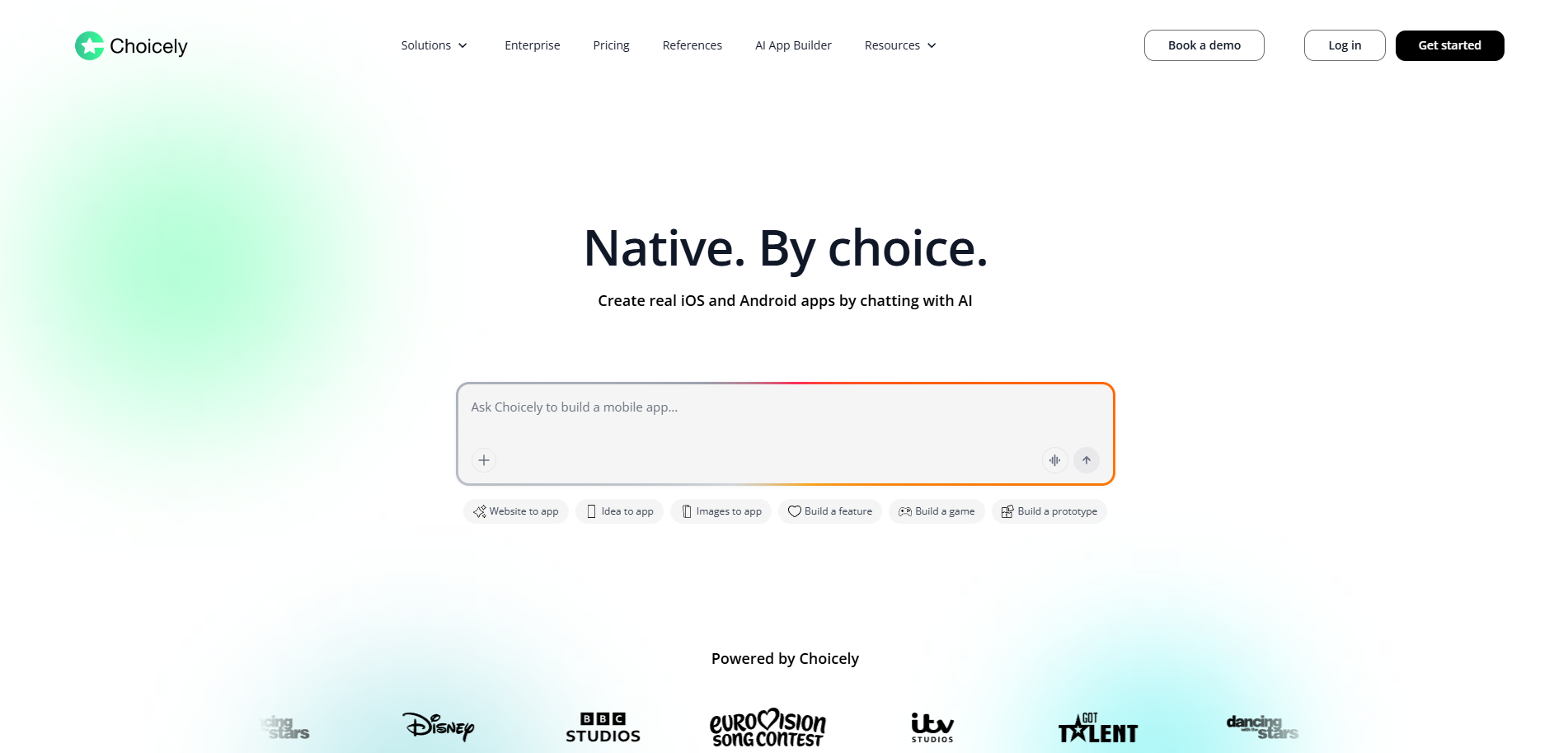
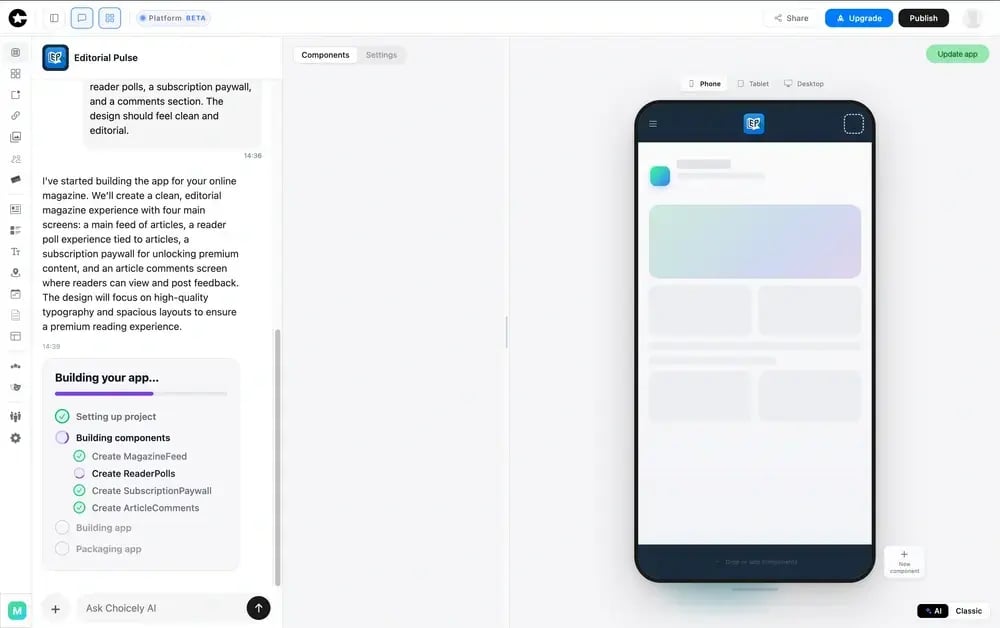
Choicely exists for the moment you have just hit: the app is real, the audience is real, and the platform underneath can no longer keep up. It is an AI-powered mobile app platform from Helsinki that compiles genuine native iOS and Android apps, driven three ways, by describing the app to a conversational AI, by refining it in a drag-and-drop visual editor, or by handing the whole build to Choicely's own design and engineering team. Broadcasters and global brands run on it: Eurovision, Miss Universe, Got Talent, the BBC, and Arsenal fan channel AFTV among them.
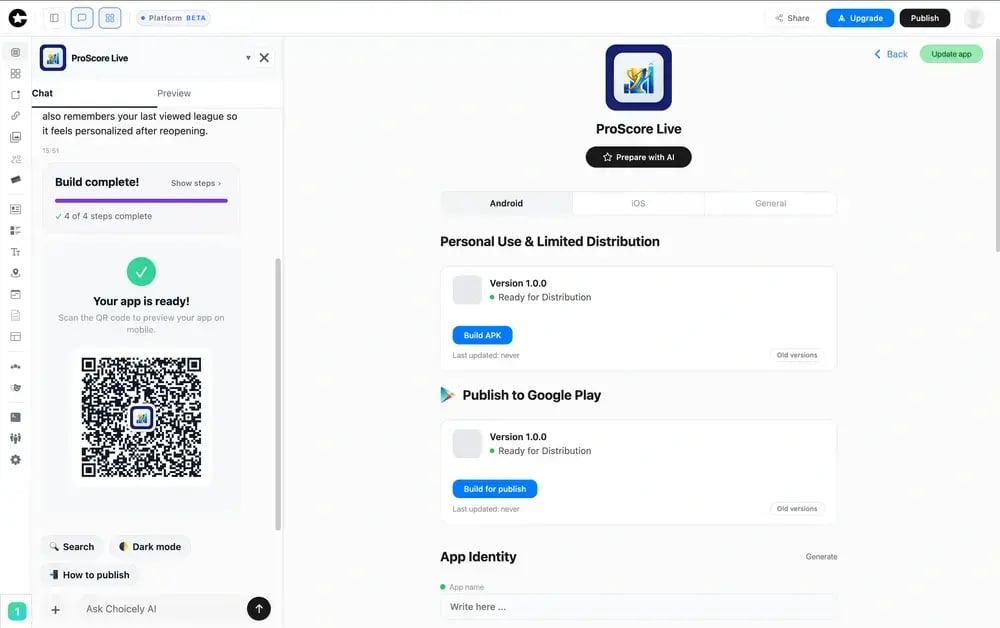
Best for: teams and founders moving off Thunkable who need a real, performant native iOS and Android app in the App Store, not an app that slows down at scale.
Product Overview
Teams leave Thunkable for three reasons, and each one maps directly to something Choicely was engineered around.
Native Performance That Holds Up at Scale
Choicely compiles real native iOS (Swift) and Android (Java) apps; the AI builder also generates React Native, with true native code used to reach full device features (push notifications, camera, biometrics). There is no runtime layer between your app and the device, which is precisely the difference you feel when screens, data, and users multiply. The sluggishness that sent you searching does not come along for the migration.
Deeper Logic With AI and a Human Team Behind It
Where blocks ran out, you get two escalation paths instead of a wall. The conversational AI handles structure, content models, and backend wiring that would take hours to express visually, and the visual editor keeps every non-coder on the team productive. When a requirement is genuinely beyond DIY, the in-house Pro Services team takes it over, the option Thunkable never had.
Engagement and Live-Event Scale Built In
Voting, polling, rankings, battles, reactions, and paid voting ship as native platform features, not a to-do list after the rebuild. And the scale proof is unusually concrete: Eurovision and Got Talent run live-vote spikes of millions of concurrent users on Choicely, and the Miss Universe app cleared roughly three million downloads in about five weeks. Content and feature updates push to the live app instantly, with no App Store re-review, which is what makes those live moments possible at all.
 Pricing
Free tier to build and preview. Premium is $25 per month, or from $21 per month billed annually, and Business is $50 per month. Monthly credit allotments with rollovers and optional top-ups keep ongoing cost predictable. A done-for-you Pro Services build starts at $15k to $20k per engagement, covering design, engineering, integrations, and store submission. Details on the Choicely AI App Builder page.
Integrations
An open, API-driven platform: native connectors for CRMs, ecommerce (Stripe, Shopify), streaming platforms, advertising platforms, automated content feeds, CMSs, maps services, and UGC software, with an SDK for anything custom. The full capability list lives on the Mobile App Platform Features page.
Setup
Minutes from prompt to a working prototype in the AI builder, with no code and nothing to install. A full Pro Services build delivers a production-ready native iOS and Android app in weeks, not the months a rebuild-from-scratch agency project would take, which matters when you are migrating a live app with real users waiting.
Tradeoffs
If your Thunkable project was a simple utility, a class project, or an idea you are still validating, Choicely is more platform than you need, and staying on Thunkable, or moving to Glide or Softr, is the cheaper, saner path. Choicely earns the switch when the app is a real consumer product with an audience that will grow. For what that looks like in production, see the AFTV fan app case study or the wider case library.
2. FlutterFlow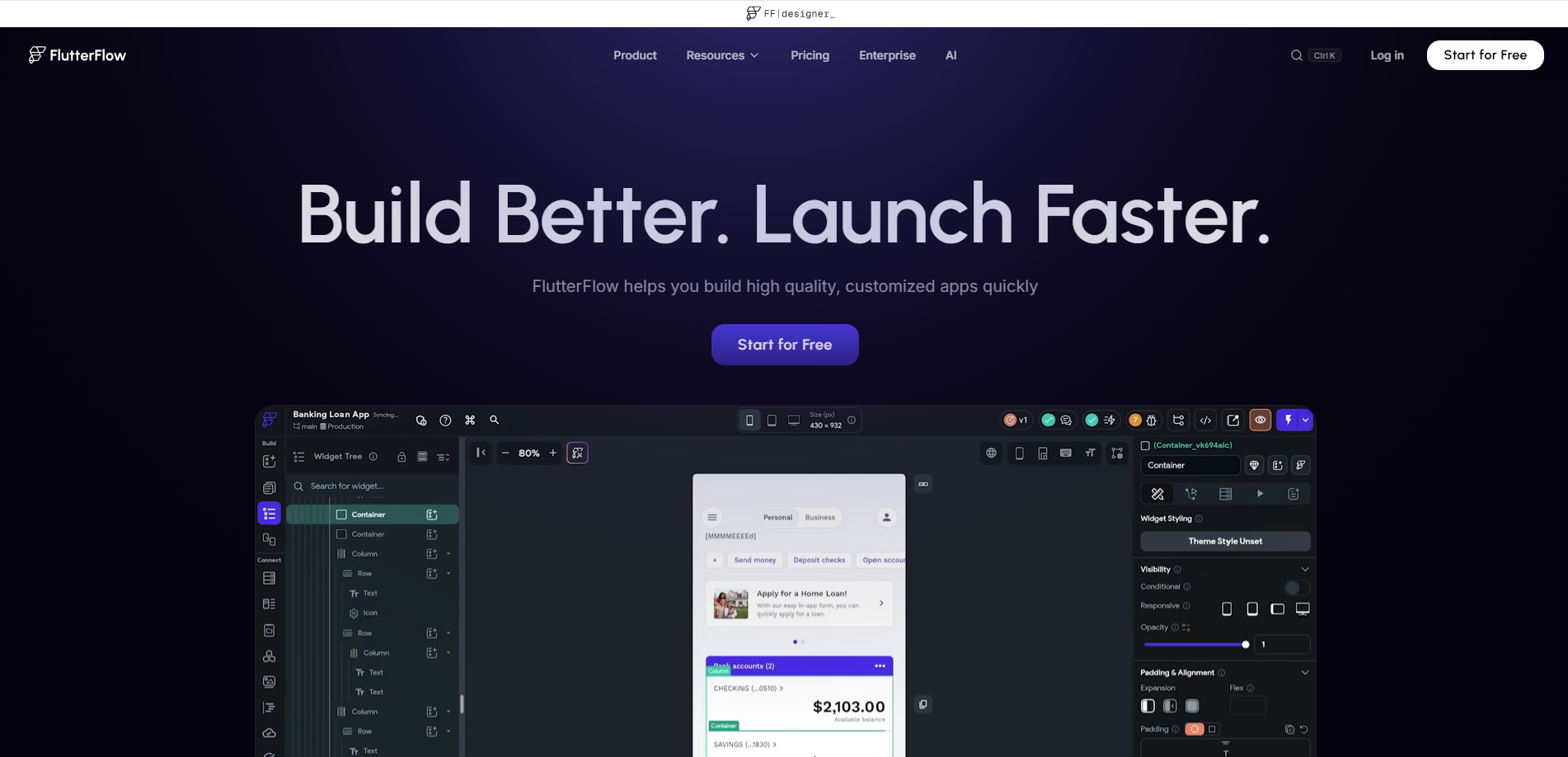
FlutterFlow is where ex-Thunkable teams with engineering muscle usually look first. Built on Google's Flutter framework, it wraps serious visual tooling around real code, and its output is the thing Thunkable never gave you: a complete, exportable native codebase your team owns outright.
Product Overview
You compose the app visually, drop to custom Dart wherever the builder ends, and lean on the AI copilot for scaffolding. The result compiles to native iOS and Android, deploys to both stores from the platform, and exports as a full Flutter project, so there is no lock-in cliff waiting later.
Pricing
Free to learn. Code export and store deployment arrive with the Basic plan at $39 per month; the team-oriented Growth and Business tiers are $80 and $150 per month for the first seat. Add your backend on top: FlutterFlow assumes Firebase or Supabase, and that bill is separate.
Integrations
Native Firebase and Supabase connections, broad REST API support, and the entire Flutter package ecosystem once you are in code. The backend and its maintenance are yours.
Setup
Hours to a working app for someone comfortable with the tool, and a real climb from there to store-ready. That climb assumes Flutter and Dart fluency somewhere on the team.
Tradeoffs
The skill assumption is the whole story. A team leaving Thunkable because blocks hit a ceiling may just be trading a blocks ceiling for a Dart requirement, and the non-technical people who built your current app cannot drive FlutterFlow the way they can Choicely's AI-plus-editor. No engagement features, no first-party build team, and content changes still mean a rebuild and store resubmission. It beats Choicely on one axis, total codebase control, and that axis matters most to teams with developers on staff.
3. Bravo Studio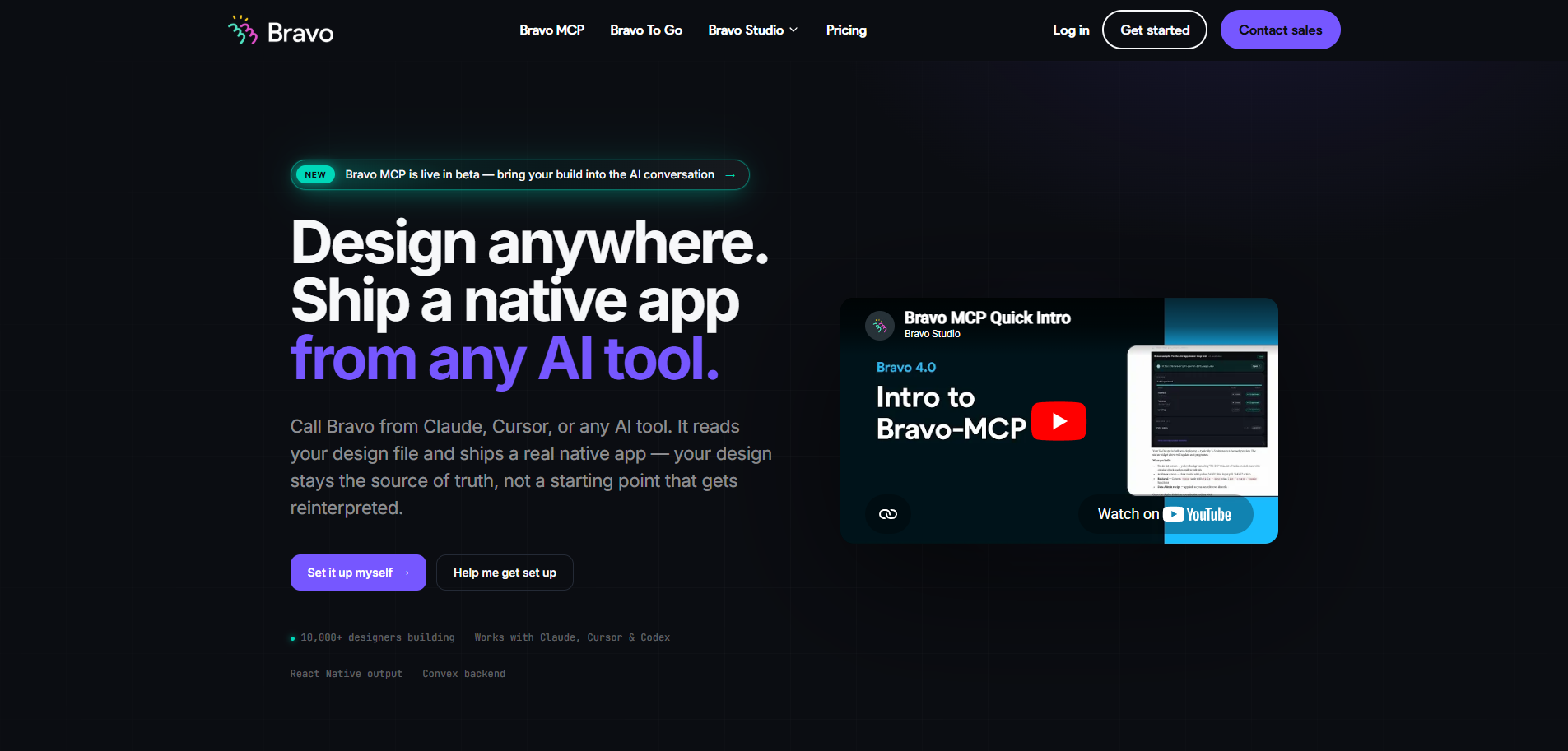
Bravo Studio takes the design-first road to native. If the part of Thunkable you loved was arranging screens, and the part you hated was everything after, Bravo lets you design the entire app in Figma, bind the screens to APIs, and compile a real, publishable native iOS and Android app.
Product Overview
Your Figma file is the source of truth: Bravo converts it to a native app shell, you connect data through its API binding layer, and native device features like camera, GPS, and push come along. What you designed is, pixel for pixel, what ships.
Pricing
A free-forever plan for experimenting; the Solo plan is $23 per month, or $20 per month billed annually ($240 per year), the lowest paid entry among the native tools here. The real budget line is the backend and API work you bring yourself.
Integrations
Any REST API, plus ready-made recipes for Firebase auth, Airtable, Xano, and Stripe payments. Bravo deliberately owns the app shell and leaves the server side to you.
Setup
Hours to a working native app if the Figma file is ready, then real integration time wiring every screen to live data. It suits people who think in design plus API, not people who want one platform to hold the whole stack.
Tradeoffs
Bravo assumes you are both the designer and the backend integrator, a bigger ask than Thunkable ever made. There is no engagement layer, no services team, and no scale story. Against Choicely it wins only when Figma fidelity is the single non-negotiable; for everything else, a platform that includes the backend, the engagement features, and the humans is the shorter path.
4. Rork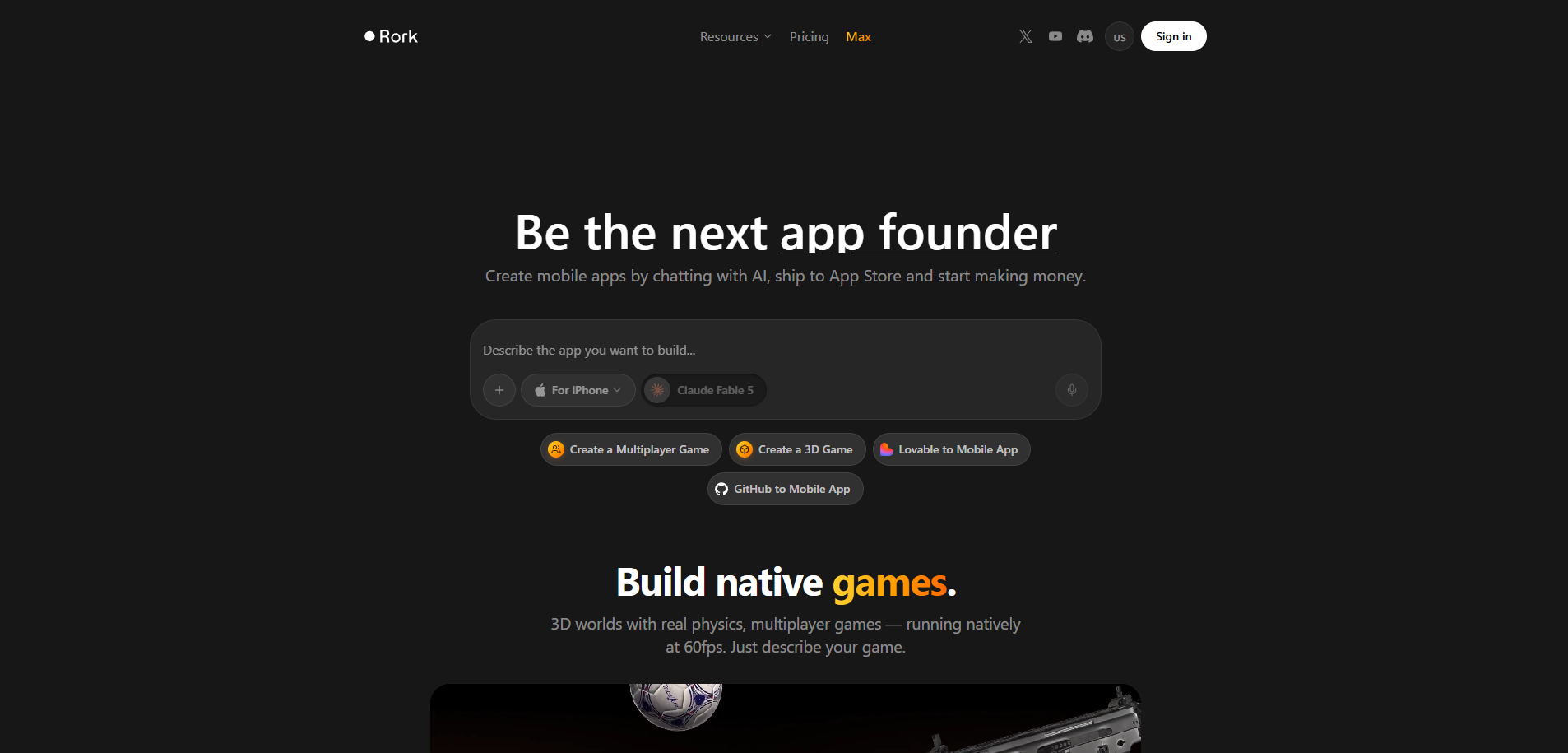
Rork will feel like the future to anyone tired of dragging blocks: you type what the app should do, and it generates a working cross-platform mobile app on React Native and Expo, complete with cloud builds that reach the App Store and Google Play without a Mac in sight. It is young, a16z-backed, and squarely aimed at the solo mobile builder.
Product Overview
The entire workflow is conversational: prompt, preview on your phone, prompt again. GitHub export exists for developers who outgrow the chat, and the separate Rork Max product compiles native SwiftUI apps across the Apple ecosystem. There is no visual editor; the AI is the only way in.
Pricing
Free tier of 35 monthly credits with a 5-per-day cap. Pro is $20 per month for 100 credits, with larger allowances above it, and Rork Max is $200 per month. Iteration is the hidden cost: every fix-it prompt spends credits, and complex apps spend plenty.
Integrations
RevenueCat for subscriptions, Expo's cloud pipeline for store builds, GitHub for code export, and beyond that, whatever you can convince the AI to wire.
Setup
Minutes from prompt to on-device preview, genuinely. You still bring your own Apple and Google developer accounts, and anything the AI misjudges becomes either more prompting or developer time.
Tradeoffs
Chat-only building means your co-founder, designer, and content lead have no way into the app except through you and the prompt box, the exact team bottleneck Choicely's visual editor removes. Standard output is cross-platform React Native rather than the native Swift and Java Choicely compiles, engagement features do not exist, live updates mean redeploys, and there is no human team behind it. Rork wins for a solo builder validating a mobile idea on pocket money.
5. GoodBarber
GoodBarber is the boutique of the no-code mobile builders: template-driven, design-obsessed, and refreshingly guided. Where Thunkable hands you blocks and a blank canvas, GoodBarber hands you a polished starting point for content, community, and commerce apps, and its higher plans compile genuinely native iOS (Swift) and Android (Kotlin) apps.
Product Overview
Pick a template, customize it in the visual editor, and extend it from a library of 190-plus extensions covering payments, memberships, bookings, ads, and push. The company can even handle store submission for you, and its support earns consistent praise from first-time app owners.
Pricing
Content plans start at $36 per month, or $30 per month billed annually, for web app and PWA output. Native iOS and Android publishing begins on the Premium plan at $70 per month ($55 annual), with Pro at $135 ($105 annual) and ecommerce plans from $50. Note the dependency: if the subscription lapses, the app stops working, the same leash you are trying to escape at Thunkable.
Integrations
Stripe, Apple Pay and Google Pay, AdMob, WordPress, YouTube, Vimeo, and Zapier for the long tail. Rich for its target verticals, thin beyond them.
Setup
Days to a store-ready app, with the template doing the heavy lifting. The learning curve is gentler than Thunkable's blocks by a wide margin.
Tradeoffs
Templates give speed and take freedom: apps outside GoodBarber's content-and-commerce patterns fight the platform, custom logic is limited, and there is no AI builder, no engagement primitives like voting or battles, and no live-event scale record. It loses to Choicely on flexibility, engagement, and scale; it wins for a small business that wants a beautiful, conventional app with hand-holding included.
6. BuildFire
BuildFire is one of the longest-running names in no-code mobile, a click-and-edit platform with a large plugin marketplace, a developer SDK for custom functionality, and an in-house agency that will build the app for you. For business apps, employee apps, and content apps, its feature surface is one of the broadest here.
Product Overview
You assemble the app from configurable plugins, preview changes in real time, and publish to both stores with the platform's publishing support. When the marketplace runs out, the SDK lets developers write custom plugins, and BuildFire's professional services arm takes on full builds.
Pricing
No free plan: Standard is $165 per month, Growth $315, and Scale $440, with 20% off on annual billing and push notification and storage caps by tier. Professional services builds are custom-quoted. It is comfortably the highest self-serve entry price on this list.
Integrations
A large plugin marketplace plus connections like Shopify, Instagram, and Google Docs, with the SDK as the extension path for anything bespoke.
Setup
Days to weeks assembling and configuring plugins, faster than coding and slower than an AI-generated first draft, because there is no AI builder in the flow.
Tradeoffs
BuildFire's output is a hybrid app in a native wrapper rather than compiled native code, which returns you to the performance question that started this search. There is no AI build path, entry pricing is more than six times Choicely's Premium tier, and while its agency mirrors the done-for-you idea, the platform has no answer to native performance, built-in engagement, live no-review updates, or broadcast-scale proof. It wins for plugin-driven business and employee apps where a mature marketplace matters more than native speed.
7. Adalo
Adalo is the gentlest landing spot on this list: another friendly, no-code visual builder, but with app store publishing on a mid-tier plan, unlimited-usage pricing, and AI assists (Magic Start and Magic Add) that generate app foundations and features from plain descriptions.
Product Overview
You design screens on a large visual canvas, wire them to Adalo's built-in database, and publish the same project to iOS, Android, and the web. The AI features shortcut the blank-canvas problem that eats the first day on most builders.
Pricing
A free plan publishes to the web. Paid plans start at $36 per month with unlimited usage and app store publishing, and no metered charges as your data or users grow, a genuine relief after per-tier download caps.
Integrations
Stripe for payments, Xano and external collections for data, Zapier for automation, and a component marketplace for the rest. Serviceable for straightforward consumer apps, thinner once requirements get exotic.
Setup
Hours to days to a publishable app, and genuinely learnable by a non-coder in a weekend. It is the shortest re-learning curve of any tool here for someone arriving from Thunkable.
Tradeoffs
Adalo's output is cross-platform React Native based rather than platform-native code, and community threads tell a familiar story: apps can slow as screens and data grow. If performance at scale is the reason you are leaving Thunkable, Adalo risks re-running the same movie with nicer scenery. It loses to Choicely on native performance, engagement features, live updates, and the human-team path; it wins for quick, simple consumer apps where the budget is tight and the roadmap is short.
8. Appy Pie
Appy Pie is the budget corner of this market, and unapologetically so: hundreds of vertical templates, a simple drag-and-drop editor, and per-app pricing that undercuts everything else here. For a restaurant, salon, gym, or small shop that needs a functional app this week, it does the job.
Product Overview
Choose a template for your business type, swap in your content and branding, toggle the features you need, and publish. AI-assisted generation and a stack of adjacent products (websites, chatbots, automation) surround the app builder.
Pricing
Basic is $16 per app per month billed annually ($32 monthly) and covers Android only; Gold is $36 ($72 monthly), and iOS publishing requires Platinum at $60 per app per month ($120 monthly). Even so, it remains the cheapest store-bound path on this list, with upsells doing the margin work.
Integrations
The common small-business set: payments, social feeds, forms, and appointment tools, plus Appy Pie's own automation product for connecting the rest.
Setup
Hours from template to submitted app, among the fastest here. The speed comes from staying inside the template's lines.
Tradeoffs
The output is a wrapper-based hybrid, design freedom ends where the template does, and reviewers regularly note the quality ceiling on anything ambitious. None of the reasons you outgrew Thunkable, performance, logic depth, native polish, gets solved here. Against Choicely it is not a real contest on capability; it is a contest on price, and if price is the entire decision and the app is simple, Appy Pie honestly wins that one.
9. Bubble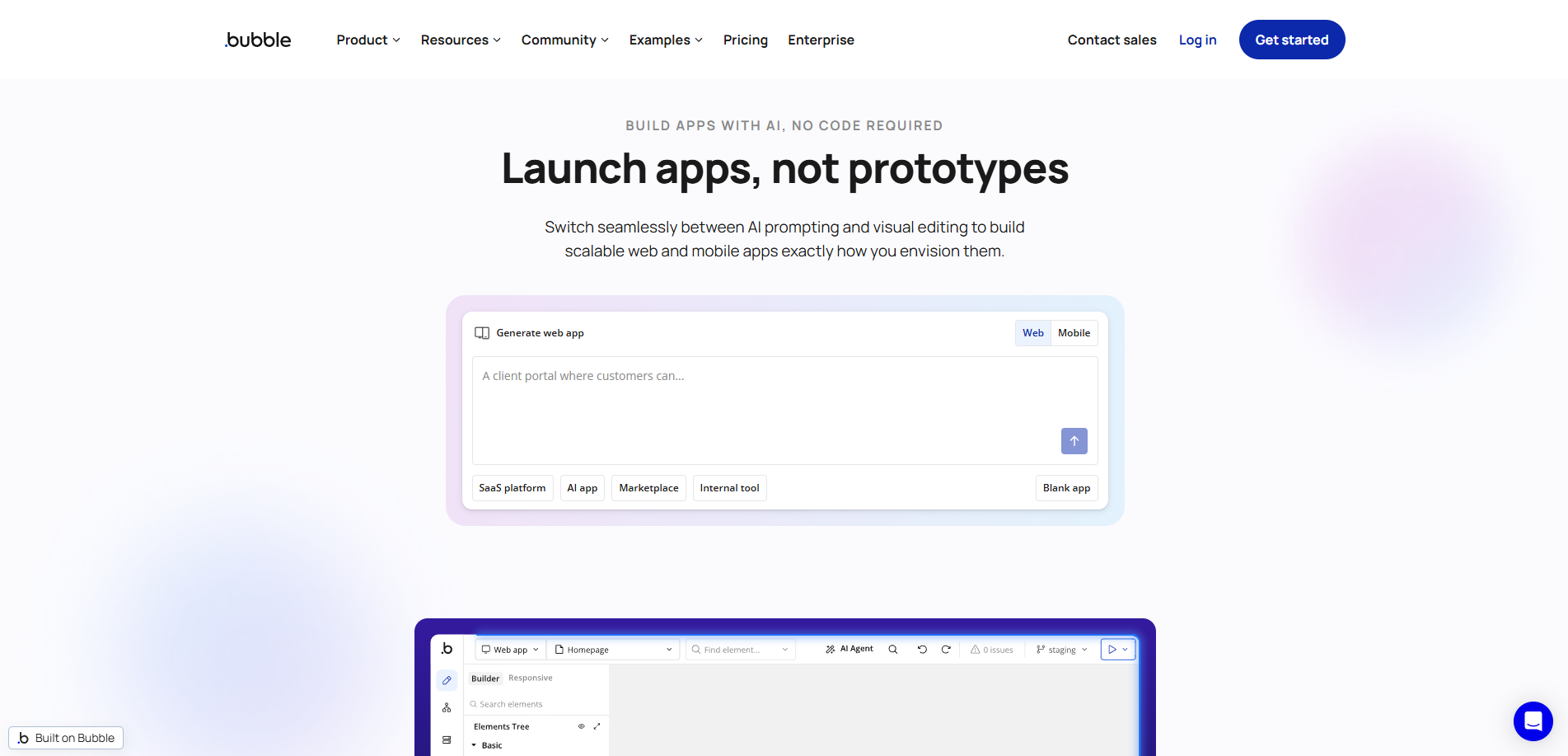
If the wall you hit was logic rather than performance, Bubble is the specialist. Nothing in no-code models complex workflows, data structures, and conditional behavior like Bubble's visual engine, and since 2025 its React Native mobile builder (public beta) publishes real native iOS and Android apps alongside the web product.
Product Overview
Bubble pairs a pixel-level design canvas with a workflow engine deep enough to express almost anything you would otherwise code, backed by its own database, hosting, and thousands of marketplace plugins. Web and mobile builds can now share one backend, though mobile screens are built separately.
Pricing
Free to learn on. Web plans from $29 per month billed annually ($32 monthly), mobile-only from $42 ($49 monthly), and web plus mobile from $59 ($69 monthly), with Enterprise above. Compute is metered in Workload Units, so every workflow run and query has a cost, and spiky traffic turns directly into overage risk.
Integrations
The largest plugin marketplace in no-code plus a flexible API connector. Whatever Thunkable would not connect to, odds are a Bubble plugin already does.
Setup
Budget weeks, honestly. Bubble repays study like a professional tool because it is one, and most production teams keep a Bubble specialist around.
Tradeoffs
The mobile builder is genuinely native but young, there is no source-code export if you ever leave, and the learning curve is the steepest here, a strange fit for a team that chose Thunkable for its friendliness. Against Choicely the honest split is app-type: Bubble for data-and-logic-heavy applications, Choicely for audience-facing apps where engagement, live real-time updates, and spike-proof scale decide the outcome. Workload-unit pricing makes Bubble expensive in exactly the live moments Choicely is proven in.
10. Glide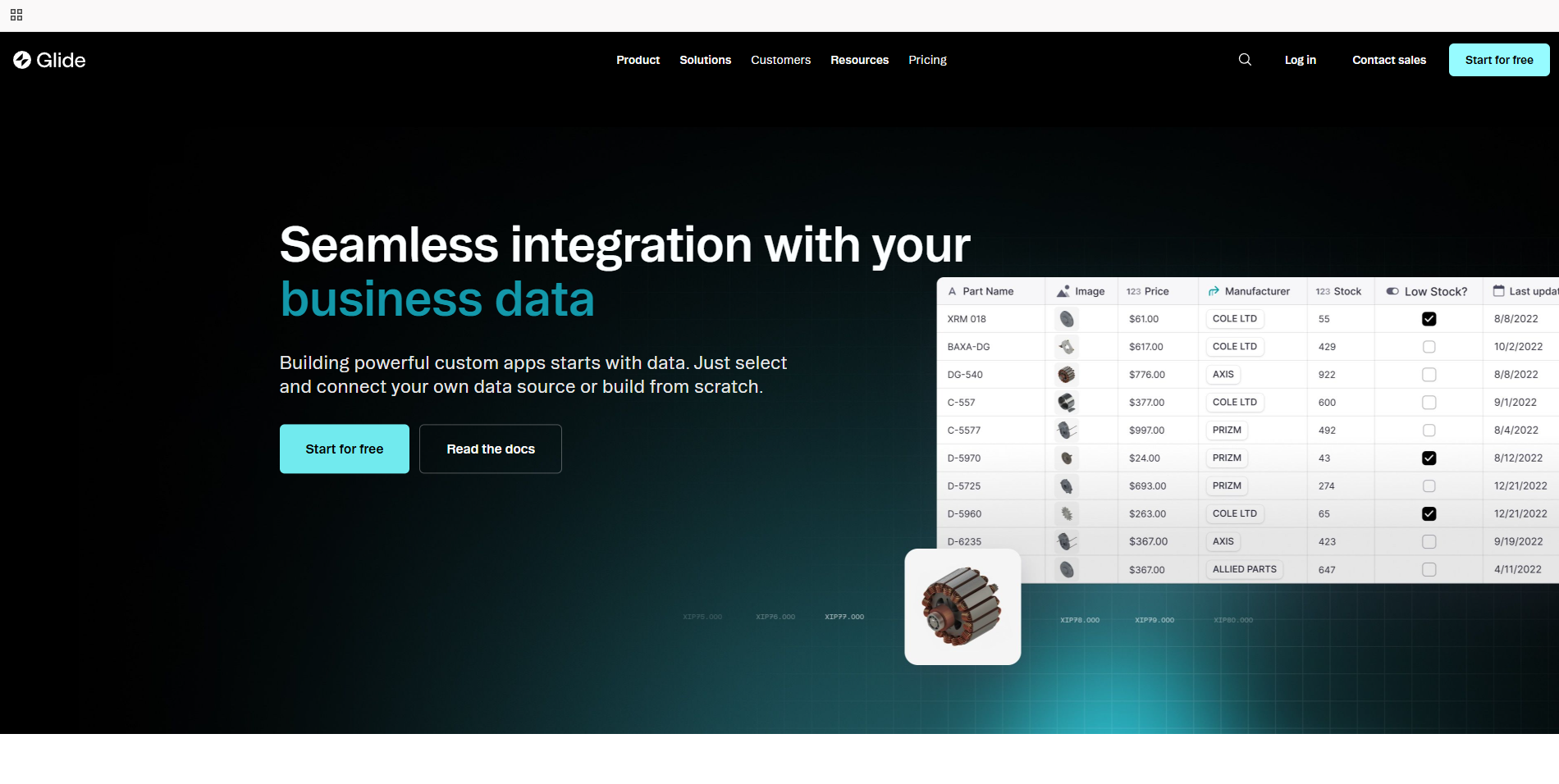
Glide answers a question worth asking before you migrate anywhere: was your Thunkable project actually a business app in disguise? If the app mostly reads and writes structured data, Glide will generate a cleaner version of it from your spreadsheet or database in an afternoon.
Product Overview
Connect Google Sheets, Airtable, Excel, SQL, or Glide's own tables and it produces a polished web app or PWA around the data, with AI columns for summarization and extraction layered in. For field teams, ops tools, and directories it is remarkably fast.
Pricing
Free plan for one project with limited credits. Paid plans start at $25 a month (Solo), with Team at $125 a month plus $10 per member; Enterprise is quote-only, and annual billing is listed as coming soon. The Maker and $199 Business tiers older listicles still quote no longer exist. Per-member pricing on Team still makes public consumer apps a poor fit, and Glide ships PWAs rather than store-published native apps. Verified 7 August 2026.
Integrations
Deep spreadsheet and database connectivity, with SQL sources, automations, and premium integrations reserved for higher tiers.
Setup
Minutes to a working app when the data is already structured, the fastest start on this list. The finish line is a data app that looks great, not a consumer product.
Tradeoffs
No native binaries, no store presence beyond a PWA, no engagement layer, and pricing that punishes big audiences: Glide is simply not aimed at the consumer-app job Choicely does. Where it wins is equally clear, and worth taking seriously: if your app is internal and data-driven, Glide is the better and cheaper answer, and no native platform should talk you out of it.
11. Softr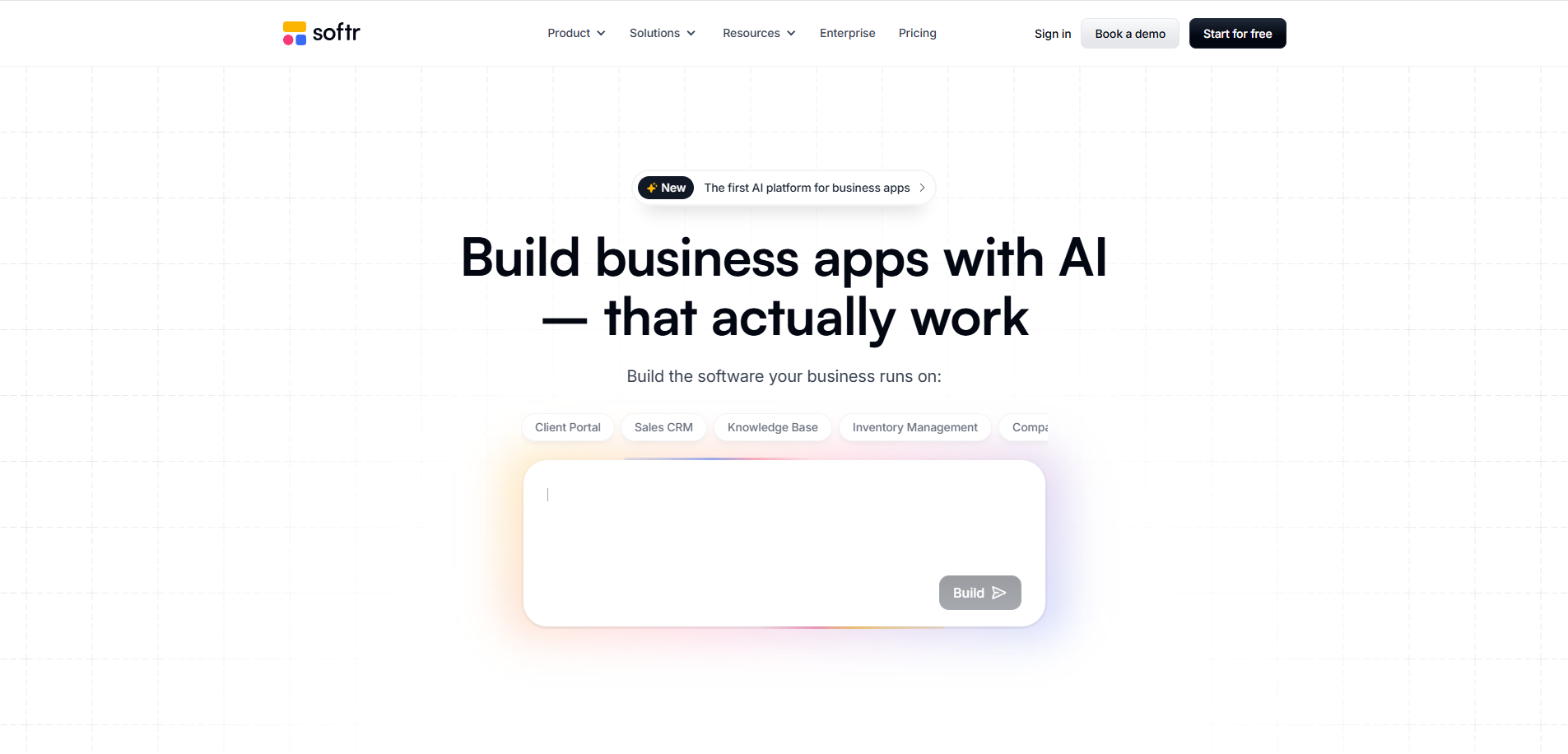
Softr rounds out the list for the same reason Glide makes it: some Thunkable refugees do not need a mobile platform at all. Softr assembles client portals, membership sites, and internal tools from pre-built blocks on top of Airtable or a database, with permissions handled properly out of the box.
Product Overview
Pick blocks, connect data, set granular access rules per user or role, and publish a professional web app or PWA. It is closer to building with LEGO than programming with blocks, which after Thunkable's logic canvas can feel like a holiday.
Pricing
Free plan to start. Basic is $49 per month billed annually ($59 monthly), Professional $139 ($167 monthly), and Business $269 ($323 monthly), with pricing keyed to app users rather than apps. Predictable and easy to model.
Integrations
Airtable and Google Sheets natively, SQL sources on higher tiers, plus Stripe, Zapier, and embedded tools. Built for the business-software ecosystem rather than the consumer one.
Setup
Minutes to hours from connected data to a live portal. The block model trades flexibility for speed, and for its target jobs the trade is worth it.
Tradeoffs
Web and PWA output only, no native depth, no engagement features, and design freedom bounded by the block library: Softr is not competing with Choicely for consumer mobile apps and does not pretend to. It wins when the honest job description was a portal or an internal tool all along.
How To Choose the Right Alternative to Thunkable
Nine steps, each concrete enough to run today. Most teams finish the whole framework inside a weekend, which is exactly the pre-migration window this decision usually gets.
Step 1: Identify Which Piece of Thunkable Is Actually Your Blocker
Name the wall before shopping: the performance ceiling on complex apps, the blocks-logic and integration limits, missing native depth, pricing as usage grows, or the absence of a human help path. Each alternative on this list fixes a different subset, so a vague answer here produces a wrong pick later.
Step 2: Decide Between a Simple No-Code App and a Real Native App Platform
Glide and Softr center on PWAs, web apps, and portals, and Appy Pie and BuildFire ship wrapper-based hybrids; if a simple app is genuinely fine, you may not need to switch far. If the deliverable is a polished, performant native app in the App Store and Google Play, you need a true native platform, and on this list that means Choicely, FlutterFlow, or Bravo Studio.
Step 3: Stress-Test Output Type and Performance, Native vs Hybrid, PWA, or Web
Confirm the alternative compiles a real, signed native binary that performs at scale, not a runtime-wrapped app or a PWA with an icon. Test with your data volumes and screen counts, not the demo project, because performance under real load is the exact wall you are escaping.
Step 4: Verify Code and Data Portability and Ownership
Thunkable does not export code, and you have felt what that means. Confirm the next platform gives you your app, your data, and a clean exit: Choicely outputs portable native code your team owns, FlutterFlow exports the Flutter project, and Bubble notably exports no source at all.
Step 5: Evaluate Custom-Logic and Integration Depth
List the workflows, third-party services, and data models your app actually needs, including the ones blocks could not express, and check each candidate against that list. Then ask what handles the genuinely hard parts: an AI builder, a human team, or you again.
Step 6: Check Whether the Platform Deploys Directly to the App Store
Some tools hand you a URL or a PWA to wrap and submit yourself, and calling a hosted link your app is not the same as shipping one. Confirm the platform delivers the native binary to the App Store and Google Play, and ask who handles signing, certificates, and review.
Step 7: Evaluate the Human Help Path When You Hit a Wall
You will hit one; you already did once. Adalo, FlutterFlow, Bravo Studio, Rork, Bubble, Glide, and Softr leave you with documentation, community forums, or a paid agency search, and BuildFire and GoodBarber sell services at a premium. Choicely pairs the platform with an in-house Pro Services team as a first-class option, so decide up front how much that insurance is worth.
Step 8: Match the Tool to Who Will Build and Maintain It
FlutterFlow rewards developers, Bravo Studio rewards designers who can wire APIs, Bubble rewards no-code power users willing to study, Rork funnels everything through one person and a prompt box, and Glide and Softr reward people comfortable modeling data. If non-technical co-founders or content leads must keep contributing after launch, confirm a real visual editor and a conversational AI they can drive without a translator.
Step 9: Pressure-Test Scale and Built-In Engagement
Ask for evidence the platform survives real users arriving at once, named references, concurrency numbers, uptime under spikes, and check whether voting, polling, and engagement features exist in the box or on your to-do list. Choicely's Eurovision and Miss Universe track record is the benchmark to hold everyone else against.
Things to Consider Before Looking for a Thunkable Alternative
Six checks before you commit the migration weekend. They exist to stop the two classic mistakes: switching for the wrong reason, and swapping one platform's limits for a different platform's identical limits.
1. Identify Which Thunkable Capability You Actually Depend On
Thunkable is a bundle: drag-and-drop editor, blocks logic, components library, publishing pipeline. Your app probably leans hard on one or two of those and barely touches the rest. List what you truly use, and judge alternatives against that short list instead of the whole brochure.
2. Decide If You Need Native Performance or Just a Simpler App
Not every frustrated Thunkable team needs a native platform. If a web app or PWA honestly serves your users, Glide or Softr ends the search cheaply. If the problem is performance, polish, and native depth as the app grows, you are shopping in a different category, and should compare accordingly.
3. Confirm Code and Data Portability Before You Commit
You are living through what lock-in costs right now, so make it a gate, not a nice-to-have. Verify the export path for app, code, and data before signing up: owned native code on Choicely and FlutterFlow, versus no source export at all on Bubble.
4. Model Pricing at Your Real Scale, Not the Starting Tier
Thunkable's tiers taught you that the entry price is not the price. Run every candidate's numbers at your realistic user count, app count, and traffic pattern, and add the quiet line items: separate backend costs on FlutterFlow, Workload Units on Bubble, per-user fees on Glide.
5. Map Who Actually Needs to Touch the Build
Write down every person who edits the app today and everyone who should be able to after the move. If that list includes non-engineers, developer-first tools like FlutterFlow drop off it, and a conversational AI plus visual editor stops being a feature and becomes the requirement.
6. Plan for the Wall Before You Hit It
The next wall is a when, not an if. Decide in advance what you want on the other side of it: a first-party Pro Services team, a strong community, or a freelancer budget, and let that answer weigh the shortlist, because it is the difference between a delay and a dead project.
FAQs
Why are founders and teams looking for Thunkable alternatives in 2026?
Mostly the ceiling. Apps built on blocks-based logic slow down as screens and data grow, advanced logic and integrations hit hard limits, publishing requires the $59-a-month Builder tier for a single live app, and there is no first-party team to call when something complex breaks.
What is the best Thunkable alternative for non-technical founders?
Choicely. A founder describes the app to the conversational AI, refines it in the drag-and-drop editor, and hands anything hard to the in-house Pro Services team, no code at any step. Adalo is the runner-up for simpler apps; FlutterFlow assumes developer skills most founders lack.
What is the best Thunkable alternative for building native iOS and Android apps?
Choicely, FlutterFlow, and Bravo Studio are the true native platforms here, with GoodBarber compiling native apps on its higher plans. Choicely leads: native Swift and Java from an AI prompt or visual editor, built-in engagement, and a done-for-you team. FlutterFlow suits developer-led teams; Bravo suits designers.
What is the best Thunkable alternative for apps that need complex logic?
Bubble has the deepest logic engine in no-code, and workflows that defeated blocks will usually fall to it. Budget for a real learning curve and metered Workload Unit pricing. If the logic serves an audience-facing app with engagement at its core, Choicely's AI plus Pro Services covers the hard parts without the ramp.
What are the best no code app builder alternatives to Thunkable?
By job: Choicely for real native consumer apps a whole team can build, Adalo and GoodBarber for quick polished apps, Appy Pie for budget builds, BuildFire for plugin-driven business apps, Bubble for complex web logic, Glide for data apps, and Softr for portals. FlutterFlow and Rork lean developer and solo-builder respectively.
Is Thunkable free, and what are the best free Thunkable alternatives?
Thunkable has a free plan, but it is public projects only, and publishing starts at the $59-a-month Builder tier with one live app. Choicely, Adalo, Bravo Studio, Rork, Bubble, and Softr all offer free tiers to build and test on; Choicely's is the one that leads to a real native app.
When is Choicely the right Thunkable alternative?
When the deliverable is a real, performant native iOS and Android app with an audience attached, especially voting, contest, fan-engagement, media, sports, or event apps. You get AI plus a visual editor the whole team can use, live updates without store re-review, and a Pro Services team behind you.
Can I move my project off Thunkable to another platform?
Yes, but by rebuilding, not exporting: Thunkable offers no code export, so no platform can import the project directly. The silver lining is starting clean on the right foundation. Choicely's AI builder compresses that rebuild to days, and the Pro Services team can carry it entirely.
The Bottom Line on Thunkable Alternatives
Match the platform to the wall you hit. Developers who want the codebase go to FlutterFlow, designers to Bravo Studio, solo prompt-builders to Rork, polished small-business apps to GoodBarber or Adalo, budget builds to Appy Pie, plugin-heavy business apps to BuildFire, complex web logic to Bubble, and data apps and portals to Glide or Softr. If what pushed you off Thunkable was the thing that pushes most teams, an app that needs real native performance, engagement, and room to grow, Choicely is the alternative built for precisely that migration. Start free at studio.choicely.com, or book a demo and bring the exact feature that would not fit in blocks.
For the full market view, see our price-verified ranking of the best AI app builders.
Sources & disclosure: Pricing verified on the vendors' official pricing pages (Thunkable, FlutterFlow, Choicely) as of August 3, 2026. Choicely publishes this guide and appears in the ranking, so we have a commercial interest in one of the tools compared. Rankings weigh fit for real native iOS and Android output; where a rival tool is the better fit, we say so.
Build your own app by chatting with AI

Create mobile apps for App Store & Google Play by chatting with Choicely AI
Keep reading, here are some similar posts
Last updated: August 10, 2026 If you’re weighing Replit alternatives, you’ve probably already hit the wall:...
Last updated: July 23, 2026 If you're weighing Base44 alternatives, you've probably already hit one of its...

Last updated: July 23, 2026 You built your app on Adalo, shipped something real, and for a while it worked....