
Compare the best Lovable alternatives for shipping native iOS and Android apps in 2026: Choicely, Bolt.new, v0, Cursor, and more.


Last updated: July 23, 2026
You built something on Lovable, it came together fast, and then you hit the wall every prompt-to-app tool eventually runs into: the thing you built lives in a browser, and you need it in the App Store. That is when founders and developers start comparing Lovable alternatives, looking for one that produces a real native iOS and Android app, owned code, and a shipped backend rather than another web prototype.
Lovable is genuinely good at what it does, turning a prompt into a working React web app with a real GitHub repo you can edit. The walls show up when the idea outgrows the browser: there is no native mobile path, you end up hand-wiring backend, auth, and payments, and there is no human team to lean on when the AI stalls on something complex.
There is a catch in the search results. Most Lovable alternatives are also web-only: Bolt.new and v0 generate web apps, Cursor and Replit are developer tools, and WeWeb is web by design. Switching between them does not get you a native app; it changes the workflow. If your goal is a true native iOS and Android app you own, only a couple of these tools qualify.
This guide compares the seven Lovable alternatives worth your time in 2026, grouped by what they really output: native app builders, web-app AI builders, developer IDEs, and no-code platforms. We scored each on seven things teams weigh when leaving Lovable: native output, whether non-coders can use it, AI and logic depth, App Store and Google Play deployment, the human help available when AI hits a wall, built-in engagement, and pricing predictability.
The Best Lovable Alternatives at a Glance
|
Choicely |
Bolt.new |
v0 |
Cursor |
Replit |
|---|---|---|---|---|
|
Best overall for native mobile |
Best for a fast web prototype |
Best for React UI generation |
Best for engineers extending code |
Best for cloud dev + AI agent |
What Are the Best Lovable Alternatives? Comparison and Ratings Chart
| Software | Best For | Key Capabilities | Output | Setup | Starting Price |
|---|---|---|---|---|---|
| Choicely | Native mobile, no code | AI chat + visual editor + in-house Pro Services; built-in engagement; live updates with no re-review | Native iOS + Android | Minutes (DIY); weeks (full build) | Free; Premium from $25/mo |
| Bubble | Deep no-code web logic | Visual workflow engine, plugins, native mobile (React Native, beta) | Web + native (beta) | Days to weeks | Free; From $59/mo |
| Bolt.new | Fast full-stack web | WebContainers, prompt-to-React, deploy, code export | Web app | Minutes | Free; From $25/mo |
| Replit | Cloud dev + AI agent | Cloud IDE, AI Agent build/deploy, hosting | Web app | Minutes | Free; From $20/mo |
| v0 | React UI generation | Prompt-to-React/Tailwind UI, VS Code-style editor, Vercel deploy | Web (frontend) | Minutes | Free; From $20/mo |
| WeWeb | Web frontends + portals | Visual web builder, AI generation, code export, bring-your-own backend | Web only | Days | Free; From $20/mo |
| Cursor | Engineers extending code | AI code editor (VS Code), multi-file agent, large context | Whatever you code | Install + code | Free; From $20/mo |
How We Evaluated These Lovable Alternatives
We scored each platform on seven weighted dimensions, drawn from what a team actually weighs when Lovable's web-only output stops being enough. Each platform is scored for fit to that specific job, a real native iOS and Android app you own that non-coders can help build, not for raw product quality.
A low score reflects a poor fit for that job, not a weak product for the market it was built for. Several of these tools are excellent at what they do, and we say so where a different job would make one of them the right call.
| Criterion | Weight | What We Measured |
|---|---|---|
| Native iOS + Android output | 25% | Whether the platform ships a real native app to the App Store and Google Play, not a web app, PWA, or dev preview. |
| Usable by non-technical builders | 20% | Whether someone who does not code can build and ship without an IDE, a React stack, a terminal, or Git. |
| AI and logic depth | 15% | Whether the AI ships backend, data, and integrations alongside the UI, not just the cover screen. |
| App Store and Google Play deployment | 10% | Whether it ships the actual native binary and handles submission, or hands you a URL or source to sign yourself. |
| Human help when AI hits a wall | 10% | Whether there is a first-party Pro Services team, an expert community, or a clean hand-off. |
| Built-in engagement features | 10% | Whether voting, polling, ratings, and similar features are available out of the box. |
| Ownership and pricing predictability | 10% | Whether you own the code and data with a clean exit, and how forecastable the cost is versus credit metering. |
Best Lovable Alternatives for Native Mobile Apps in 2026
The alternatives below fall into a few groups. Choicely is a native app builder. Bubble, Bolt.new, v0, and WeWeb are web-app builders. Replit and Cursor are developer tools. Here is where each one fits, ordered by how well it does the job you are leaving Lovable for.
1. Choicely: The Best Lovable Alternative for Native Mobile Apps
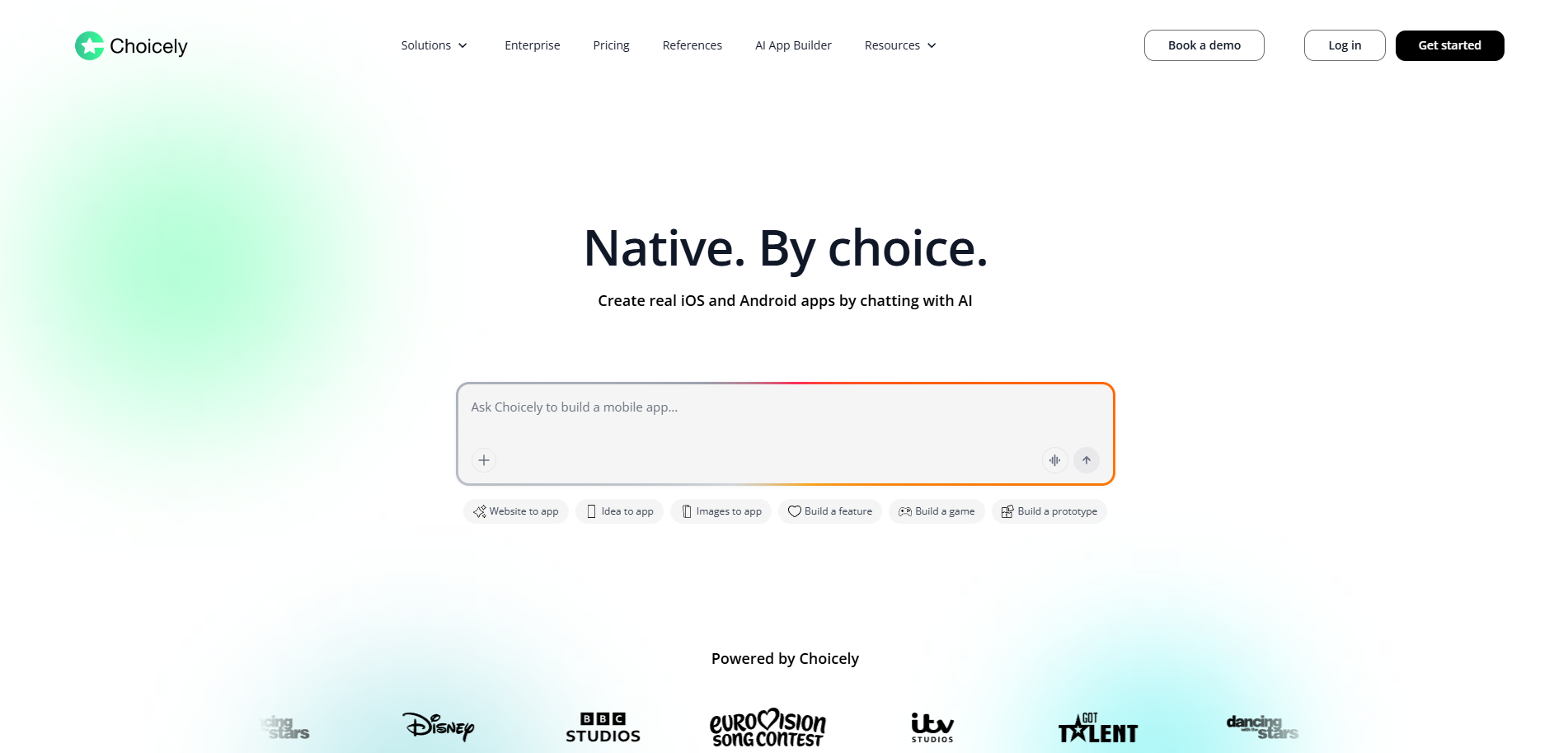
Best for developers and founders moving off Lovable who need a real native iOS and Android app in the App Store, not a web prototype, with an in-house team for when AI hits a wall.
Score
9.4 / 10. Top marks for native output (10/10), App Store and Google Play deployment (10/10), the in-house team when AI hits a wall (10/10), and built-in engagement (10/10). Scored lower on raw code-level control for engineers (6/10), which is not what it is built for.
Product Overview
Choicely is an AI-powered mobile app platform built for the one thing Lovable was never meant to do: turn a prompt into a real native iOS and Android app that ships to the App Store and Google Play, with the backend already wired in. It's the platform behind apps for Eurovision, Miss Universe, Got Talent, ITV's Love Island, the BBC, Disney, and Arsenal fan channel AFTV, so the kind of idea you'd prototype on Lovable can go all the way to a shipped, scalable app without a rebuild.
Native iOS and Android, Where Lovable Stops at the Browser
Lovable is great at turning a prompt into a polished React web app, but that app lives in a browser and can't become a first-class native app no matter how good it looks. Choicely produces real native iOS (Swift) and Android (Java) apps; the AI builder also generates React Native, with true native code used to reach full device features (push notifications, camera, biometrics) and the performance and store quality a web app or PWA cannot match.
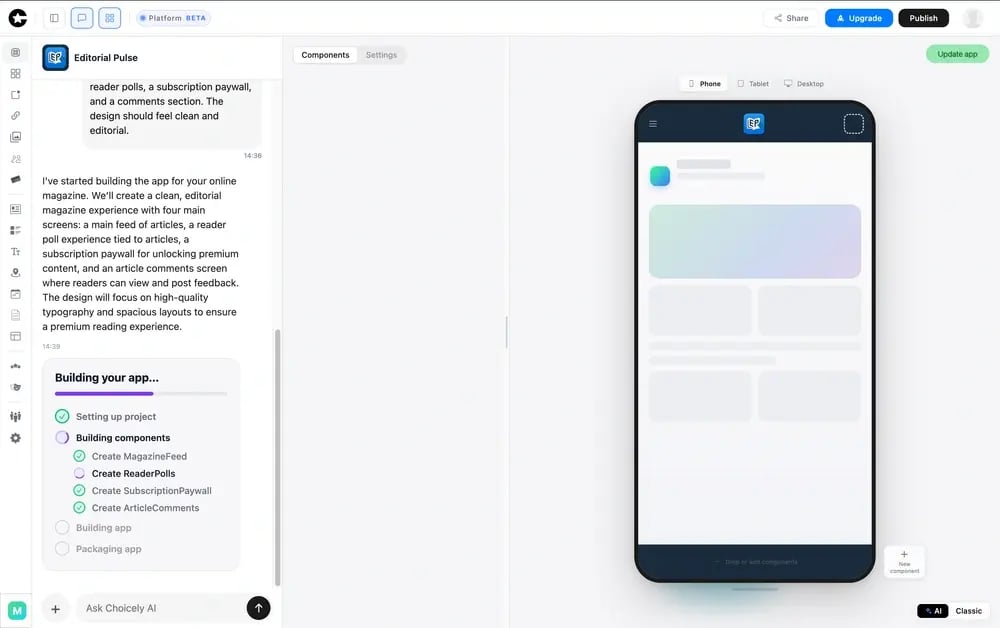
The Backend Comes Wired, Not Hand-Assembled
The second wall on Lovable shows up right after the UI generates: you're left wiring Supabase, auth, and payments yourself. Choicely's AI builder, visual editor, and open API deliver the data layer, auth, and integrations as part of the build, so what you get is closer to a shippable app than a front end waiting for plumbing.
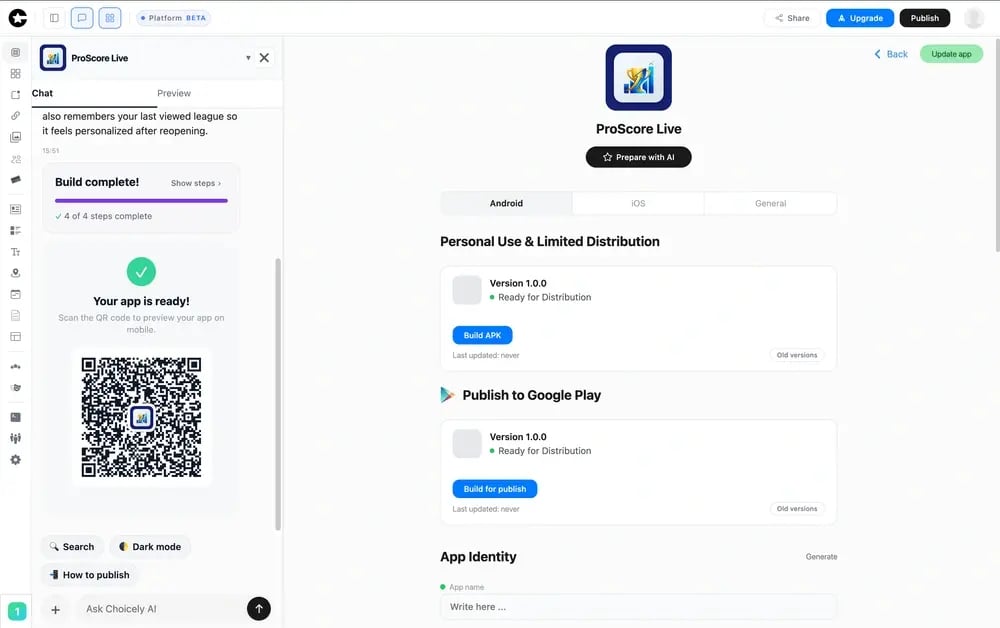
A Human Team for When the AI Stalls
When a build gets complex, Lovable hands you community forums and contractors. Choicely has an in-house design and engineering team (Pro Services) that can take the build over the finish line, including App Store and Google Play submission. That first-party team is the safety net most prompt-to-app tools don't have.
Engagement and Live Updates, Out of the Box
Voting, polling, ratings, rankings, reactions, and surveys, including paid voting, ship as native features, where a Lovable build expects you to construct them after the fact. You can also push content and feature changes to a live app in real time, bypassing the 24 to 72 hour store review that would otherwise kill a time-sensitive moment.
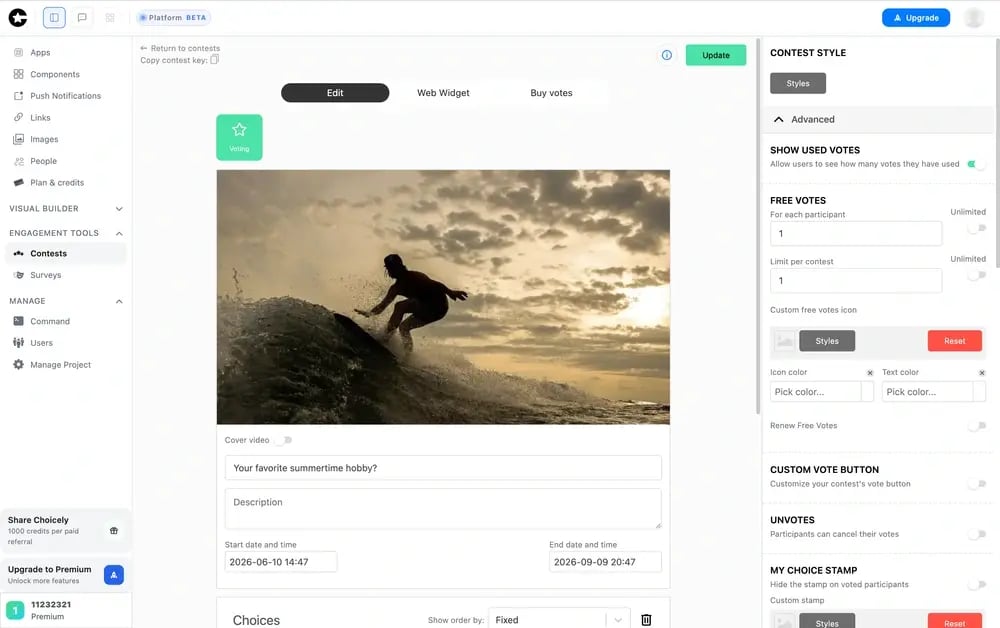
Open, and Proven at Scale
Lovable gives you a React repo, but it keeps you on a web codebase. Choicely is an open, API-driven platform with an SDK and support for custom code (React, Java, Flutter, and web), so you're not boxed into one stack. And it's proven where prototypes rarely go: the Miss Universe app reached roughly three million downloads in about five weeks across more than 200 countries, with Eurovision and Got Talent handling live-vote spikes of millions of concurrent users.
Teams move off Lovable for three reasons, and Choicely is built around each.
“I Need Native, Not a Web App.”
If the destination is the App Store and Google Play, a polished web build doesn't get you there. That's the one line Lovable can't cross.
“I Do Not Want to Hand-Wire the Backend.”
You'd rather ship than spend the week after the prompt stitching Supabase, auth, and payments together by hand.
“I Need a Human Team When AI Hits a Wall.”
When the build gets hard, you want people who can finish it and submit it to the stores, not a forum thread.
Pricing
Credit-based self-serve subscriptions (Premium at $25 a month and Business at $50 a month) with a free starter tier to build and preview apps. For teams that want the app designed and built for them, the Pro Services full build is a separate, project-based engagement.
Monthly credit allotments with rollovers and optional top-ups keep ongoing cost predictable.
Integrations
Open, API-driven platform with native connectors to CRMs, ecommerce (Stripe, Shopify), streaming, advertising, automated content feeds, CMSs, maps, and UGC tools, plus first-class push notifications, in-app purchases, and biometric login. An SDK is available for deeper customization.
Setup
- DIY via AI: minutes to a working prototype.
- Pro Services full build: a production-ready native iOS and Android app in weeks rather than months. No CLI, terminal, or Git required.
Tradeoffs
Where it is not the right fit: Choicely is not a code-first web prototyping tool. If you only need a fast web prototype to validate an idea or pitch, with no need to ship to the App Store, Lovable, Bolt.new, or v0 will get you there faster. Choicely earns its place when the deliverable is a real native app that has to handle real users from day one.
Support
White-glove onboarding and a hands-on team for Pro Services customers, plus community and email support on self-serve plans. That first-party team is the support advantage most tools on this list do not have: no one to call when you hit a wall, only forums or a paid agency.
Case Study
AFTV, the leading Arsenal fan-media platform, used Choicely's no-code mobile app builder to launch a mobile-first experience for a global audience. Through the AFTV+ app, fans get real-time updates via live streams and push notifications, and content from AFTV's video channels and social feeds publishes into the app automatically.
Choicely also lets AFTV update and manage its native apps quickly without heavy technical resources. AFTV CEO Brett Best called it a “clever and intuitive product” and, on value, “remarkable technology” for organizations that are not tech-first.

2. Bubble: Deep No-Code Web Logic
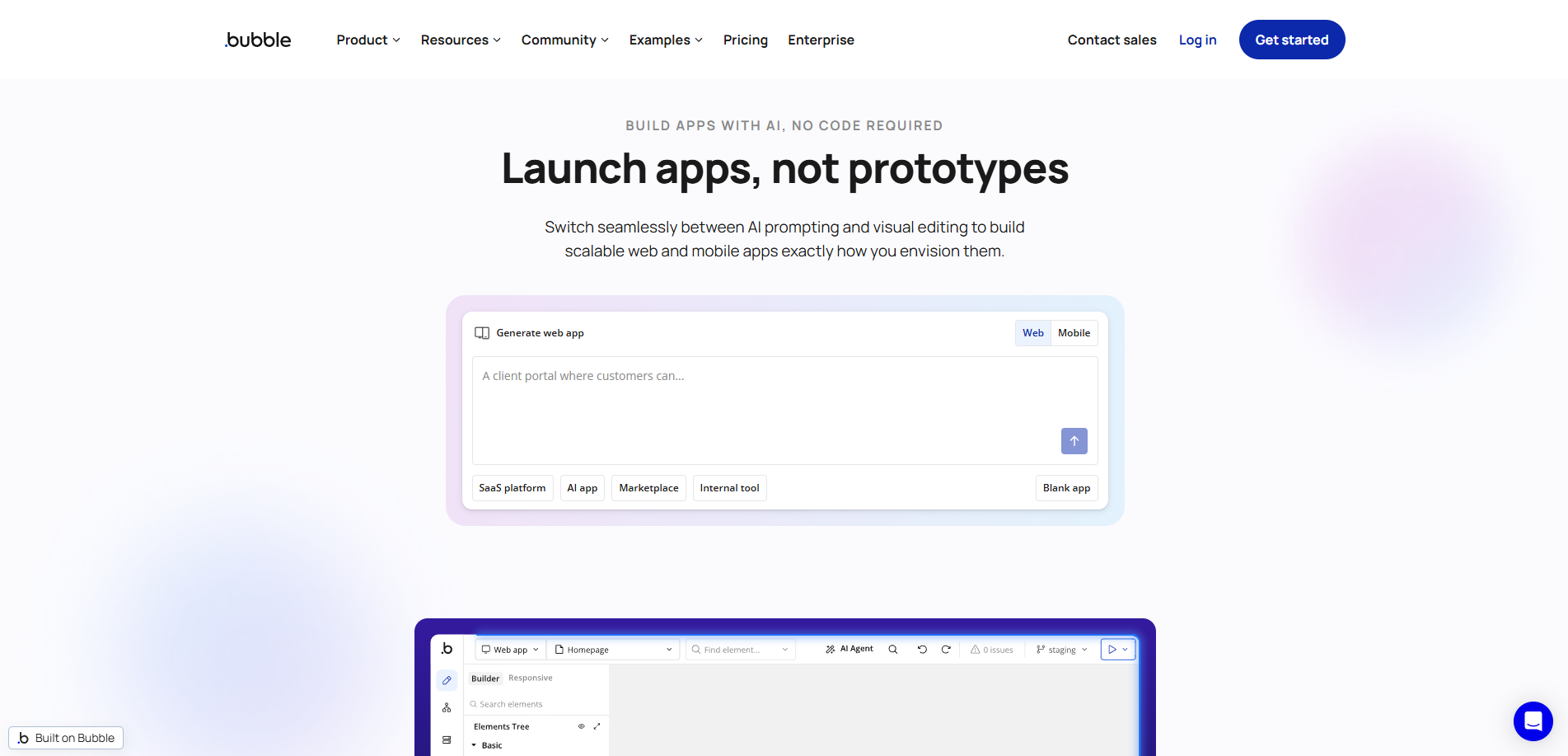
Best for teams building deeply customizable no-code web apps with complex logic, who can live with a learning curve.
Score
6.0 / 10. The deepest no-code logic here (9/10) and now native mobile (6/10, still maturing), but a real learning curve (non-technical 5/10), no built-in engagement (3/10), and no source-code export (ownership 4/10).
Product Overview
- A visual workflow engine for genuinely complex no-code logic, extended by thousands of plugins, now with a React Native native mobile builder in public beta.
- Web-first heritage; the native mobile path is newer and forces a screen-by-screen rebuild, and there is no source-code export.
- Workload-Unit pricing meters server usage, so costs rise with traffic.
Pricing
Free to prototype. Paid plans run web-only from $29 a month billed annually ($32 monthly), mobile-only from $42 ($49 monthly), and web plus native mobile from $59 ($69 monthly), all metered by Workload Units.
Integrations
One of the largest plugin and integration ecosystems in no-code, plus a full API connector.
Setup
Days to weeks; the workflow model has a real learning curve.
Tradeoffs
Bubble is far deeper than Lovable for no-code logic, but it is still web-first with a maturing native path and no code export. Choicely is the better fit when you need a true native consumer app with engagement and a team rather than a no-code web build.
3. Bolt.new: Fast Full-Stack Web Prototypes
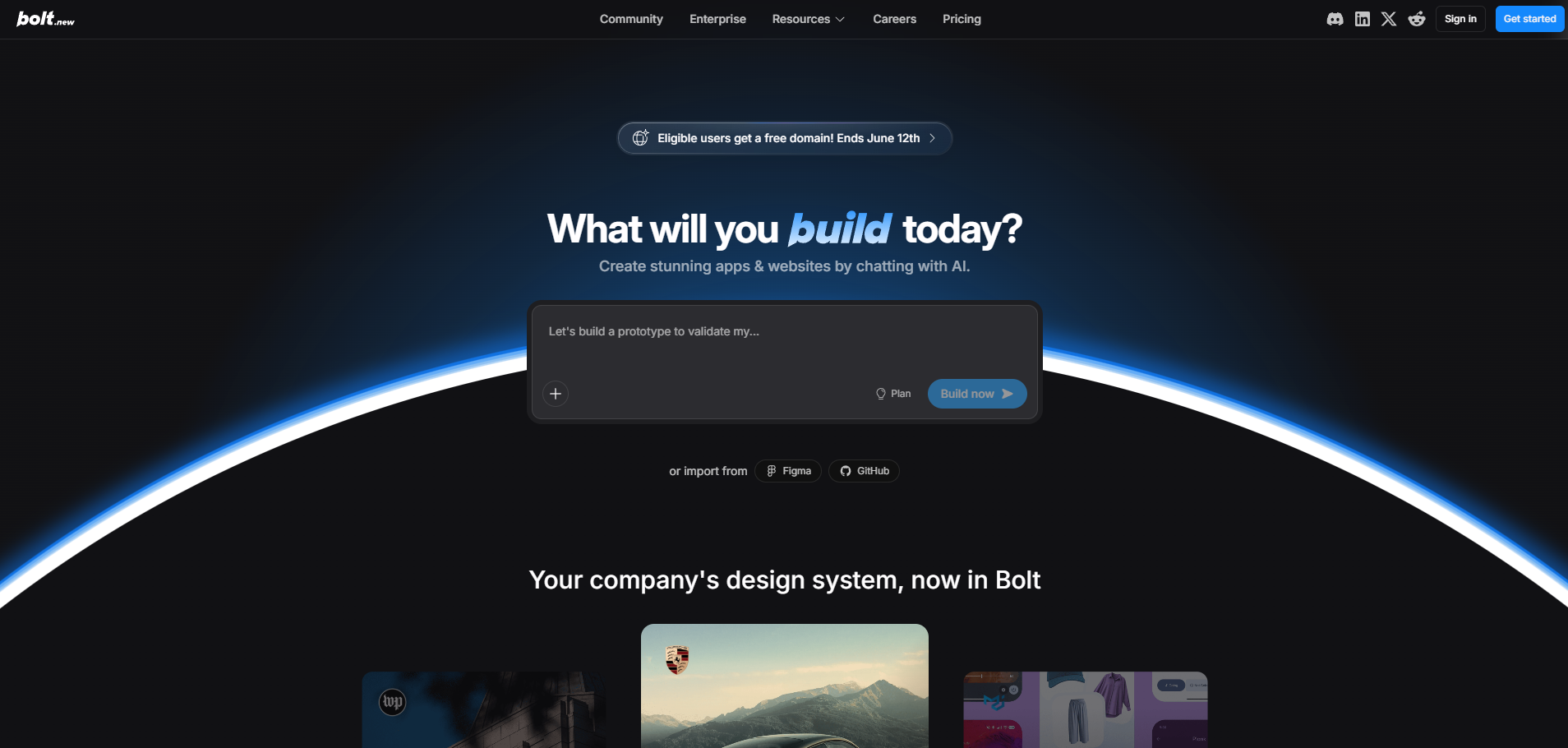
Best for founders and developers who want the fastest path from a prompt to a deployable full-stack web app.
Score
5.2 / 10. Fast full-stack web prototyping with code export (ownership 8/10), but web-only output (native 2/10) and no in-house team (3/10).
Product Overview
- A browser-based AI builder from StackBlitz whose WebContainers run a full Node.js environment in the tab and generate full-stack React apps from prompts.
- Token-based generation with live preview, one-click deploy, and full code export or GitHub sync.
- Mobile support is via responsive web and an Expo integration, not a signed native binary.
Pricing
Free with daily tokens; Pro about $25 a month for more tokens; Team about $30 per user. Heavy iteration burns tokens fast.
Integrations
Supabase, Stripe, GitHub, Netlify, and Figma; one-click deploy to Vercel or Netlify.
Setup
Minutes to a working web prototype in the browser, with no local setup.
Tradeoffs
Bolt ships a web app, and its Expo path stops at a dev preview, not a signed native binary. For a real native iOS and Android app with push, in-app purchases, and biometrics, you would still need a native pipeline Bolt does not provide, and there is no in-house team. It wins for fast web prototyping.
4. Replit: Cloud Coding With an AI Agent
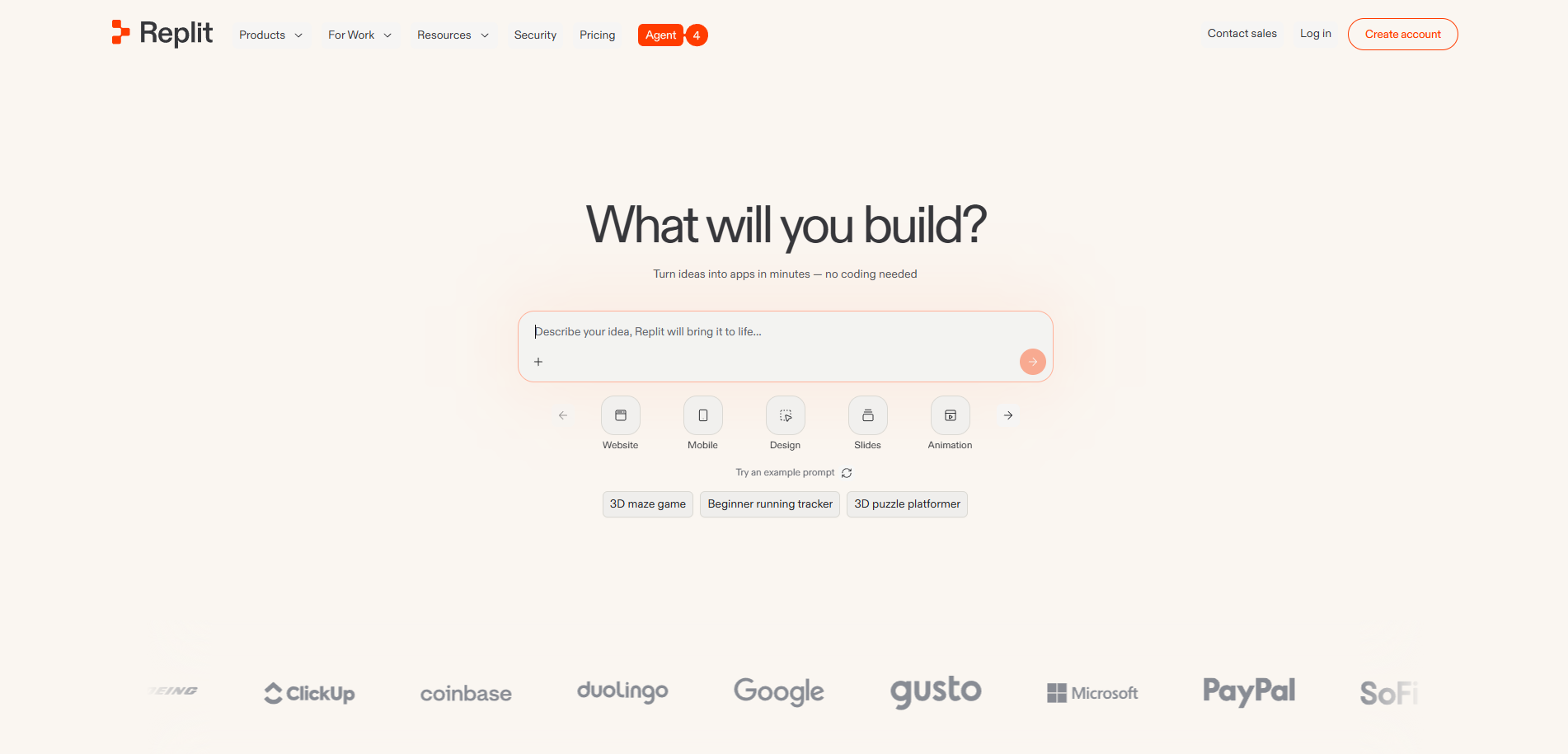
Best for solo builders and small teams who want to code, prototype, and ship web apps in the browser with an AI Agent.
Score
4.8 / 10. A strong browser coding platform with an AI Agent (8/10), but web output (native 3/10) and developer-leaning (non-technical 3/10).
Product Overview
- A browser-based cloud IDE with an AI Agent that builds, runs, and deploys apps without local setup.
- Output is a web app; the effort-based credit model can make heavy Agent use and always-on deployments expensive.
- Capable, but it still leans toward a developer workflow even with the Agent doing more of the work.
Pricing
Starter free; Core about $25 a month ($20 on annual billing); Pro about $100 a month. Effort-based credits add usage cost on top.
Integrations
Your code and its stack; deployments handled by Replit.
Setup
Minutes to a running web app; assumes comfort with code.
Tradeoffs
Replit ships a web app and assumes coding comfort. It does not produce a native iOS and Android binary, has no in-house team, and no built-in engagement. Choicely is the native, non-technical, team-friendly path.
5. v0: AI React UI Generation
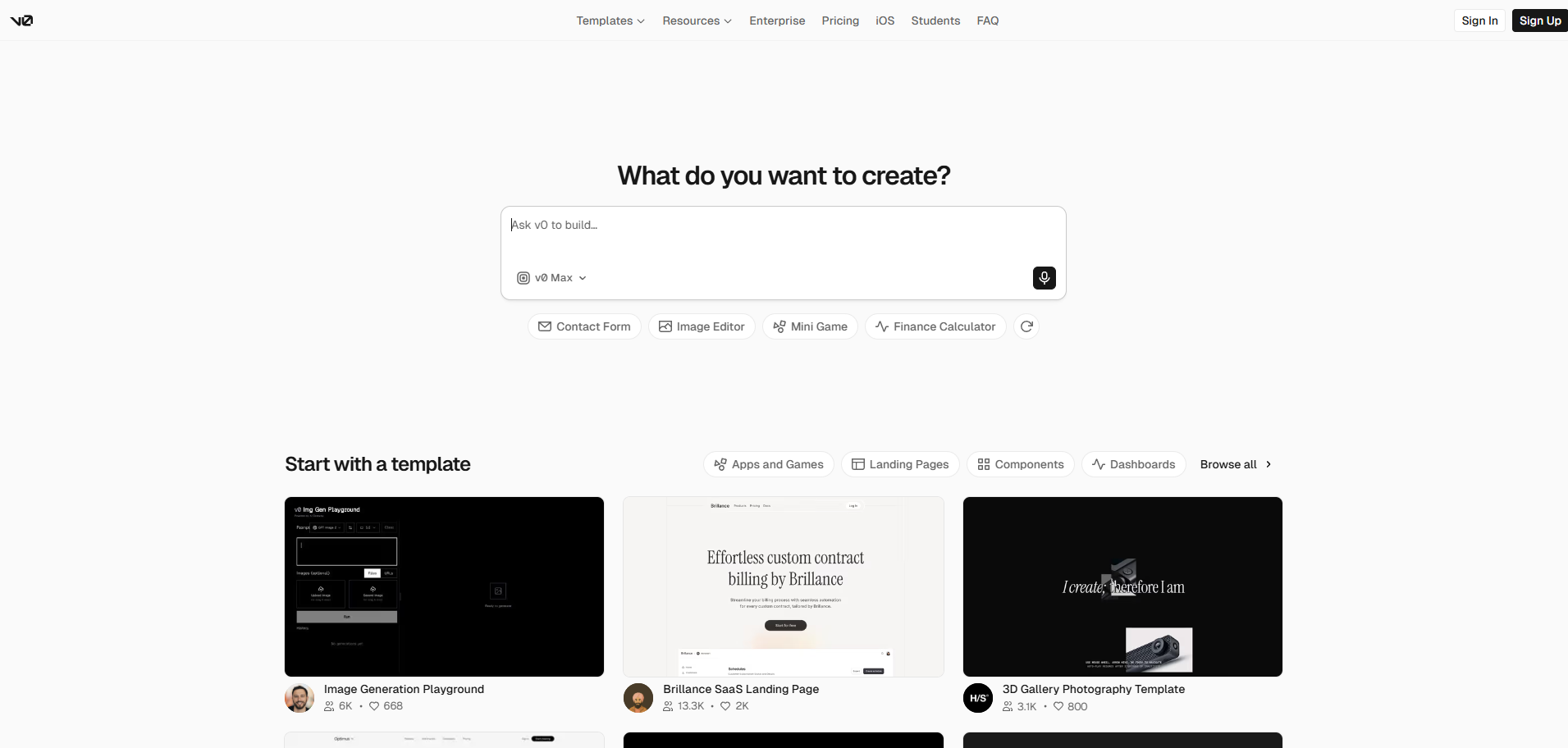
Best for frontend developers who want to generate React and Tailwind UI from prompts and deploy on Vercel.
Score
4.6 / 10. Excellent AI frontend generation with Vercel-native deploy (design 9/10), but it generates frontend only (full-stack 2/10) and no native output (1/10).
Product Overview
- An AI frontend generator from Vercel that turns prompts into React and Tailwind components, with a VS Code-style editor and one-click Vercel deploy.
- Generates frontend code only; for backend logic and databases you need another tool.
- Credit-based generation, and it is a web UI tool, not a native app builder.
Pricing
Free with $5 in monthly credits; Premium about $20 a month; Team about $30 per user. Credits meter generation.
Integrations
Vercel-native deployment, GitHub integration, and React and Tailwind code export.
Setup
Minutes to a multi-screen web UI.
Tradeoffs
v0 is a frontend generator, not an app platform: no backend, no native output, no App Store path, and no engagement. It is a design-and-frontend step, where Choicely takes you all the way to a published native app.
6. WeWeb: Web Frontends and Portals
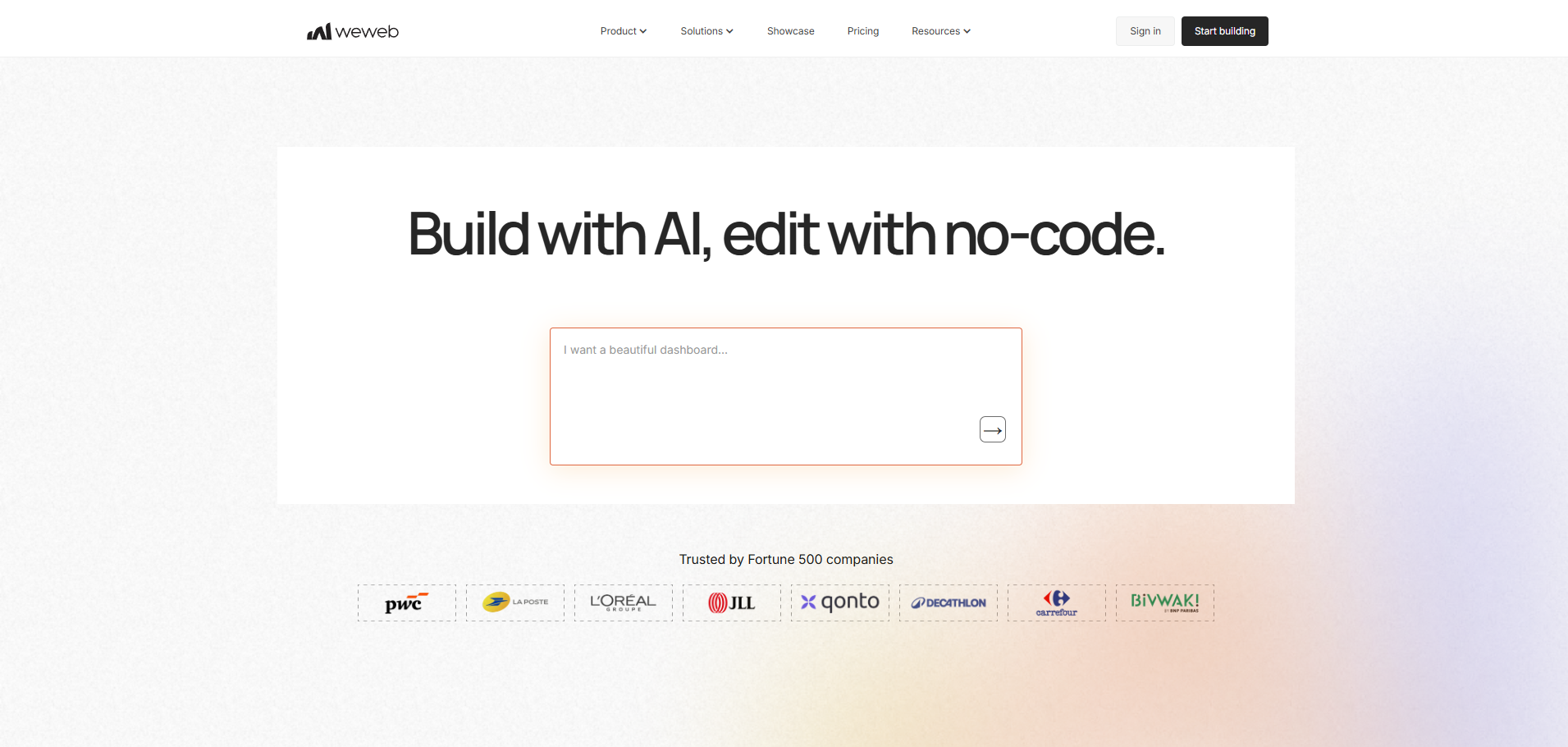
Best for teams building web dashboards, portals, and SaaS frontends on top of their own backend.
Score
4.5 / 10. Flexible web frontends with code export to avoid lock-in (ownership 7/10), but web-only by design (native 2/10) and no built-in engagement (2/10).
Product Overview
- A no-code and low-code visual builder for responsive web apps, with AI generation, a flexible logic system, and clean code export.
- Web output only, by the vendor's own positioning; you bring the backend (Supabase, Xano, or any REST/GraphQL API).
- Strong for data-driven web frontends and SaaS dashboards, not native mobile apps.
Pricing
Free to build and preview. Paid plans start around $20 a month per seat (Essential), rising to roughly $42 to $50 for Pro, billed per editor.
Integrations
Connects to Supabase, Xano, Airtable, Firebase, and any REST or GraphQL API; you wire and host the backend yourself.
Setup
Days to a polished web app if your backend is ready. There is no native mobile path.
Tradeoffs
WeWeb is a strong web frontend builder, but it does not ship native iOS and Android apps, has no built-in engagement, and no in-house team. It wins when a responsive web app on your own backend is the actual deliverable, not when you need to reach the App Store.
7. Cursor: An AI Code Editor for Engineers
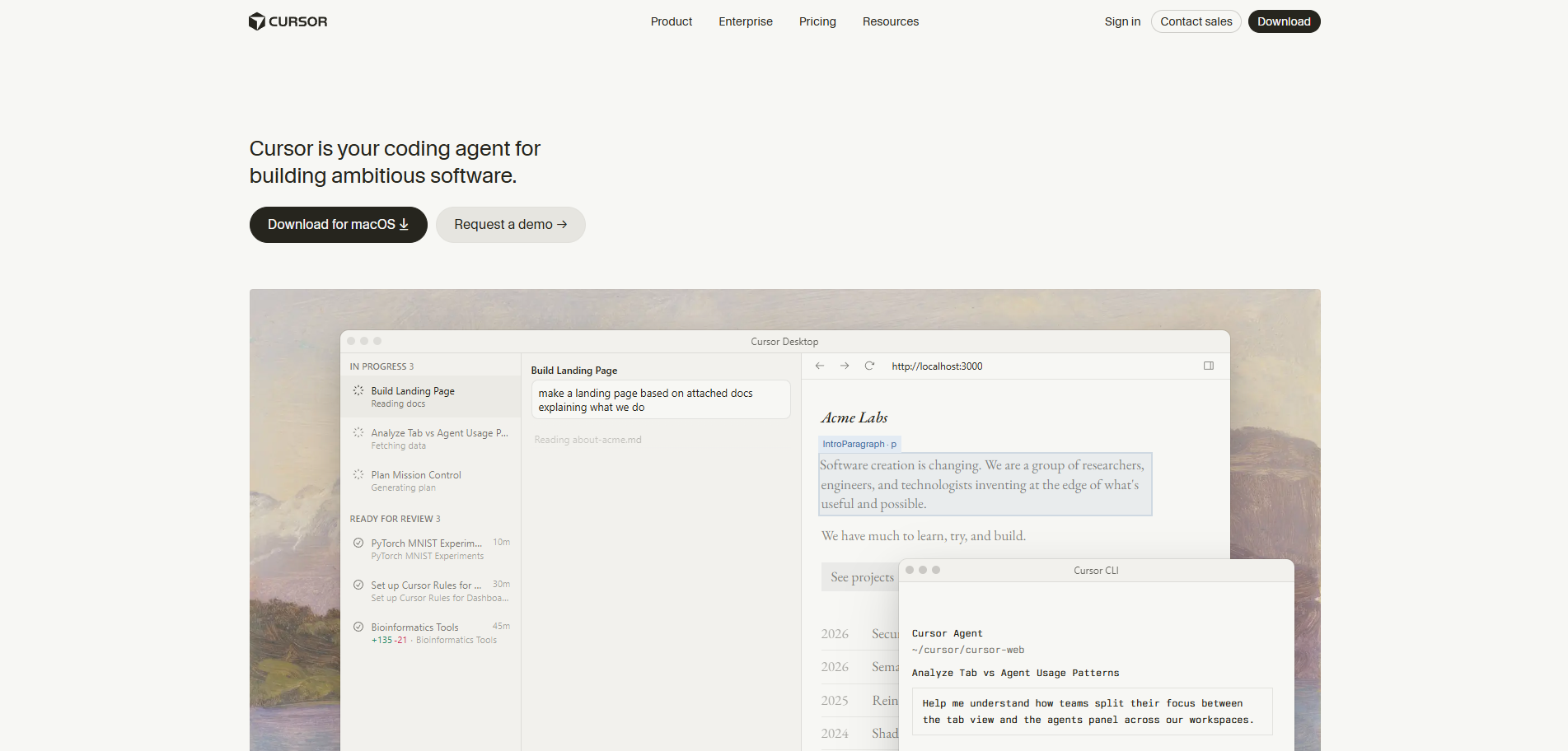
Best for engineering teams who want an AI editor to write, refactor, and extend a real codebase.
Score
4.0 / 10. An outstanding AI code editor for engineers (9/10), but it assumes coding skills (non-technical 1/10) and has no app or native pipeline (3/10).
Product Overview
- An AI code editor built on VS Code, with strong multi-file editing, an agent mode, and a large context window.
- Best for developers extending or refactoring an existing codebase, not generating a finished app from a prompt.
- Output is whatever you code; there is no built-in path to a native binary or the app stores.
Pricing
Free Hobby tier; Individual about $20 a month; Teams about $40 a month per user.
Integrations
Works inside your repo and toolchain; you bring your own frameworks and services.
Setup
Install and code; it assumes a developer workflow.
Tradeoffs
Cursor is for people who write code. A non-technical founder gets no app builder, no store deployment, and no engagement features. It is a tool for engineers, not a no-code path to a native app, which is exactly what Choicely is.
How To Choose the Right Lovable Alternative
Use this as a decision framework. Each step is specific enough to act on today, and most teams can work through the whole list in an afternoon.
Step 1: Name the Piece of Lovable That Is Actually Your Blocker
Is it the web-only output, the manual backend plumbing (Supabase, auth, payments), the AI's complexity ceiling, the credit burn, or the lack of native mobile output? The right alternative depends on which piece you are replacing.
Step 2: Decide Between a Web Prototype and a Real Native App Platform
Lovable, Bolt.new, and v0 output web apps. If you only need a browser prototype, you may not need to switch at all. If you need to ship to the App Store and Google Play, only a native-output platform like Choicely gets you there.
Step 3: Stress-Test Output Type, Web/PWA vs Real Native iOS and Android
Confirm the alternative compiles a real, signed native binary, not a web URL or an Expo dev preview. Push notifications, in-app purchases, and biometric login all depend on true native output.
Step 4: Verify Code and Data Portability and Ownership
Confirm before signing up that the alternative gives you your code, your data, and a clean exit. Bolt.new and v0 export code; Choicely outputs portable native iOS and Android code you own; Bubble does not export source at all.
Step 5: Evaluate AI Depth Across the Full Stack
Confirm the AI ships backend logic, data models, integrations, and payments alongside the UI, not just the cover screen. A great prompt-to-app demo means little if you still wire the hard parts by hand.
Step 6: Check Direct Deployment to the App Store and Google Play
Confirm the alternative ships the actual native app, not a web URL or source you must sign and submit yourself (Mac, Xcode, certificates, a paid Apple account). Choicely handles the native build and submission.
Step 7: Evaluate the Human Help Path When AI Hits a Wall
Confirm whether the alternative offers a Pro Services team, an expert community, or a clean hand-off. Lovable, Bolt.new, v0, Cursor, Replit, WeWeb, and Bubble leave you with forums and contractors; Choicely has a first-party team.
Step 8: Compare Pricing and Credit Burn Fairly
Lovable, Bolt.new, and v0 meter credits, Replit meters effort-based credits, WeWeb prices per seat, and Bubble meters Workload Units. Map your realistic usage to each model before falling for a headline price.
Step 9: Match the Tool to Who Will Build and Maintain It
Cursor and Replit assume real coding skills, Bolt.new and v0 assume comfort with React stacks, and Bubble rewards no-code power users. If non-technical teammates must contribute, confirm a visual editor and conversational AI they can actually use.
Things to Consider When Assessing Lovable Competitors
Before you move off Lovable, walk through these checks. They help you avoid switching for the wrong reason, and avoid trading one web tool for another.
1. Be Honest About Whether You Need Native at All
If your deliverable is genuinely a web app or an internal prototype, Lovable, Bolt.new, or v0 may already be fine. The case for switching is strongest when the app has to live in the App Store as a real native app.
2. Separate the AI-Depth Problem From the Output Problem
Some teams leave Lovable because the AI gets shallow on complex apps, others because the output is web-only. The first points to deeper builders or code tools; the second points to a native platform. Name which it is.
3. Confirm Code and Data Portability Before You Commit
Concern about lock-in is a common reason to leave Lovable. Confirm the alternative gives you your code, your data, and a clean exit. Choicely outputs portable native code you own.
4. Model Credit Burn at Your Real Usage
Credit and token models look cheap until a debugging loop eats a month's allowance. Estimate your real iteration volume and price each tool against it, not against the headline tier.
5. Map Who Actually Needs to Touch the Build
If non-technical co-founders or content leads must contribute, rule out developer-first Cursor and Replit and confirm a visual editor and conversational AI non-coders can use.
6. Plan for the Wall Before You Hit It
Every AI builder eventually stalls on something complex. Decide now whether you want a first-party Pro Services team, a community, or a contractor, because that should shape which alternative you pick.
FAQs
Why Are Founders Looking for Lovable Alternatives in 2026?
Three reasons dominate: Lovable ships a web app, not a native iOS and Android app; you end up hand-wiring backend, auth, and payments; and there is no human team when the AI stalls. Founders search for native output, less plumbing, or a team to lean on.
What Is the Best Lovable Alternative for Native iOS and Android Apps?
Choicely. It is the only option here that produces a true native Swift and Java app from an AI prompt or visual editor, ships to both stores, and adds built-in engagement and an in-house team. The rest output web apps or are developer tools.
What Is the Best Lovable Alternative for Non-Technical Founders?
Choicely. Its conversational AI builder and visual editor let non-coders ship real native apps, with a Pro Services team for the hard parts. Bolt.new and v0 assume comfort with React stacks, and Cursor and Replit assume real coding skills.
What Is the Best Lovable Alternative for Developers?
It depends on the job. Cursor is best for refactoring and extending a real codebase, Replit for cloud development with an AI Agent, and Bolt.new for fast full-stack web prototypes with code export. For a native app a team can own, Choicely.
Which Lovable Alternatives Give Me Code Ownership?
Bolt.new and v0 export their generated code, and Replit and Cursor work in code you control. Choicely outputs portable native iOS and Android code you own and supports custom code. Bubble notably does not export source at all.
How Much Do Lovable Alternatives Cost?
Entry pricing clusters low: Replit from about $20 a month (annual billing), v0, Cursor, and WeWeb from about $20, Bolt.new and Choicely Premium from about $25, and Bubble from about $59. Most meter credits or usage, so model your real iteration volume.
Which Lovable Alternative Builds True Native Apps Instead of Web Apps?
Only Choicely on this list ships a real native iOS and Android binary to the stores. Bubble has a maturing native beta, while Bolt.new, v0, WeWeb, Replit, and Cursor produce web apps or code without a native build pipeline.
When Is Choicely the Right Lovable Alternative?
When the deliverable is a real native iOS and Android app in the App Store, you want a human Pro Services team to lean on when AI hits a wall, and the app needs to handle real users and built-in engagement from day one.
The Bottom Line on Lovable Alternatives
If you are leaving Lovable because the web prototype cannot become the product, the shortlist is short: Choicely for a real native app a team can own, Bubble for deep no-code web logic, Bolt.new or v0 for fast web work, and Cursor or Replit if you are really after a developer tool. For a native consumer app that has to ship to the App Store and scale, Choicely is the one option here built and proven for exactly that.
Sources & disclosure: Pricing verified on the vendors' official pricing pages (Lovable, Bubble, Replit) as of July 23, 2026; review signals from G2 and Capterra. Choicely publishes this guide and appears in the ranking, so we have a commercial interest in one of the tools compared. Scores follow the methodology above; where a rival tool is the better fit, we say so. For the whole market in one view, see our ranking of the best AI app builders (prices re-verified August 2026).
Build your own app by chatting with AI

Create mobile apps for App Store & Google Play by chatting with Choicely AI
Keep reading, here are some similar posts
Last updated: July 23, 2026 If you're weighing Base44 alternatives, you've probably already hit one of its...
Last updated: August 10, 2026 If you’re weighing Replit alternatives, you’ve probably already hit the wall:...
Last updated: July 23, 2026 You built your app on Adalo, shipped something real, and for a while it worked....