If you created a personal Google Play developer account after November 13, 2023, you cannot publish an app to production until you have run a closed test with at least 12 testers who have been opted in for the last 14 days continuously. Until you meet it, Play Console keeps Production and Pre-registration switched off. Google scopes this requirement to personal accounts. Here is exactly what it requires, what it does not require, and how to stop it costing you a month.
Verified against Google's Play Console Help, July 2026.
The rule, precisely
Google's wording is narrow and worth reading literally, because most of the confusion around this rule comes from paraphrases rather than the rule itself.
| Requirement |
Detail |
| Who |
Developers with personal accounts created after November 13, 2023 |
| How many testers |
A minimum of 12 |
| For how long |
Opted in for at least the last 14 days, continuously |
| Until you comply |
Certain Play Console features, including Production and Pre-registration, stay disabled |
| How you exit |
Apply for production access from the Play Console dashboard |
"Continuously" is the word that catches people. The 14 days must be unbroken and must be the most recent 14 days at the moment you apply. A tester who opts in, stays a week, drops out and rejoins later does not restore your streak — and if you fall below 12 opted-in testers at any point, the clock effectively restarts. Over-recruit for this reason: aim for 15 to 20 so that ordinary attrition does not reset you.
Google also changed this rule once already: the original November 2023 version required 20 testers, reduced to 12 in December 2024. The 14-day duration has never changed. Worth knowing because plenty of guides still on page one describe the 20-tester version.
Does this apply to company accounts?
Here is where almost every article overstates what is known. Google scopes this requirement to personal accounts created after November 13, 2023, and its documentation does not mention organization or company accounts anywhere on that page. Secondary sources universally describe organizations as exempt. That is a reasonable reading of the scoping — but it is an inference from Google's silence, not a statement Google has made, and it is worth knowing which of those two things you are relying on.
If you are a registered business, registering as an organization rather than a personal account is therefore the cleanest way to sidestep the requirement. But there is a cost that the "just register as a company!" advice always omits: an organization account requires a D-U-N-S number, and obtaining one can take up to 30 days. Google's own payment-method verification can add up to five more.
So the honest comparison is not "14 days versus instant". It is 14 days of closed testing against potentially 30-plus days of business verification. If you already hold a D-U-N-S number, the organization route is clearly faster. If you do not, running the closed test is very often the quicker path to production — and you get real feedback out of it.
Do testers have to actually use the app?
Google's requirement is expressed entirely in terms of testers being opted in. The page does not define "opted-in", does not say testers must install the app, and does not say they must use it for any length of time.
You will nonetheless read confident claims that Google tracks whether testers open your app, that short sessions get flagged as fake, and that emulators or throwaway accounts trigger suspension. Those claims are plausible, but note where they come from: overwhelmingly from services that sell testers, which is a commercial interest in the rule sounding both stricter and scarier than the documentation states. We are not going to repeat them as fact.
What is verifiable is more useful anyway: meeting the numeric bar is necessary but not sufficient. Applying for production access is not an automatic unlock — it is a form, reviewed by Google, that asks about how you ran your closed test, what you learned, and what changed as a result. Google's own developer community forum contains threads from developers rejected after correctly completing 14 days with enough testers. The numbers get you to the door; the answers get you through it.
Which means the strategy that actually works is the one the rule was designed to produce: run a real test, gather real feedback, fix something, and be able to describe it.
Running it properly
- Recruit 15–20, not 12. The threshold is a floor you must hold continuously, so build in slack for people who drop out.
- Start on day one. The 14 days are calendar time you cannot compress, so open the closed test before you write your store listing, complete your data safety form, or finish your screenshots. Those tasks fit inside the fortnight for free.
- Use a Google Group rather than a list of emails. Managing testers by email list becomes painful the moment anyone changes address; a group lets you add and remove without editing the track.
- Ask for specific feedback. "Try it and tell me what you think" produces nothing you can write in the application. Ask three concrete questions — what confused you, what broke, what would you not bother using.
- Actually ship a fix during the test. The strongest production-access answer is a specific change you made because of specific feedback.
- Write the application answers properly. Vague summaries are the most commonly reported cause of rejection. Name what you tested, what testers reported, and what you changed.
- Use internal testing for your own loop. Internal testing takes up to 100 testers, has no review, and does not count toward the closed-testing requirement — use it for fast iteration alongside the closed test.
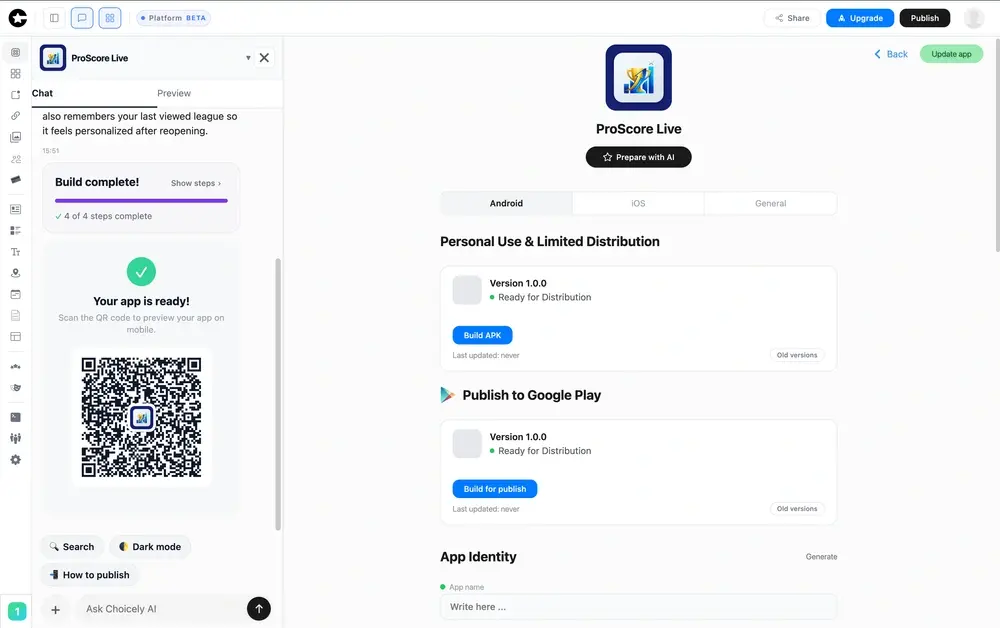
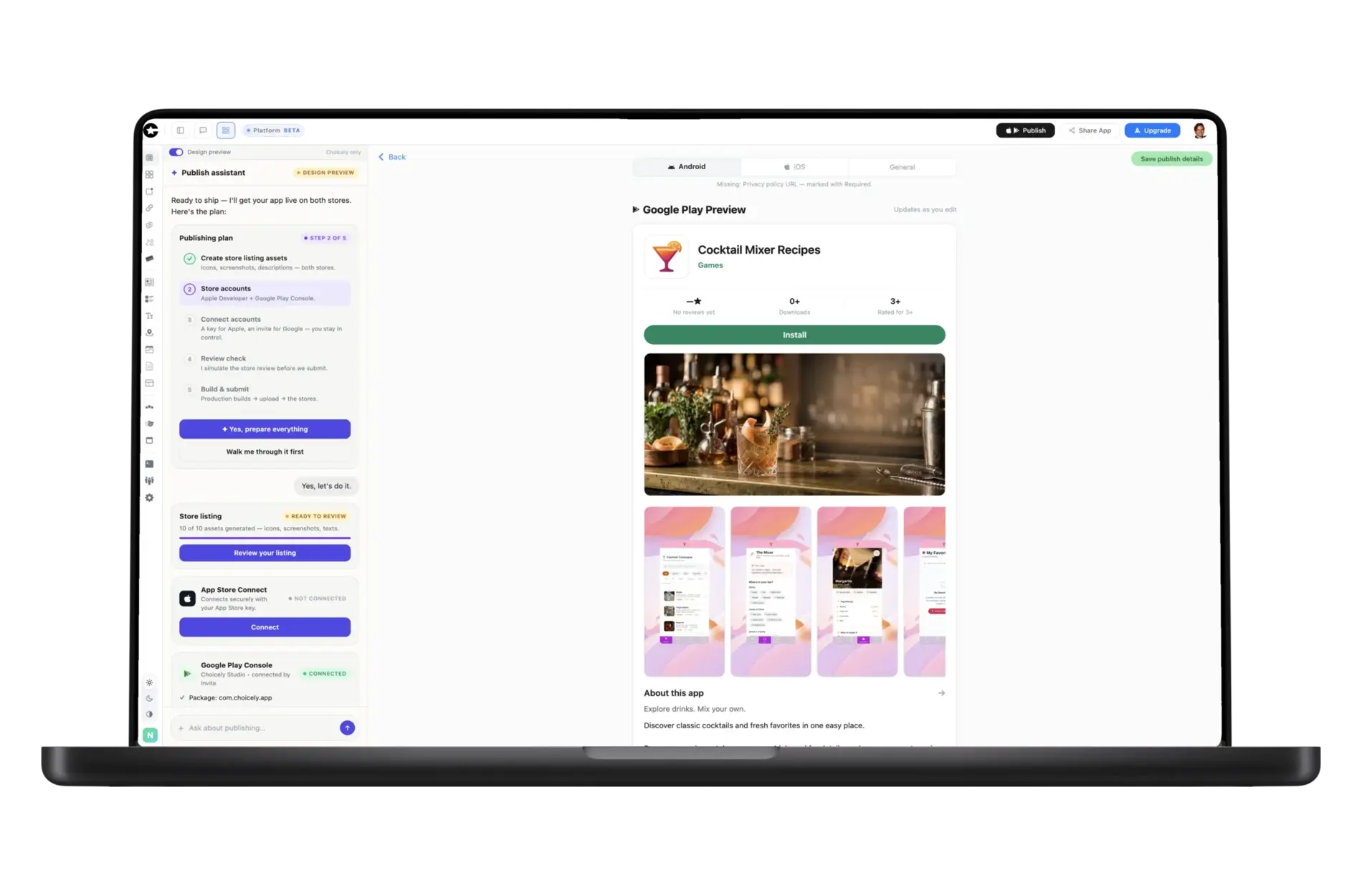
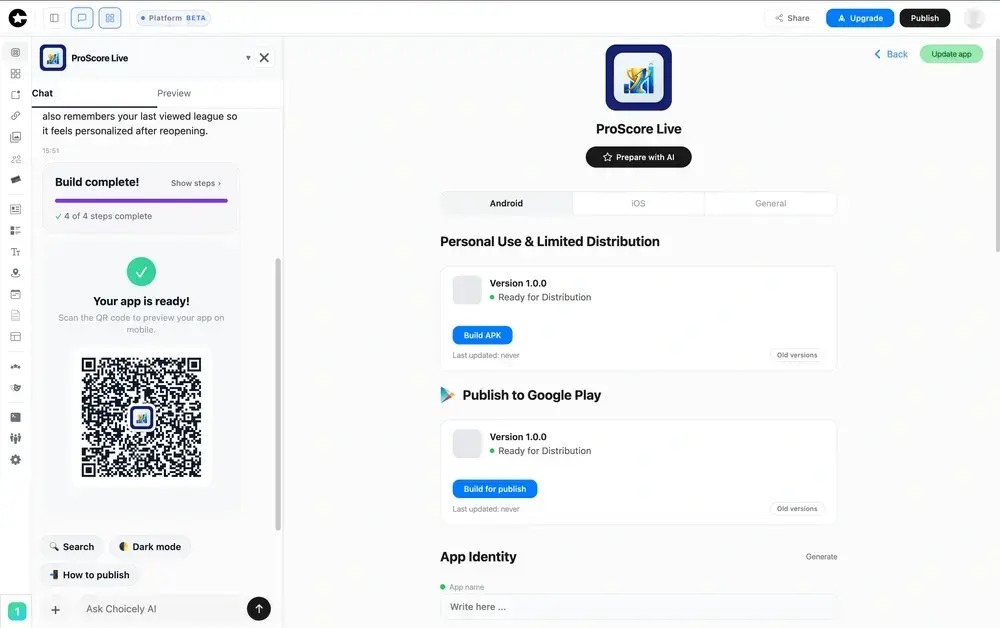
Nothing removes the fourteen days — but they don't have to be dead time. While your closed test runs, Choicely's Publish Assistant can prepare the rest: store listing, graphics, content rating and privacy details, all ready for the moment production unlocks. Build free while you wait. Get started free →
On paying for testers
Google's closed-testing page places no prohibition on how you recruit, and suggests reaching out to friends, family and colleagues. So paying for testers is not something we can tell you Google forbids — the documentation does not say so.
We would still advise against it, for two reasons that do not depend on any unverifiable claim about Google's detection. First, production access is a reviewed application asking what you learned, and a group of paid strangers who installed your app and never opened it gives you nothing to write. A rejection costs you another full 14-day cycle, which is far more expensive than the testers were. Second, you are being sold a way to skip the only part of this rule that has any value to you — twelve people using your app before the public does is genuinely useful, especially for a first launch.
If you cannot find twelve people who will try your app for two weeks, that is worth sitting with for a moment. It is not always a signal about the app, but it sometimes is.
Who does the Google Play 12-tester rule apply to?
Developers with personal Google Play accounts created after November 13, 2023. You need at least 12 testers opted in for the last 14 continuous days before you can apply for production access. Google scopes the requirement to personal accounts and does not mention organization accounts in its documentation — so organizations are widely understood to fall outside it, though that is an inference from Google's scoping rather than an explicit statement.
Do the 14 days have to be consecutive?
Yes. Google requires that your 12 testers have been opted in for the last 14 days continuously. A tester who leaves and rejoins does not restore the streak, and dropping below 12 opted-in testers effectively restarts the clock. Recruit 15 to 20 so normal attrition does not cost you a fortnight.
Do my testers have to actually use the app?
Google's requirement is written purely in terms of testers being opted in — it does not define "opted-in", nor state that testers must install or actively use the app. Claims that Google tracks session length come mainly from companies selling testers, not from Google's documentation. What is documented is that production access is a reviewed application asking how you ran the test and what you learned, so a test with no real engagement leaves you nothing credible to submit.
Can I skip the 12-tester rule with a company account?
Google scopes the requirement to personal accounts, so an organization account is the usual way around it. But an organization account needs a D-U-N-S number, which can take up to 30 days to obtain, plus up to five days for payment verification. If you already have a D-U-N-S number that route is faster; if you do not, running the 14-day closed test is often the quicker path to production.
Why was my production access rejected after I met the requirements?
Because meeting the numbers is necessary but not sufficient. Applying for production access is a form Google reviews, covering how you ran your closed test, what feedback you received and what you changed. Vague answers are the most commonly reported cause of rejection, and a rejection means starting a fresh 14-day cycle — so describe specific feedback and a specific fix you shipped.
How long until my app is live, in total?
Budget around three weeks for a first launch on a new personal account: 14 continuous days of closed testing, then the production-access application, then review itself. Google publishes no review-time target and says some accounts can take up to seven days or longer. Run the closed test in parallel with preparing your listing, assets and data safety form so the fortnight is not dead time.
Choicely builds real native Android and iOS apps free — 150 credits every month, no credit card — and the Publish Assistant prepares your store listing and walks the submission, so the fortnight of testing is the only part you actually have to wait for.
Sources & disclosure: the closed-testing requirement, its scoping, tester count and continuity wording were verified against Google's official Play Console Help on July 28, 2026. Where this article says Google has not stated something — for example that it does not define "opted-in" or prohibit recruited testers — that reflects the documentation as of that date. Claims about Google detecting inactive or fake testers circulate widely but originate largely from services that sell testers, and we have not repeated them as fact. Choicely publishes this article and sells an app-publishing product, so we have a commercial interest in it; we do not sell testers.