
Discover the 9 best AI app builders for non-technical founders in 2026. Compare ease of use, native iOS/Android output, App Store deployment, and pricing.

Last updated: October 7, 2026. Prices verified on each vendor's pricing page on that date; we re-check this post monthly.
You have an app idea. You can’t code, and you don’t want to spend six months learning Swift or hand a chunk of your company to a technical co-founder you barely know. So you start looking for the best AI app builder for non-technical founders, and you find a hundred demo videos that all look magical.
The problem shows up later, when you realize the beautiful thing you built in an afternoon is a web prototype, and your idea actually needs to live in the app stores as a real native iOS and Android app.
That’s the gap this guide is about. Most AI app builders are genuinely good at turning a prompt into a working web app. Very few produce a true native app you can submit to Apple and Google, and almost none give you a human team to call when the you need to.
If your idea needs push notifications, in-app purchases, offline use, and a real listing in the stores, the category that fits is a native app builder, not another web generator.
We compared nine AI and no-code app builders that a non-technical founder would realistically shortlist. We scored each on what actually matters to you: can you build it without code, does it produce a real native app, does it handle the backend (auth, database, payments), does it deploy to the stores, and is there a human to help when you get stuck.
|
Choicely |
Adalo |
Bolt.new |
Base44 |
|
Best overall for native mobile |
Best native no-code builder |
Best for a fast web prototype |
Best all-in-one web builder |
Best AI App Builders for Non-Technical Founders: Quick Comparison Table
| Software | Best for | Ease of use (no code) | Output | Free tier | Starting price | Score |
|---|---|---|---|---|---|---|
| Choicely | Native consumer apps | Very high (AI + visual) | Native iOS + Android | Yes | Free plan; From $25/mo | 9.4 |
| Adalo | Native no-code apps | High | Native iOS + Android | Yes | Free plan; From $36/mo | 7.2 |
| WeWeb | Customizable web apps, no lock-in | Medium | Web app (Vue.js SPA) + code export | Yes | Free plan; From $20/mo | 5.9 |
| Bubble | Customizable no-code | Medium | Web + native (beta) | Yes | Free plan; From $59/mo | 6.0 |
| Base44 | All-in-one web apps | Very high | Web / PWA | Yes | Free plan; From $16/mo | 5.6 |
| Bolt.new | Fast web prototype | High | Web app | Yes | Free plan; From $25/mo | 5.5 |
| Lovable | Ownable web MVP | High | Web app | Yes | Free plan; From $25/mo | 5.4 |
| Glide | Data-driven apps | Very high | PWA / web | Yes | Free plan; From $25/mo | 4.8 |
| Zite | Internal business tools | High | Web (business) | Yes | Free plan; From $15/mo | 4.2 |
How We Evaluated These AI App Builders
We assessed each platform across seven weighted dimensions, drawn from what a non-technical founder actually weighs when choosing a tool to build and ship an app.
We read aggregated user reviews, checked public pricing, and tested the build-to-ship path on each. Each platform is scored for fit to a non-technical founder shipping a real native app, not for raw product breadth.
A low score reflects a poor fit for that specific job, not a weak product for the market it was built for.
Several of these tools are excellent at what they do.
Our Scoring Methodology
| Criterion | Weight | What we measured |
|---|---|---|
| Native iOS + Android output | 25% | Whether the platform produces a real native app for the App Store and Google Play, not a web app or PWA. |
| Ease of use for non-coders | 20% | Whether someone who does not code can build and ship without a terminal, IDE, or Git. |
| Full-stack depth | 15% | Whether the tool handles backend, auth, database, and payments, not just the UI layer. |
| App Store + Google Play deployment | 10% | Whether the platform ships the actual binary and handles store submission, or hands you a URL. |
| Human help when AI hits a wall | 10% | Whether there is a first-party Pro Services team, an expert community, or a clean hand-off. |
| Built-in engagement and monetization | 10% | Whether voting, polling, in-app purchases, and subscriptions are available out of the box. |
| Pricing transparency and ownership | 10% | Whether cost is forecastable across credits, tokens, and seats, and whether you own the code and data. |
The 9 Best AI App Builders for Non-Technical Founders in 2026
1. Choicely: Best AI App Builder for Non-Technical Founders Overall
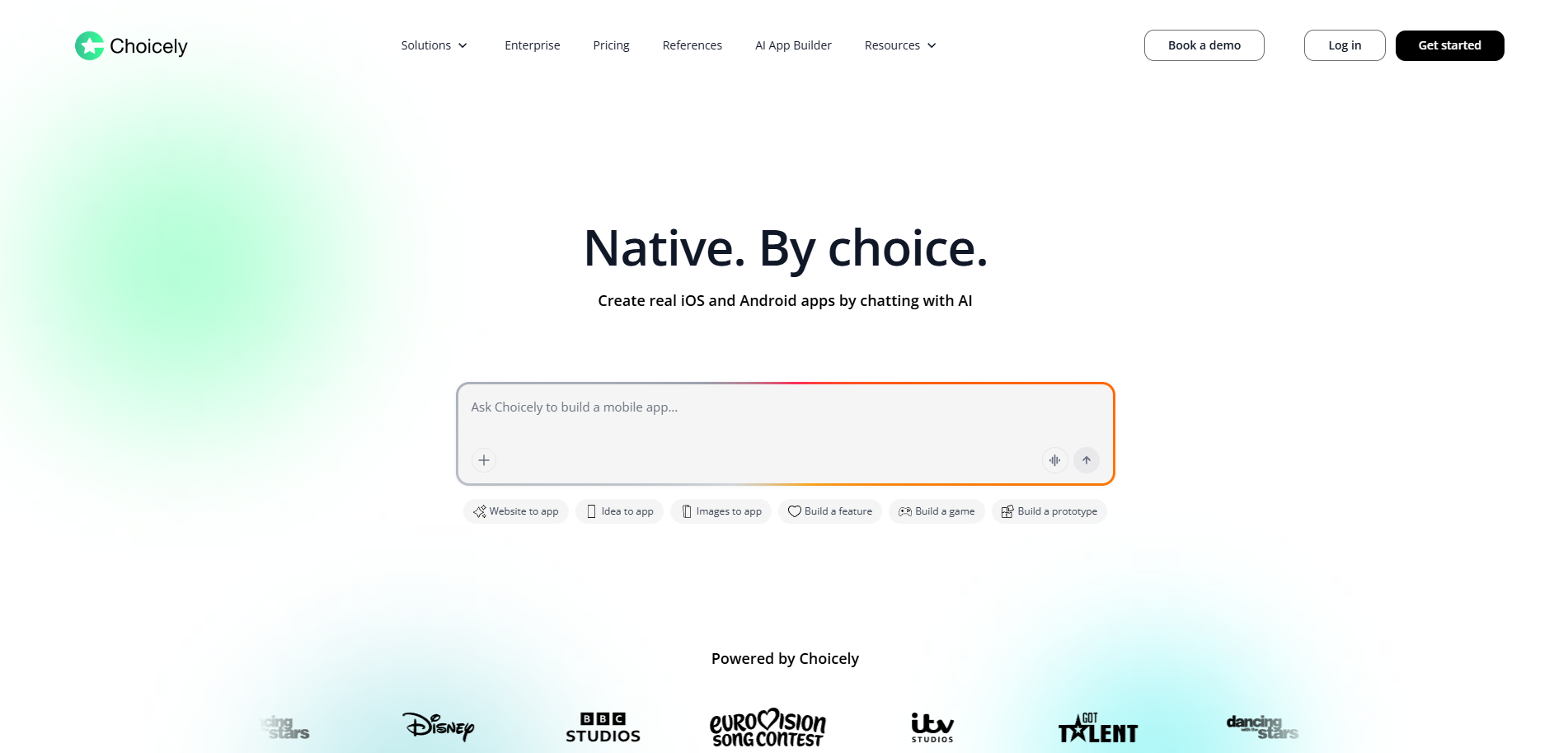
Best for non-technical founders who need a real native iOS and Android app in the App Store and Google Play, built by chatting with AI or dragging and dropping, with an in-house design and engineering team to call when AI hits a wall.
Score
9.4/10. Top marks for native output (10/10), App Store and Google Play deployment (10/10), human help (10/10), and built-in engagement and monetization (10/10). Scored lower on raw code-level control for engineers (6/10), which is not what it is built for.
Positioning
Choicely is the only AI app builder on this list that produces a true native iOS (Swift) and Android (Java) app, lets you build it by chatting with AI or dragging and dropping in a visual editor, and gives you an in-house Pro Services team to call when AI hits a wall, all on the same platform.
Product Overview
Choicely is a Helsinki-based AI-powered mobile app platform that lets a non-technical founder ship a real native iOS and Android app to the App Store without writing a single line of code. It maps directly to the three walls founders hit.
Pain 1: “I can't code, and I don't want to learn.”
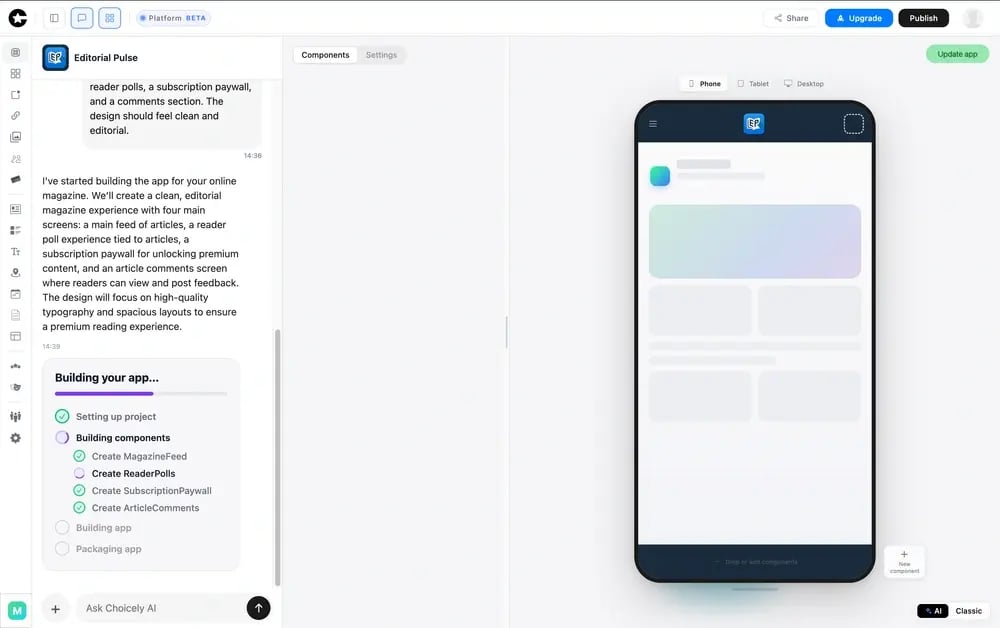
You build by describing what you want in plain language, letting the AI generate it, and then refining it by dragging and dropping components in the visual editor.
There’s no terminal, no Git, and no code editor at any point.
Because the AI works alongside the visual editor, you’re not stuck waiting for the AI to finish each step before you can adjust the app yourself.
Pain 2: “The prototype isn't a real app.”
Choicely produces real native iOS (Swift) and Android (Java) apps, not a web page in a shell. The AI builder also generates React Native code, using true native code to access full device features (including push notifications) and deliver the performance and store quality that a web app or PWA cannot match.
The result is an app you can actually submit to Apple and Google as a first-class native app.
Pain 3: “I'm stuck at the production wall (auth, payments, App Store).”
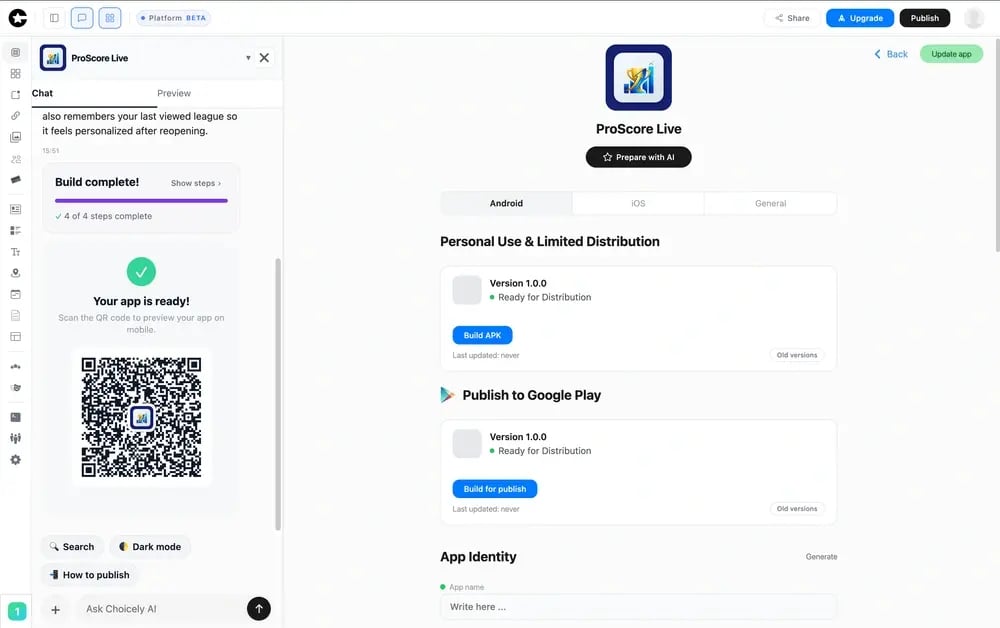
Authentication, a real database, in-app purchases, and subscriptions are built in, and Choicely deploys the actual native binary to the App Store and Google Play.
When you hit something the AI cannot finish, an in-house Pro Services team can take the build over the line, including store submission.
On top of that, Choicely ships built-in engagement features (voting, polling, ratings, battles, reactions, and paid voting), lets you push content and feature updates live without an App Store re-review, and is production-tested at Eurovision, Miss Universe (around three million downloads in five weeks), and Got Talent scale.
You also own your app and your user data on an open, API-driven platform.
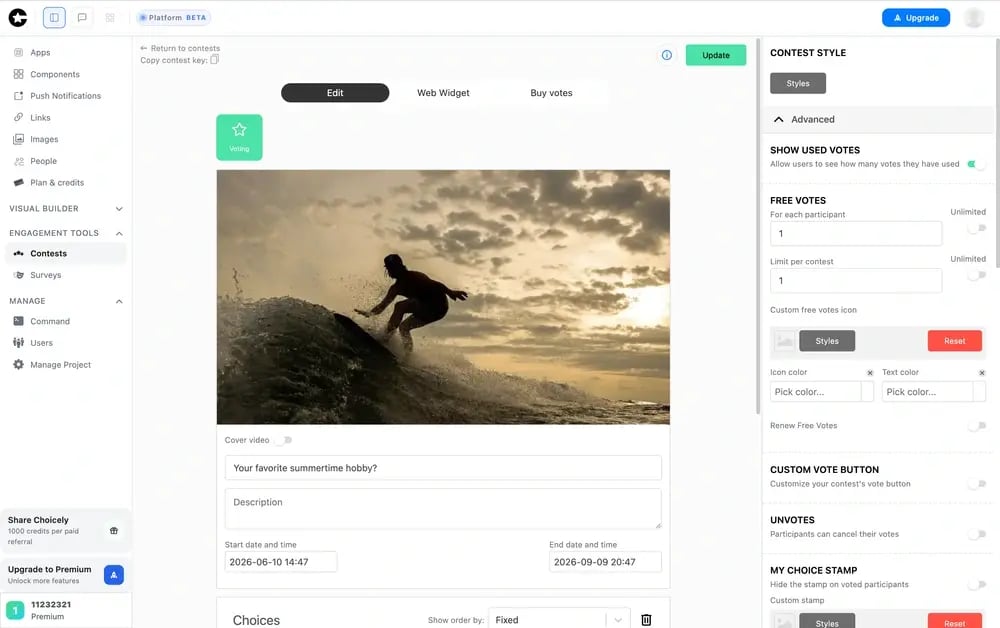
Pricing
Self-serve subscriptions (Premium at $25/month and Business at $50/month) with a free starter tier to build and preview apps.
Monthly credit allotments with rollovers and optional top-ups keep ongoing cost predictable.
Integrations
Open, API-driven platform with native connectors to CRMs, ecommerce (Stripe, Shopify), statistics and streaming services, advertising platforms, chatbots, automated content feeds, CMSs, maps, timetables, and UGC software.
First-class push notifications, in-app purchases, and biometric login. SDK at studio.choicely.com/docs/sdk.
Setup
DIY via AI: minutes to a working prototype. Pro Services full build: a production-ready native iOS and Android app in weeks rather than months. No CLI, terminal, or Git required.
Tradeoffs
Choicely is overkill for a founder who only needs a quick web prototype to test an idea or show an investor.
If you don’t need native output, the App Store, a live audience, or engagement features, you’re better served by Lovable, Bolt.new, or Base44.
Choicely earns its place when the deliverable is a real native app you intend to ship and grow.
Support
Pro Services customers get a dedicated team and white-glove onboarding; self-serve plans get community and email support. SDK documentation is at studio.choicely.com/docs/sdk.
Success Stories
Founder-shipped native apps on Choicely include AFTV+ (Arsenal Fan TV, a fan-engagement app) and Bermuda Today (a founder-launched native news app). Deeper write-ups are at choicely.com/case.
Mini Case Study: AFTV+ Mobile App
AFTV, the leading Arsenal fan media platform, used Choicely’s no-code mobile app builder to create a highly engaging, mobile-first experience for its global audience. Through the AFTV+ app, fans receive real-time updates via live streams and push notifications, while content from AFTV’s video channels and social media feeds is automatically published within the app.
Choicely also enables AFTV to update and manage its native mobile apps quickly without extensive technical resources, improving agility and reducing development overhead.
AFTV CEO Brett Best praised the platform as a “clever and intuitive product” that delivers a responsive native app experience, adding that “for the price, it is remarkable technology” and recommending it to organizations that aren’t tech-first businesses.

2. Adalo: Best Native No-Code App Builder
Best for non-technical founders who want a genuinely no-code path to a native iOS and Android app in the stores.
Score
7.2/10. Genuine native output and easy for non-coders (native 9/10, ease 8/10). Scored lower on built-in engagement (4/10), human help (3/10), and depth for complex apps (6/10).
Product Overview
- Compiles true native iOS and Android apps and publishes them to the App Store and Google Play from a single codebase.
- Drag-and-drop visual builder with a built-in database, native authentication, and AI-assisted building (Magic Start, with a fuller AI Builder arriving in 2026).
- One of the more accessible native builders for non-coders, with over three million apps created.
Pricing
Free plan; paid plans for store publishing from about $36/mo, with unlimited database records and no usage-based charges on paid tiers.
Integrations
Built-in database plus API and Zapier integrations, and common services such as Stripe.
Setup
Days to a published native app for a non-technical founder; simpler apps ship fast.
Tradeoffs
Genuinely native and easy to use, but built for simpler apps, with no first-party team when you get stuck and no built-in engagement (voting, polling, paid voting) or live-event scale.
Choicely adds the human lift, engagement, and proven scale.
3. WeWeb: Best AI App Builder for Scalable Web Apps 
Best for founders who want to build powerful, scalable web apps, including SaaS platforms, marketplaces, dashboards, or internal tools with AI speed, visual control, flexible backend integrations and the option to export and self-host their code. It simplifies long-term SaaS management, giving founders complete ownership over their infrastructure, security compliance, and operational costs from day one.
Score
9/10. Best-in-class for founders building production-grade web apps (pixel-perfect control 10/10, backend flexibility 10/10, ownership 9/10). Scored slightly lower only because WeWeb is focused on web apps rather than native iOS and Android app deployment.
Product Overview
- WeWeb is an AI-powered app builder that lets founders generate pages, logic, databases, and components with AI, connect to tools and data through MCP, and refine everything visually in a drag-and-drop Editor.
- Unlike many prompt-to-app tools, WeWeb is built for real production web apps, with responsive design, reusable components, workflows, authentication, roles, and strong data handling.
- WeWeb is backend-flexible, so founders can connect to Supabase, Xano, Airtable, REST APIs, GraphQL APIs, or WeWeb’s native backend instead of being locked into one vendor’s infrastructure.
- Paid plans include code export and self-hosting, making WeWeb one of the best options for founders who care about ownership, scalability, and avoiding platform lock-in.
Pricing
Free plan available. Paid seat plans start from about $20/mo, with separate hosting options depending on whether you publish on WeWeb, connect a custom domain, or export and self-host.
Integrations
Supabase, Xano, Airtable, REST APIs, GraphQL APIs, MCP, custom authentication, external databases, and third-party services. Strong fit for founders who already have a backend, want to choose their own stack, or need a more flexible data architecture.
Setup
Minutes to a working app prototype with AI. A production app still requires thinking through data models, permissions, workflows, and backend logic, but WeWeb keeps the build visual and avoids the need to start in a terminal or code editor.
Tradeoffs
WeWeb is the best fit here for a founder who wants to build a real web app, not just a throwaway prototype.
It gives you far more frontend control, backend flexibility, and ownership than simpler AI web builders, while staying much more accessible than custom development.
The tradeoff is mobile output. WeWeb is not a native mobile app builder, so founders who need App Store and Google Play deployment, push notifications, in-app purchases, offline mobile features, or a consumer native app experience.
4. Bubble: Best for Deeply Customizable No-Code
Best for founders who want maximum control in a no-code platform and are willing to climb a learning curve.
Score
6.0/10. The most powerful, customizable no-code builder (customization 9/10), and it now offers native mobile in beta. Scored lower on ease for non-coders (5/10, a real learning curve) and native maturity (6/10).
Product Overview
- The deepest no-code visual builder, with full workflow logic and a large plugin marketplace for almost any feature.
- Launched a native mobile builder (React Native) in public beta in 2025, so it now targets web and native from one platform.
- Very powerful, but the learning curve is steeper than its marketing suggests, especially for a first-time non-technical founder.
Pricing
Free plan for projects under construction, Starter about $59/mo, Growth about $209/mo, Team about $549/mo; for Enterprise on request; pricing is workload-unit-based.
Integrations
Large plugin marketplace, APIs, Stripe, and common services.
Setup
Hours to a web prototype; a production app, and the native beta, take real ramp-up time.
Tradeoffs
The most customizable option here, with a promising native mobile beta, but the learning curve is real for a non-technical founder; the native path is still maturing, and there’s no in-house team or built-in engagement.
Choicely is more accessible to non-coders, and ships mature native plus engagement.
5. Base44: Best All-in-One AI Web App Builder
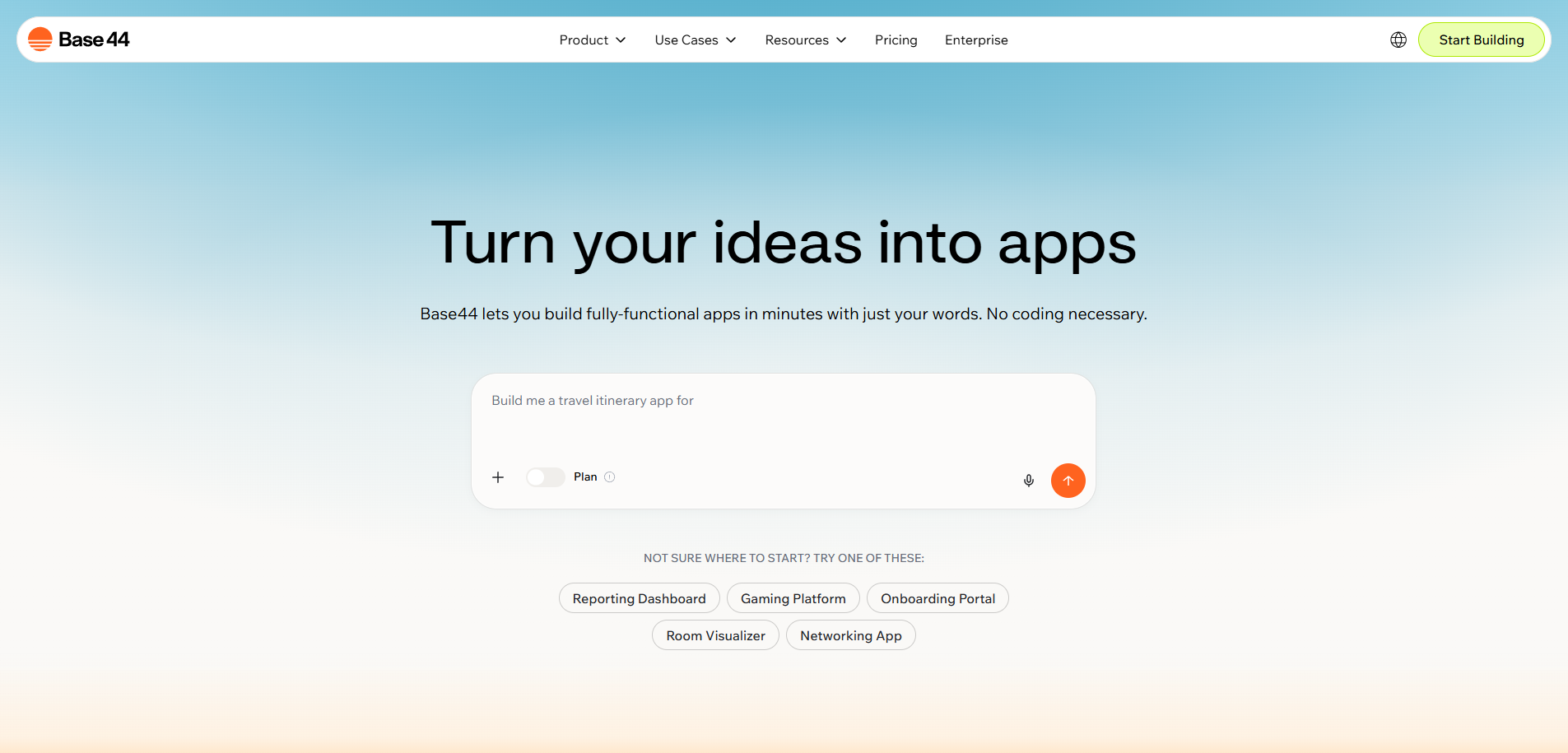
Best for founders who want the simplest possible path from a prompt to a working full-stack web app, backend included.
Score
5.6/10. The fastest all-in-one prompt-to-web-app (ease 9/10). Scored lower on native output (2/10), lock-in (backend stays on Wix infrastructure), and human help (3/10).
Product Overview
- Describe an app in natural language, and it generates the frontend, backend, database, auth, and deployment in one place, with no external setup.
- Acquired by Wix in June 2025, now with more than two million users; output is a web app or PWA.
- Its mobile deployment wraps the web build rather than shipping a fully native binary.
Pricing
Free tier (25 message credits/month); Starter $16/mo, Builder $40/mo, Pro $80/mo, and Elite $160/mo when billed annually. Credit-based usage means frequent iterations and debugging can consume allowances quickly.
Integrations
Native Stripe, Slack, Google Sheets and Drive, SendGrid and Twilio, and OpenAI and Anthropic; the backend stays on Base44 and Wix infrastructure.
Setup
Minutes to a working web app; shipping a true native app to the App Store is a different matter.
Tradeoffs
The easiest way to get a working web app fast, but it’s web or PWA rather than native, the backend locks to Wix infrastructure, and founders report credit burn and post-acquisition price and support changes.
Choicely ships native and you own it.
6. Bolt.new: Best for a Fast Web Prototype
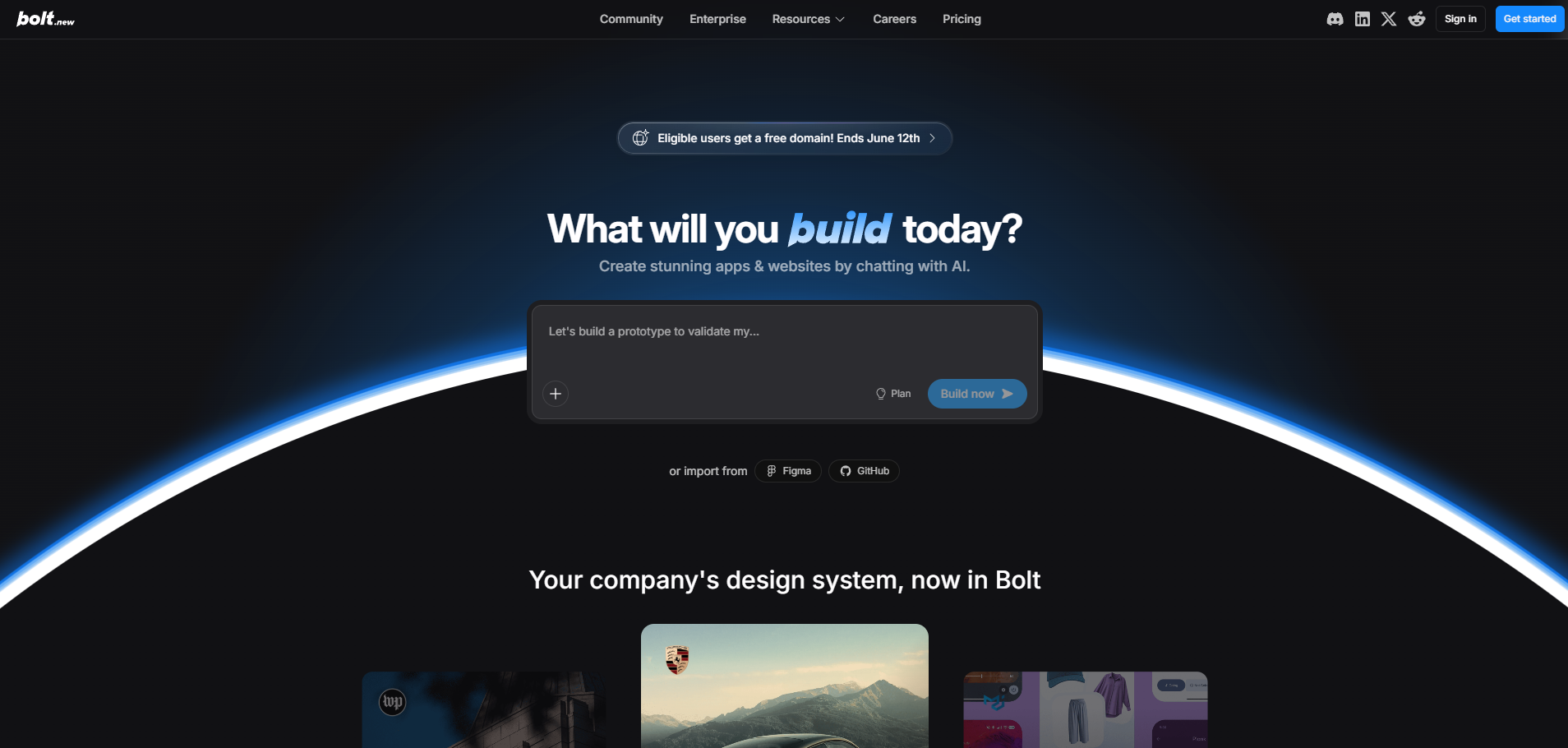
Best for founders who want the fastest path from a prompt to a deployable full-stack web app or MVP.
Score
5.5/10. Fast web prototyping (9/10), but web-only output (native 2/10) and no human build team (3/10).
Product Overview
- A browser-based AI builder from StackBlitz; its WebContainers run a full Node.js environment in the tab and generate full-stack React apps from prompts.
- Token-based generation with a live preview, one-click deploy, and full code export or GitHub sync.
- Mobile support is via responsive web and an Expo integration, not a true native iOS or Android binary.
Pricing
Free about 300K tokens/day; Pro $25/mo for ~10M tokens; Team $30/user/mo; Enterprise on request. Heavy iteration burns tokens fast.
Integrations
Supabase, Stripe, GitHub, Netlify, and Figma; one-click deploy to Vercel or Netlify.
Setup
Minutes to a working web prototype in the browser, with no local setup.
Tradeoffs
Excellent for fast web prototyping, and you can export the code, but it ships a web app (no native binary), and there’s no in-house team when the AI stalls.
Choicely ships native with a human lift.
7. Lovable: Best for an Ownable Web MVP
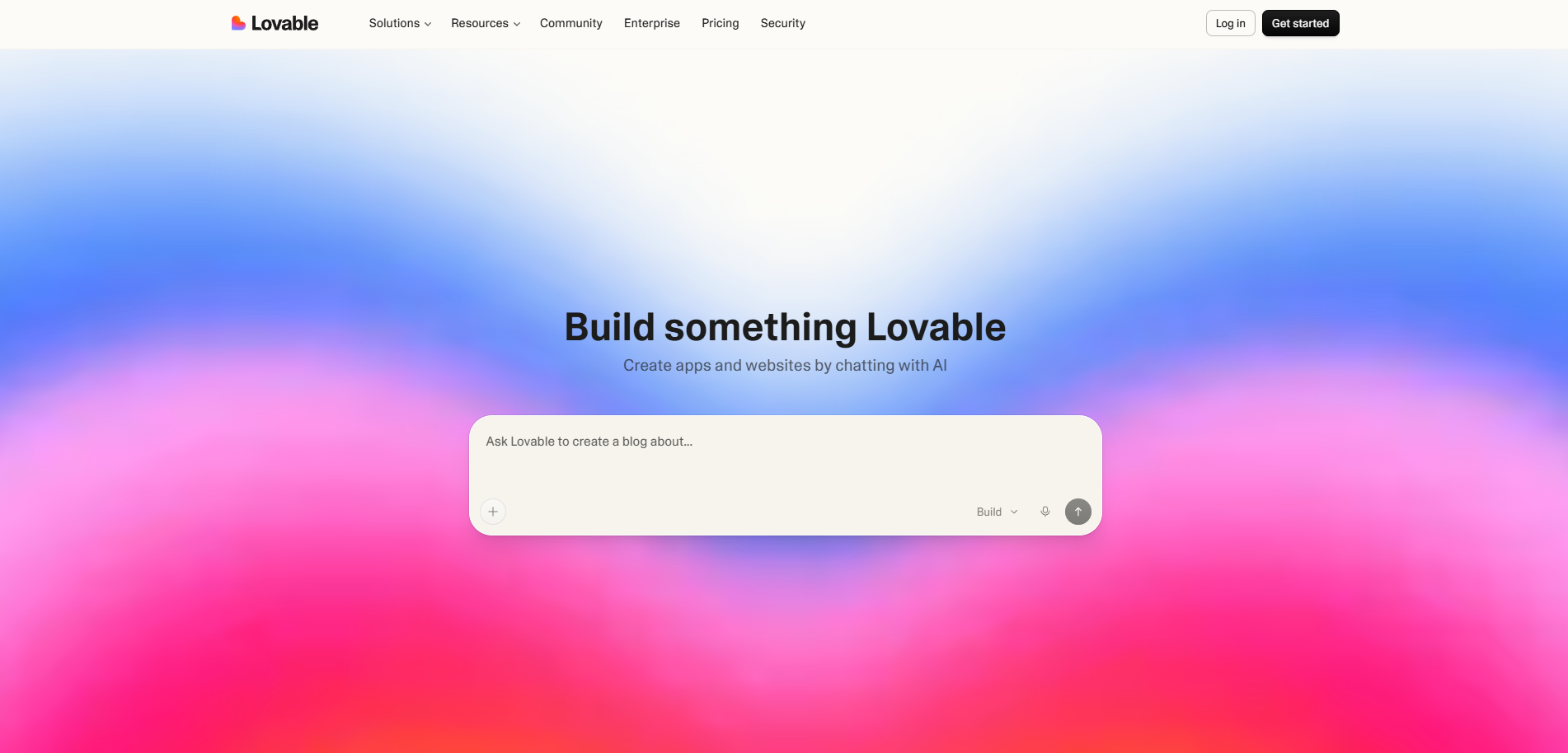
Best for founders who want a working web prototype fast and a real GitHub repo of editable React they own.
Score
5.4/10. Fast, ownable React web prototypes (9/10), but no native output (1/10) and not aimed at production mobile (3/10).
Product Overview
- An AI-first prompt-to-code generator that produces React web apps with native Supabase auth and database wiring.
- Gives you a real GitHub repo and code export; one of the most popular tools in the category, with roughly eight million users.
- Reviewers consistently note it is built for web prototypes, not production mobile apps.
Pricing
Free (5 daily credits, ~30/mo); Pro $25/mo (100 credits); Business $50/mo (10O); Enterprise on request. Credit cost varies by request.
Integrations
Native Supabase, Stripe, and Resend; GitHub sync; extend anything else in code.
Setup
Minutes to a working web app from a prompt; refining it well rewards React familiarity.
Tradeoffs
Great for an ownable web MVP, but it has no native iOS or Android path at all and no done-for-you team.
Choicely is the native, team-backed option.
8. Glide: Best for Data-Driven No-Code Apps
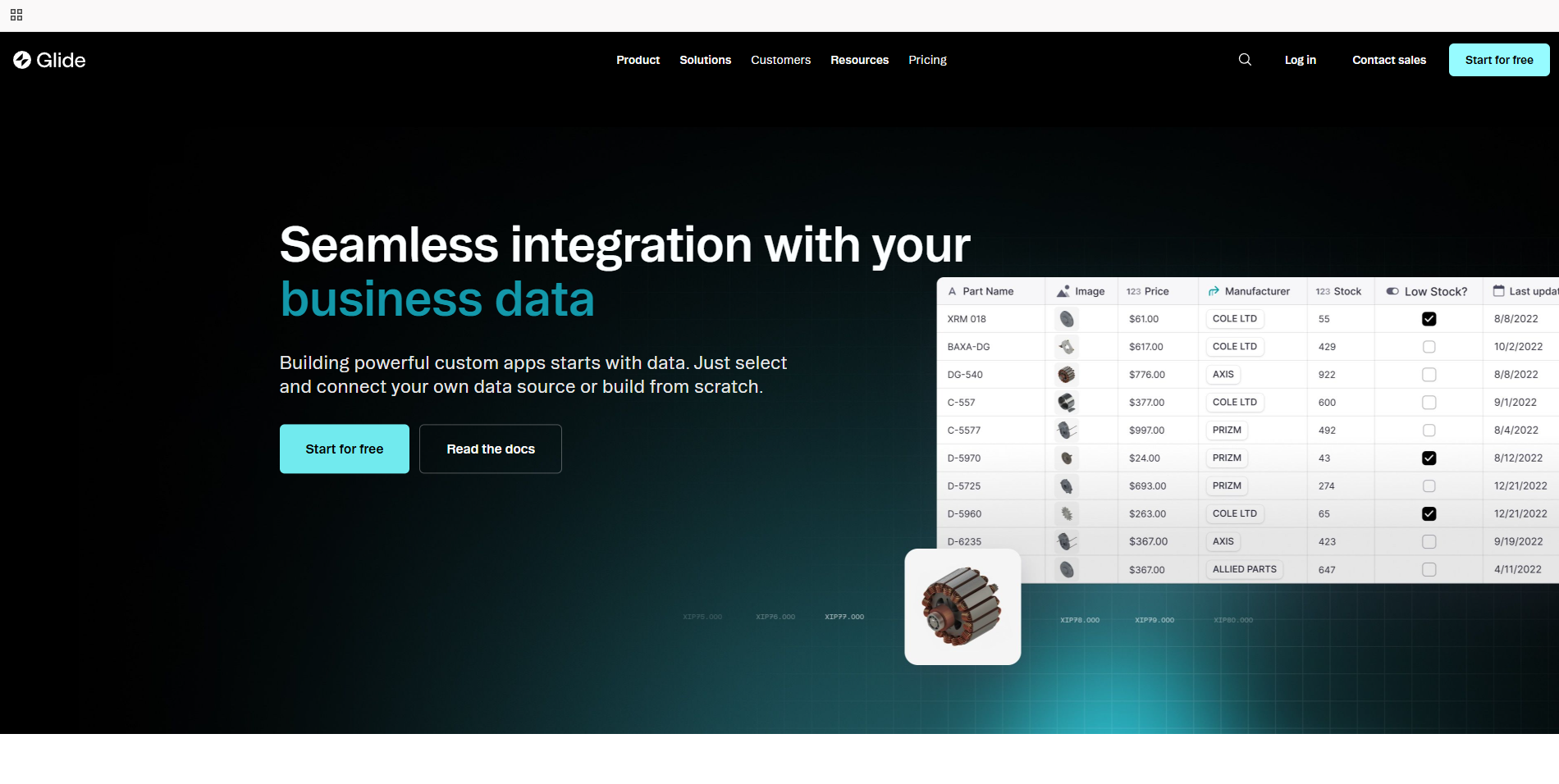
Best for founders building data-driven apps, internal tools, and lightweight consumer apps on top of a spreadsheet or database.
Score
4.8/10. Fast, polished no-code apps from your data (ease 8/10), but PWA output (native 3/10) and best for internal or lightweight apps.
Product Overview
- A no-code builder driven by structured data (Google Sheets, Airtable, Glide Tables), with native auth, roles, and a no-code action system; added an AI app generator in late 2024.
- Apps run as polished PWAs with mobile styling; Glide does not compile real native code.
- A Business-plan App Store service can wrap the PWA in a native shell and submit it, but the result is a wrapper, and Apple has grown stricter about wrapper apps.
Pricing
Free tier (one project, limited credits); Basic $25/mo; Plus $50/mo; Pro $125/mo; Enterprise on request. Repriced under GlideOS — the $199 Business tier no longer exists. Verified 7 August 2026.
Integrations
Google Sheets, Excel, Airtable, and Glide Tables; native auth and role-based access.
Setup
Very fast for spreadsheet-backed apps.
Tradeoffs
A fast, friendly way to ship a data app, but it’s a PWA (its store path is a wrapper), not a true native app, and it lacks built-in engagement and live-event scale.
Choicely is built for native consumer apps at scale.
9. Zite: Best for Internal Business Tools
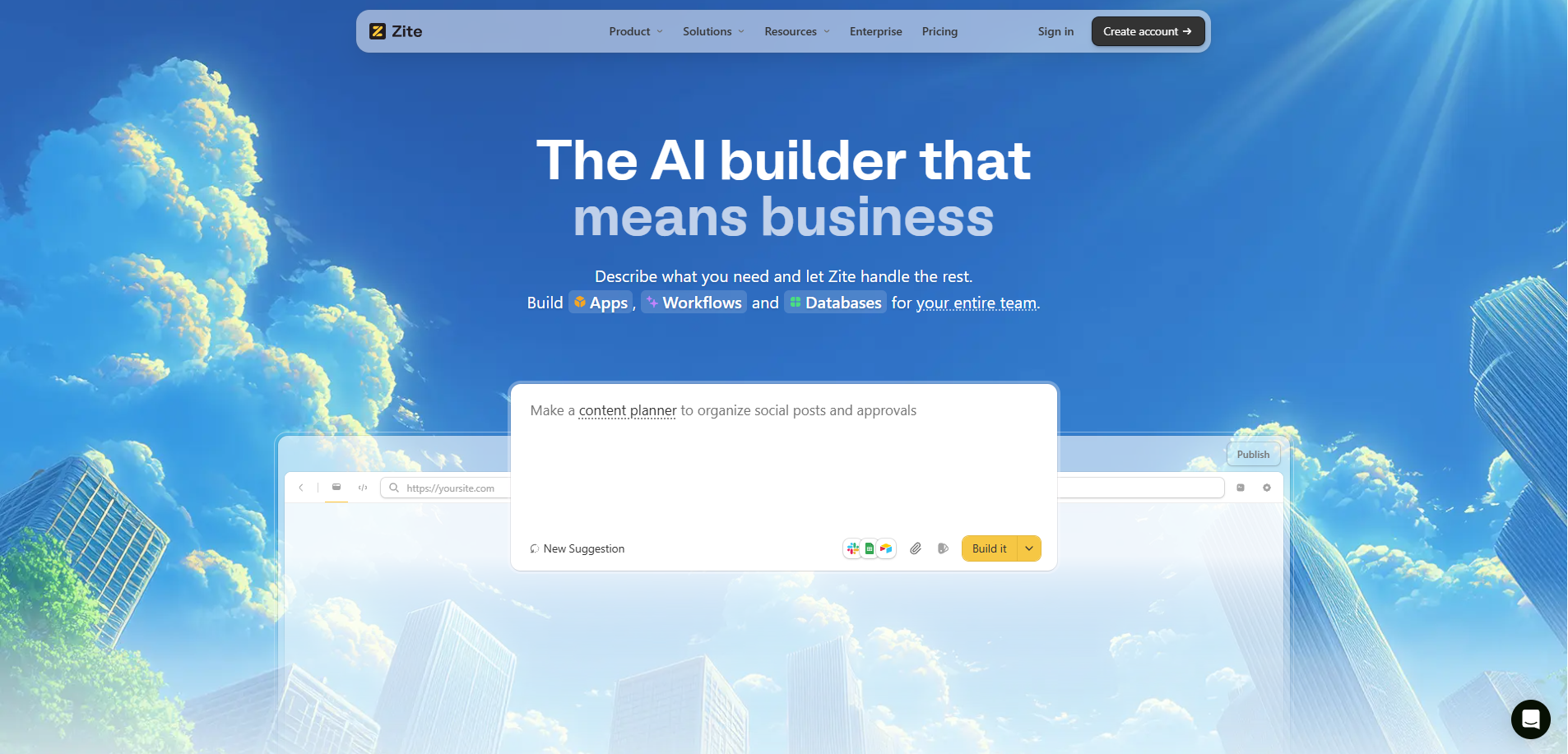
Best for founders and operators building internal tools, client portals, dashboards, and workflows, not consumer mobile apps.
Score
4.2/10. Strong AI no-code for business software (8/10), but web output (native 1/10) and aimed at internal tools rather than consumer native apps.
Product Overview
- An AI no-code platform (by Fillout) that turns prompts into web business software with a built-in database, authentication, role-based access, and workflows.
- You can refine visually: the UI by clicking components, the backend as an editable flowchart; used by more than 100,000 teams.
- Output is web business software that runs in the browser, not a native mobile app.
Pricing
Free forever (limited credits); Pro about $15/mo (100 credits); Business about $55/mo (200 credits); Enterprise. No per-user fees.
Integrations
Airtable, Google Sheets, Salesforce, and Slack; built-in database and single sign-on.
Setup
Minutes to a working internal web tool from a prompt.
Tradeoffs
Excellent for internal business software, but it produces web apps for operations, not a native consumer app you submit to the App Store, with no engagement features or live-event scale.
A founder shipping a consumer app needs Choicely.
How to Choose the Best AI App Builder as a Non-Technical Founder
Step 1: Decide whether you need a true native app or just a web prototype
Most AI app builders (Lovable, Bolt.new, Base44, Glide) produce web apps or PWAs.
If your idea needs to live in the App Store and Google Play with push notifications, in-app purchases, and online use, a web prototype won’t get you there.
Decide this first, because it eliminates most of the list.
Step 2: Confirm the AI handles the full stack, not just the cover screen
A beautiful UI is worthless if you still have to wire up auth, a database, payments, and hosting yourself.
Confirm the platform generates backend logic, data models, and integrations alongside the UI, and that you don’t have to configure Supabase or Vercel on your own.
Step 3: Verify you can use it without ever opening a terminal or code editor
Some AI app builders still expect you to commit to a Git repo, open VS Code, or run commands.
If you cannot do that, confirm that the platform is fully browser-based, with no terminal, and that every edit can be made in natural language or via a visual editor.
Step 4: Check whether it deploys directly to the App Store and Google Play
Submitting to Apple and Google is its own learning curve (certificates, provisioning profiles, review guidelines).
The right platform ships the actual binary for you; web-only platforms hand you a URL and call it your app.
Step 5: Evaluate the human help path for when AI gets stuck
Every founder hits a wall: an integration the AI cannot figure out, a design tweak it keeps undoing, a performance issue, or if you need customization, support or an app built for you.
Confirm there’s a Pro Services team, a community of experts, or a clear hand-off before you commit.
Most builders leave you with a forum; Choicely offers an in-house team.
Step 6: Compare pricing fairly, because credits, flat fees, and done-for-you all hide costs
Lovable and Base44 meter credits, Bolt.new meters tokens, Adalo and Glide price by plan, and Pro Services builds are a flat engagement fee.
Map your realistic monthly usage to each model before falling for a sticker price.
Step 7: Look for proof that founders, not engineering teams, have shipped real products
Demo videos look incredible everywhere. Ask for named founder case studies and live App Store or Google Play links to apps shipped by non-technical users.
Choicely points to founder-shipped apps like AFTV and Bermuda Today.
Step 8: Plan for life after launch: updating, scaling, and monetizing
Pick a platform that lets you update the app without resubmitting to the stores every time, monetize through in-app purchases or subscriptions, and scale if the app takes off.
Choicely ships live content updates without re-review, supports in-app purchases on day one, and has handled live-event traffic at Eurovision and Miss Universe scale.
AI App Builder Pricing Models and Costs in 2026
Four pricing models dominate this category, and each behaves differently as your app grows.
1. Credit-based AI
Base44, Lovable, Zite, and Glide's AI features meter generation credits. Predictable on paper, but a debugging loop where the AI breaks and re-fixes the same feature can burn a month's credits in a day. Check overage pricing before you commit.2. Token-based
Bolt.new meters AI tokens, with a free daily allowance and paid tiers from about $20/mo. Complex apps and repeated iterations consume tokens faster than founders expect.3. Flat subscription
Adalo (from about $36/mo), Bubble (from about $29/mo plus workload units), and Glide (from about $49/mo) charge a monthly fee, sometimes per published app or per workload. More predictable, but watch for usage add-ons. Choicely Premium is $25/mo and Business is $50/mo, with a certain amount of AI credits included.4. Outcome-based Pro Services
Choicely Pro Services offers a full native build, custom-priced to the scope of the project (book a demo for a quote). Higher upfront than a subscription, but it buys a shipped app and a human team rather than a tool you operate alone. Self-serve Choicely plans are subscription-based with a free starter tier.The hidden costs across every model are the same: the time you spend wiring integrations the AI couldn't finish, the developer you may hire for the last mile, and the cost of switching if the tool hits a ceiling as your app grows.
Questions to Ask When Choosing an AI App Builder as a Non-Technical Founder
1. Native or web output?
Does the platform produce a real native iOS and Android app, or a web app or PWA dressed up to look like one? This single answer eliminates most of the shortlist for a consumer app headed to the stores.
2. Who handles App Store and Google Play submission?
Does the platform ship the actual binary and handle certificates and reviews, or do you have to set up Apple and Google developer accounts and submit them yourself?
3. What does AI credit or token overage cost?
When you blow through the included credits or tokens (and debugging loops make that easy), what is the overage rate, and can you cap it?
4. What happens when the AI gets stuck?
Is there a Pro Services team, a vetted expert network, or only a community forum? Get the hand-off path in writing before you build something you cannot finish.
5. Who owns the data and the codebase?
If you stop paying, do you keep your app, your user data, and a deployable export, or does it all stay on the vendor's infrastructure?
6. What is the real total cost of ownership?
Add the subscription, likely overages, any developer you hire for the last mile, and a Pro Services lift if you need it. Compare that to the cost of shipping the app right the first time.
AI App Builder Integrations: What Non-Technical Founders Should Verify Before Buying
Integrations are where founder buying decisions quietly fail, because you’ll need several of them working on day one, and the demo rarely shows them.
Before you commit, confirm the platform covers the handoffs your app actually depends on.
The critical handoffs: idea to build (AI generation), prototype to production (deployment to the stores), build to payments (Stripe and Apple or Google in-app purchases), build to users (Google and Apple Sign-In, plus email through Mailchimp or Postmark), and build to analytics (GA4, Mixpanel).
A CRM such as HubSpot or a data source like Airtable is often needed soon after.
Verify each of these as a named, supported integration.
Choicely is an open, API-driven platform with native push notifications, in-app purchases, biometric login, and connectors across payments, CRM, content, and analytics, plus an SDK and webhook support for anything custom.
Key Features to Look for in Your AI App Builder
Natural-Language Build Interface (No Code, No Terminal)
The AI should accept plain-English prompts and produce a working app, including UI, logic, and data, without forcing you into a code editor or a terminal at any point.
A visual editor as a fallback matters for the moments a prompt doesn’t land.
True Native iOS + Android Output (Not a Web Wrapper)
For App Store credibility, push notifications, in-app purchases, and access to native device features, the platform must compile real native code rather than wrapping a web app in a shell.
This is the single biggest differentiator for a consumer app.
Direct App Store and Google Play Deployment
The platform should ship the actual binary and handle store submissions, so you don't have to learn Apple's certificate and provisioning maze on your own.
Built-in Auth, Database, and Payments
Authentication, a real database, and payments (Stripe plus in-app purchases) should be built in, not a list of external services you have to wire up yourself.
An Optional Human Help Path (Pro Services)
When the AI hits a wall, you want a team to call, not just a forum.
A done-for-you build option is the difference between shipping and stalling.
Live Content Updates Without an App Store Re-Review
Being able to push content and feature changes to a live app without waiting days for re-review matters for events, time-sensitive content, and fast iteration after early-user feedback.
Built-in Engagement Features
Voting, polling, ratings, and similar features out of the box turn a multi-week build into a same-day one, especially for consumer, fan, and event apps.
Proven Founder Case Studies and Scale
Look for named, non-technical founders who shipped real apps, and proof the platform survives a traffic spike when your app takes off on Product Hunt or in the press.
What Is the Best AI App Builder for Non-Technical Teams That Need Native Mobile Apps?
For a non-technical team whose deliverable is a real native iOS and Android app, Choicely is the strongest fit, with Adalo a solid, simpler alternative. Both let non-coders build and ship to the stores.
Choicely adds an AI chat builder plus a visual editor, an in-house Pro Services team, built-in engagement and monetization, and scalability; Adalo is the more lightweight native no-code option.
The web builders (Base44, Bolt.new, Lovable) don’t produce native apps.
What Is the Best AI App Builder for Non-Technical Teams Running Events or Contests?
Event and contest apps live or die on engagement and timing, which is exactly where most AI builders fall short.
Choicely is built for this: voting, polling, ratings, battles, and paid voting are built in, content updates go live without an App Store re-review, and the platform is proven at Eurovision qualifiers, Miss Universe, and Got Talent scale, where millions of people vote during a live broadcast.
Building those features from scratch on a general web builder turns a one-day idea into a multi-week project.
What Is the Best AI App Builder for Non-Technical Teams in TV, Media, and Entertainment?
Media and entertainment teams need native apps that handle live audiences, real-time content, and engagement, not internal tools or web prototypes.
Choicely is the clearest fit here: it’s the platform behind apps for Eurovision, ITV's Love Island, Banijay's Dancing with the Stars, and Miss Universe, with native output, live updates, and built-in voting and reactions.
No other tool on this list shows production proof at broadcast scale.
What Is the Best AI App Builder for Marketing Teams That Own a Mobile App?
A marketing team that owns the app wants to ship and update it without filing a ticket with engineering.
Choicely fits because non-technical marketers can build and edit in the AI chat or visual editor, push content live without a re-review, and lean on the Pro Services team for the heavy lifting, while keeping native output and built-in engagement and monetization. It removes the dependency on a developer for everyday changes.
Is Choicely Worth Its Cost?
Choicely's sweet spot is a non-technical founder building a real native consumer app they intend to put in the App Store and grow, especially anything with voting, contests, fan engagement, a live audience, or lots of content (including news/media apps)..
For that founder, the value is clear: native output, an AI builder and visual editor a non-coder can actually use, engagement and monetization built in, and a human team to finish the parts AI cannot.
It’s not the cheapest way to make something appear on a screen, and it’s not the right tool if you only need to validate an idea with a quick web prototype. If that is you, Lovable, Bolt.new, or Base44 will get you there faster and cheaper, and we would point you to them.
The honest test is your deliverable: a web prototype to learn from, or a native app to ship and scale. For the second one, Choicely is worth it.
Which AI App Builder Is Right for Your Idea?
-
Need a native consumer app you can ship and grow: Choicely. Native output, AI plus visual building, engagement built in, and a human team.
-
Need a simple native app, and you’re price-sensitive: Adalo. A genuinely no-code native builder for simpler apps.
-
Need maximum customization, and you’ll climb a learning curve: Bubble. The deepest no-code platform, now with a native mobile beta.
-
Need the fastest working web app, backend included: Base44. All-in-one prompt-to-web-app, easiest to start.
-
Need a fast web prototype to validate or pitch: Bolt.new or Lovable. Quick web MVPs, with code you can export.
-
Need a data-driven app or internal tool: Glide. Fast, friendly apps on top of a spreadsheet or database.
-
Need internal business software or a client portal: Zite. AI no-code for operations and workflows.
FAQs
What is an AI app builder for non-technical founders, and how does it work?
It’s a platform that turns a plain-language description into a working app, so a founder who cannot code can build one.
You describe what you want, the AI generates the UI, logic, and data, and you refine it by prompting or, on the better tools, dragging and dropping in a visual editor.
What is the difference between an AI app builder and a no-code app builder?
A no-code builder gives you visual blocks to assemble an app by hand. An AI app builder generates the app from a prompt.
The strongest tools combine both: AI to scaffold quickly, and a visual editor to refine without code. Choicely and Adalo both offer that mix.
Can a non-technical founder actually ship a native iOS and Android app with AI?
Yes, but only with a platform that produces native output and gets you through store submission.
Choicely builds real native Swift and Java apps and guides you through submitting them under your own developer accounts, and Adalo compiles native no-code apps.
Web builders like Base44, Bolt.new, and Lovable produce web apps, which cannot ship as native.
What's the catch with AI app builders that say they're free for founders?
Free tiers are for testing, not shipping. They cap AI credits or tokens (often a handful of generations a month), watermark or limit the app, and usually block code export, custom domains, or store deployment.
Map the real monthly cost at your usage before you rely on free.
What is the best AI app builder for a non-technical founder building a consumer app?
Choicely, because a consumer app usually needs to be native, in the App Store, and engaging.
It produces native iOS and Android, includes voting and other engagement features, and scales to live-audience traffic.
Adalo is a lighter native option for simpler consumer apps.
What is the best AI app builder for a non-technical founder building a SaaS product?
If the SaaS is web-based, Base44, Lovable, or Bolt.new generate full-stack web apps fast, and Bubble offers the deepest customization.
If your SaaS needs a real native mobile app alongside the web product, Choicely is the one that ships native.
What is the best AI app builder for a non-technical founder building a marketplace?
A marketplace needs accounts, listings, payments, and often a native app.
Bubble handles complex web marketplace logic, and Base44 ships a quick web version, but if the marketplace needs a real native app with in-app payments, Choicely is the fit.
Confirm payments and auth are built in.
What is the best AI app builder for a community or fan-engagement app?
Choicely, clearly. Voting, polling, ratings, battles, reactions, and paid voting are built in, content updates go live without a store re-review, and it is proven at the Eurovision qualifiers and Miss Universe fan-engagement scale.
Other tools expect you to build all of that from scratch.
What is the best AI app builder for a non-technical team that ships and updates apps without IT?
Choicely lets a non-technical team build in AI chat or a visual editor and push content and feature updates to a live app without a developer or an App Store re-review.
That self-managed path, plus an optional Pro Services team for the hard parts, is what removes the IT dependency.
What is the best AI app builder with a done-for-you build partner?
Choicely is the only option on this list with an in-house Pro Services team that can design and build your native app end-to-end, including store submission, custom-priced to the scope of the project (book a demo for a quote).
Every other tool here leaves you to a community forum when AI hits a wall.
How do I make an app without coding as a non-technical founder?
Pick a platform that matches your output (native for the stores, web for a prototype), describe your app to the AI, refine it visually, connect payments and auth, and deploy.
For a native app you intend to grow, start free on Choicely or book a demo, and use Pro Services for anything the AI cannot finish.
Sources & disclosure: every price and capability above was verified on the vendor's own pricing page or documentation on October 7, 2026. Choicely publishes this article and appears in its own ranking, so we have a commercial interest in one of the tools compared — which is why we name, per entry, the cases where a rival is the better pick. We don't reprint vendors' self-reported ratings. Prices move in this category; we re-verify monthly, and corrections are welcome from any vendor listed.
Build your own app by chatting with AI

Create mobile apps for App Store & Google Play by chatting with Choicely AI
Keep reading, here are some similar posts

Last updated: October 7, 2026. Prices verified on each vendor's pricing page on that date; we re-check this...
In the core of every powerful, feature-rich mobile application are Mobile Software Development Kits (SDK)....
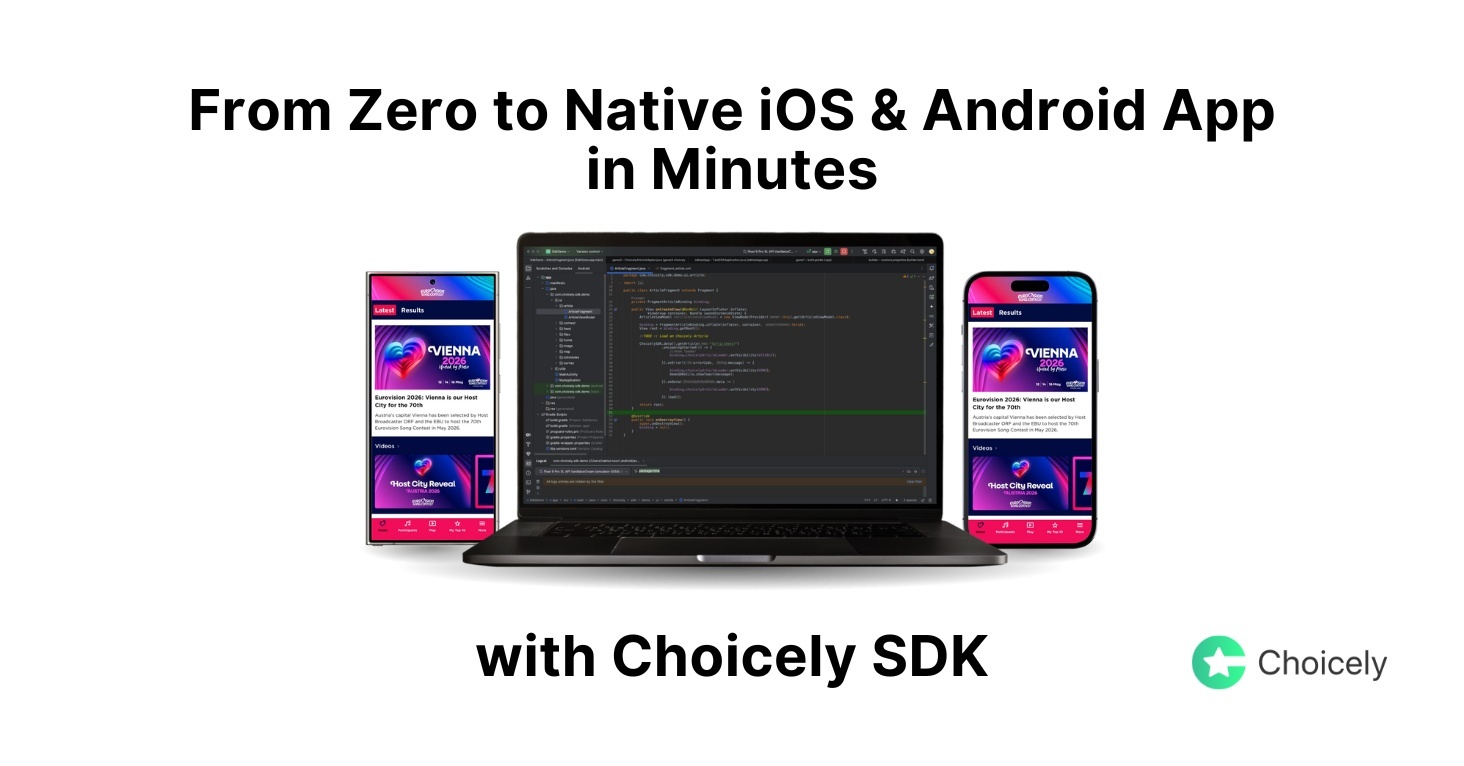
Building or extending mobile apps doesn’t have to be complicated. With the Choicely Mobile App SDK, you can...