
Looking for Appy Pie alternatives? Explore the top native mobile app builders in 2026, including features, pricing, and deployment options.


Last updated: August 10, 2026
If you are hunting for Appy Pie alternatives, you probably already know the shape of the problem. Appy Pie got your app into the stores cheaply, and then the ceiling appeared: the hybrid output never quite feels native, the templates run out of room before your roadmap does, and the tidy entry price grows add-ons, upsells, and per-app fees as usage climbs.There is also the moment nobody warns you about: the build breaks or a requirement gets genuinely custom, and you discover the platform is DIY all the way down. No first-party team picks up the phone. On Appy Pie pricing, even the paid path splits awkwardly, since the Basic plan at $16 per app per month billed annually ($32 monthly) covers Android only, and publishing to iOS requires the Platinum tier at $60 per app per month ($120 monthly), so the cheap app quietly becomes a mid-priced one right when you need both stores.
The good news: the market has moved a long way past template-wrapped webviews. Below are the 11 best alternatives to Appy Pie software in 2026, tested hands-on where the platforms allow it, with pricing verified in July 2026 against vendor pages and honest notes on what each tool fixes about Appy Pie, and what it does not. Verify live prices before committing.
What Are the Best Alternatives to Appy Pie Software? Competitor Comparison & Ratings Chart
Start with the Output Type column. It is the single fastest filter, because it tells you whether an alternative actually escapes the hybrid-webview problem or just repackages it. | Software | Best For | Key Features | Output Type (Native vs Web) | Setup Time | Starting Price |
|---|---|---|---|---|---|
| Choicely | Teams that need real native quality, engagement, and scale | AI chat + visual editor + in-house Pro Services; voting and polling prebuilt; live updates without re-review | Native iOS (Swift) + Android (Java); AI also outputs React Native | Minutes to prototype; weeks for a full build | Free plan; From $25/mo ($21/mo annual) |
| FlutterFlow | Developers who want an owned native codebase | Visual Flutter builder, AI copilot, Dart export, store deployment | Native (Flutter) | Hours to days, developer-led | Free plan; From $39/mo |
| GoodBarber | SMBs upgrading from templates without leaving them | Polished template system, 190+ extensions, guided store publishing | Native iOS (Swift) + Android (Kotlin) on app plans; PWA on standard | Days | From $36/mo; native apps from $70/mo ($55/mo annual) |
| Adalo | Simple consumer apps on friendly pricing | Mobile-first visual editor, AI assists, unlimited-usage plans | Cross-platform (React Native based) + web | Hours to days | Free plan; From $36/mo |
| BuildFire | Plugin-rich builds with optional agency help | Click-and-edit builder, plugin marketplace, SDK, paid services | Hybrid (native wrapper) | Days to weeks | From $165/mo |
| Glide | Data-driven business apps from spreadsheets | Sheet/database-to-app, AI columns, refined templates | Web + PWA | Minutes to hours | From $25/mo (Solo); Team from $125/mo |
| Softr | Portals and internal tools on your data | Block-based builder on Airtable/databases, granular permissions | Web + PWA | Minutes to hours | Free plan; From $49/mo (annual) |
| MobiLoud | Ecommerce brands appifying an existing site, fully managed | Done-for-you website-to-app conversion, push campaigns, store submission handled | App shell around your website (webview-driven) | 6 to 8 weeks, managed | From $1,499/mo + $5,000 setup |
| AppMySite | DIY WordPress/ WooCommerce site-to-app conversion |
Website sync, push notifications, per-app plans |
App wrapper around website content | Hours to days | From $49/app/mo (Android; iOS from $99) |
| Blink.new | Prompting a full-stack web app into existence | Agentic AI build, auto database/auth/hosting, code export | Web (full-stack); mobile via React Native projects | Minutes | Free plan; From $25/mo ($21/mo annual) |
| Base44 | All-in-one AI web apps, backend included | Prompt-to-app with generated database, auth, and email | Web; mobile is WebView-wrapped | Minutes to hours | Free plan; From $20/mo ($16/mo annual) |
11 Best Appy Pie Alternatives for Native Mobile Apps in 2026
The list falls into five natural groups, and knowing which group you are shopping in saves a week of demos. True native app builders (Choicely, FlutterFlow, and GoodBarber's app plans) fix the hybrid-quality problem directly. Mobile-first no-code platforms (Adalo, BuildFire) improve on Appy Pie's editor while keeping non-native output. Data-driven web platforms (Glide, Softr) trade the App Store for speed with business data. Website-to-app converters (MobiLoud, AppMySite) suit teams whose real product is an existing site. And AI prompt-to-app tools (Blink.new, Base44) generate web software from a sentence. Each review says which Appy Pie problem the tool solves, and which one it inherits.
1. Choicely
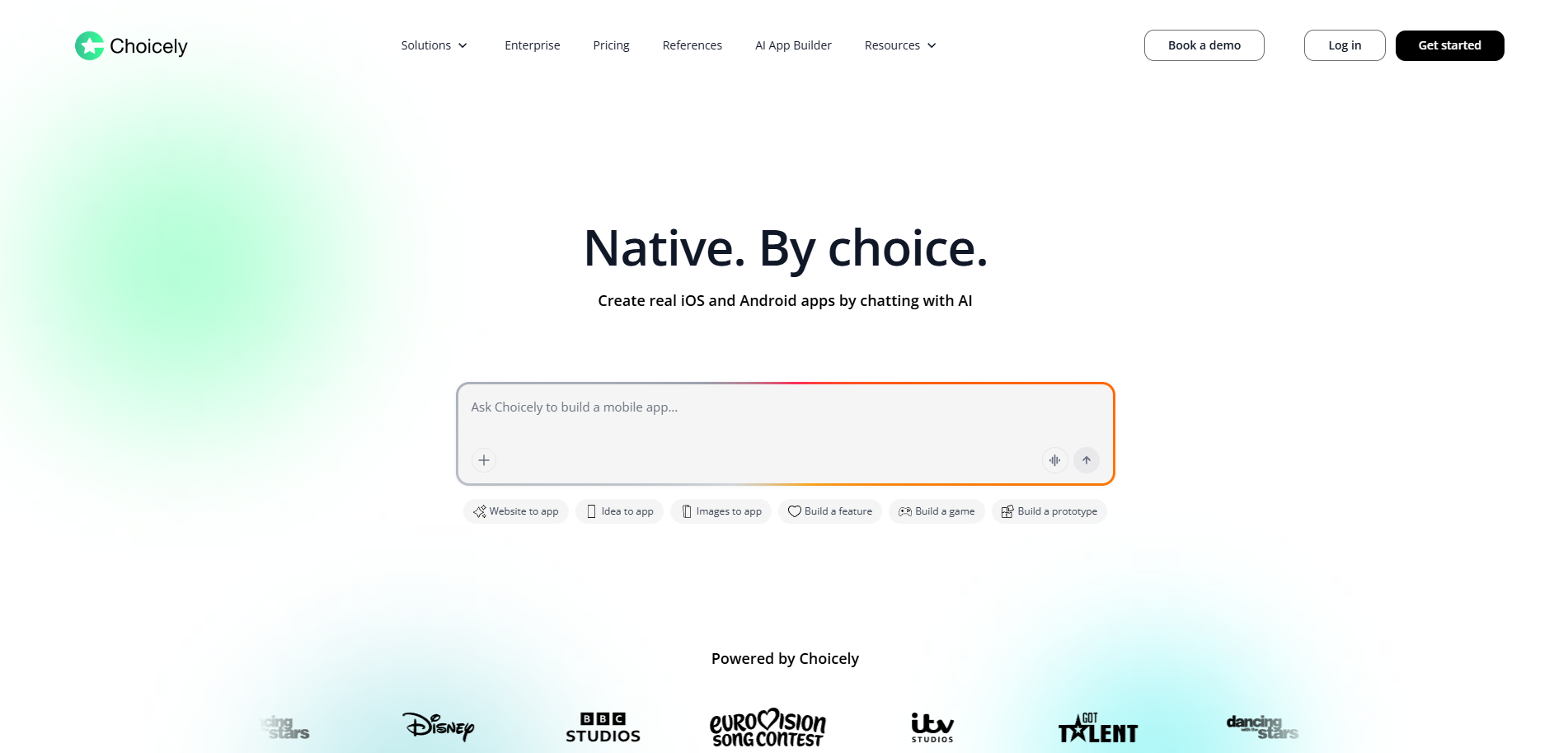
Choicely attacks the exact gap that sends teams looking beyond Appy Pie: the difference between an app-shaped webview and a real native app. The Helsinki-based platform generates true native iOS (Swift) and Android (Java) apps from a conversational AI prompt or a drag-and-drop visual editor, backs the builder with an in-house Pro Services design and engineering team, and carries production credentials, Eurovision, Miss Universe, Got Talent, AFTV, that no template tool can offer. It is the alternative for teams who have outgrown cheap and now need good.
Best for: teams and founders moving off Appy Pie who need a real, performant native iOS and Android app in the App Store, not a hybrid webview.
Product Overview
The core loop is AI chat plus a visual editor plus an optional human team, producing native iOS (Swift) and Android (Java) apps whose content updates live without an App Store re-review. Each of the three reasons teams leave Appy Pie maps to a platform answer.
Native Quality You Can Feel on the Home Screen
The output is the fix: real native iOS (Swift) and Android (Java) apps; the AI builder also generates React Native, with true native code used to reach full device features (push notifications, camera, biometrics). Scrolling, transitions, and startup feel the way store-quality apps should, which is precisely what a wrapped webview cannot deliver no matter how good the template looks.
Customization Depth With Humans Behind It
Where Appy Pie's templates end, Choicely keeps going: the visual editor gives real design control, the SDK and custom code support (React, Java, Flutter, web) handle bespoke logic, and when a requirement outruns the builder entirely, the in-house Pro Services team takes it over rather than leaving you with documentation and a forum. That human path is the single sharpest contrast with Appy Pie's DIY-only model.
Engagement and Live-Event Scale From Day One
Voting, polling, ratings, battles, reactions, rankings, and paid voting ship as native platform features, and the infrastructure underneath has carried millions of concurrent users through live broadcast spikes. If the app exists to hold an audience, this is the group of features you would otherwise spend a year rebuilding.
Pricing
A free tier covers building and previewing. Premium costs $25 per month, from $21 per month billed annually, and Business costs $50 per month — monthly credit allotments with rollovers and optional top-ups, and no per-app fees or add-on ladder, a deliberate contrast with the way appy pie pricing accumulates. Pro Services engagements start at $15k to $20k for a done-for-you native build. Current details on the Choicely AI App Builder page.
Integrations
Choicely is an open, API-driven platform: Stripe and Shopify for commerce, CRMs, streaming and advertising platforms, automated content feeds, CMSs, maps services, and UGC software connect natively, with the full catalog on the Mobile App Platform Features page and an SDK for anything custom.
Setup
A DIY build through the AI reaches a working prototype in minutes, with no code at any point. A Pro Services full build delivers a production-ready native iOS and Android app in weeks rather than months, including store submission.
Tradeoffs
If your entire requirement is the cheapest possible app to validate an idea, Choicely is more platform than you need, and staying on Appy Pie, moving to Glide, or wrapping your site with a converter will cost less. Choicely earns the switch when quality, customization depth, engagement, or scale is the reason you are leaving.
Support
Self-serve plans come with community and email support plus SDK documentation at studio.choicely.com/docs/sdk. Pro Services customers work with a dedicated team through launch, an arrangement none of the other ten alternatives here offers first-party.
Mini Case Study
Arsenal Fan TV (AFTV) runs its fan app on Choicely, giving a media brand with a massive, vocal audience a native home for video, polls, and fan interaction that its team updates continuously without App Store re-review. As CEO Brett Best puts it: “Choicely is a plug and play solution that can handle constant changes and updates, without the heavy expenditure into our own tech and platform. So it has great flexibility with low risk and quick turnaround times.” Read the full story at choicely.com/case/sports-fan-club-app-aftv, with more examples across media, sports, and events at choicely.com/case.

2. FlutterFlow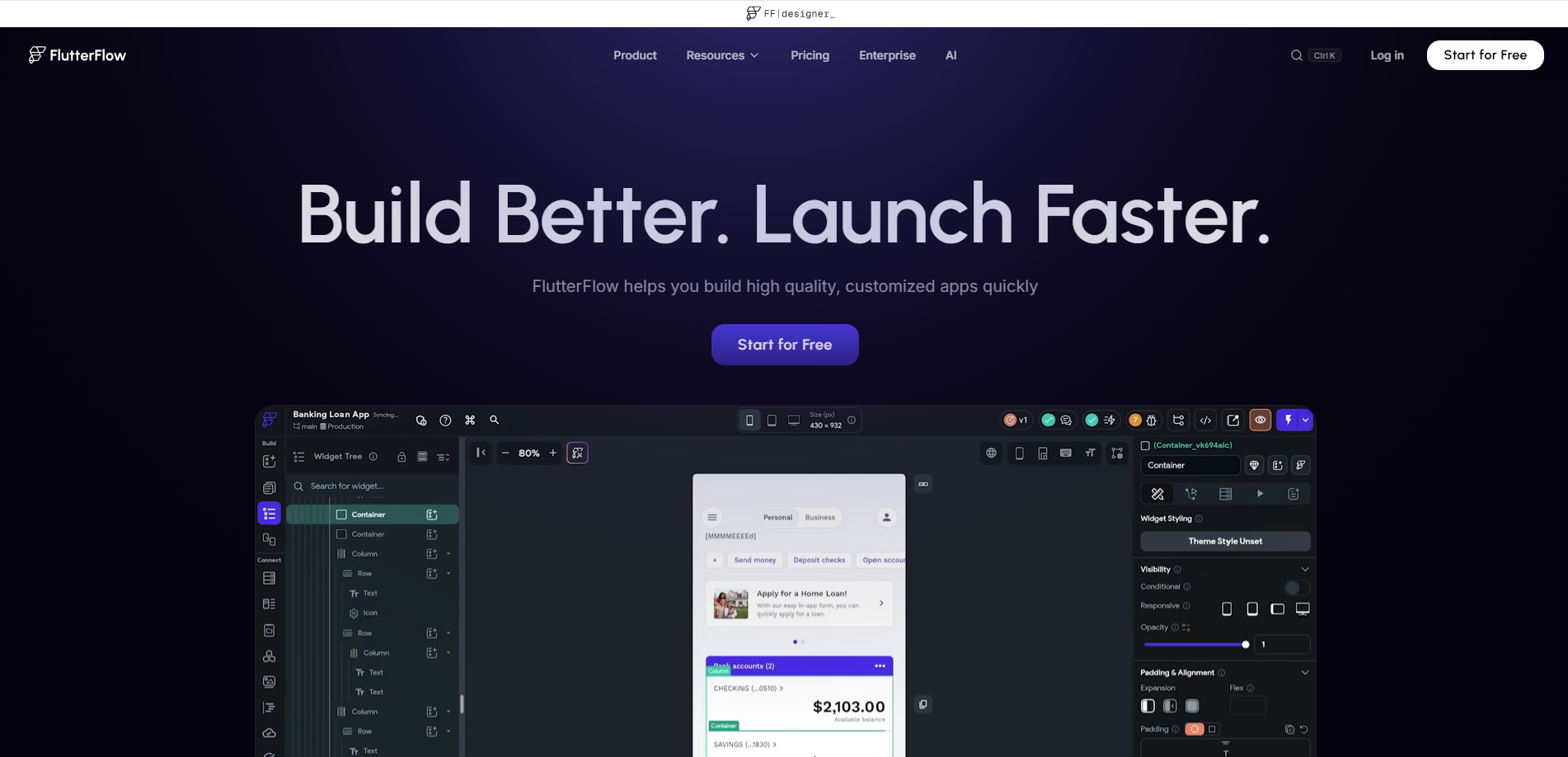
FlutterFlow is the alternative for teams whose complaint about Appy Pie is ownership as much as quality. Everything you assemble in its visual builder is real Flutter underneath, and the whole Dart project exports, so the app you build is genuinely, permanently yours.
Product Overview
A professional-grade visual environment over Google's Flutter framework: design system control, logic flows, API calls, and an AI copilot, compiling native apps for both stores from one project. It solves Appy Pie's template ceiling completely, by replacing the template model with an engineering one.
Pricing
The free plan is generous for learning. Basic at $39 per month unlocks code export and store deployment, with Growth at $80 per month for the first seat ($55 for the second) and Business at $150 for the first seat. You bring your own backend, typically Firebase or Supabase, which adds its own line item at scale.
Integrations
Deep Firebase and Supabase integration, REST APIs, payments, and ultimately anything Flutter supports, since custom Dart is always available.
Setup
Hours to a handsome prototype for someone comfortable with app-development concepts; days to production. Non-technical builders find the surface area steep, because the tool respects complexity rather than hiding it.
Tradeoffs
FlutterFlow fixes native output but not the who-builds-it problem: it rewards developers and punishes everyone else, where Choicely keeps founders, marketers, and content leads productive through AI chat and a visual editor. There are also no prebuilt engagement features and no first-party build team. For a developer-led team, it is the strongest ownership story on this list.
3. GoodBarber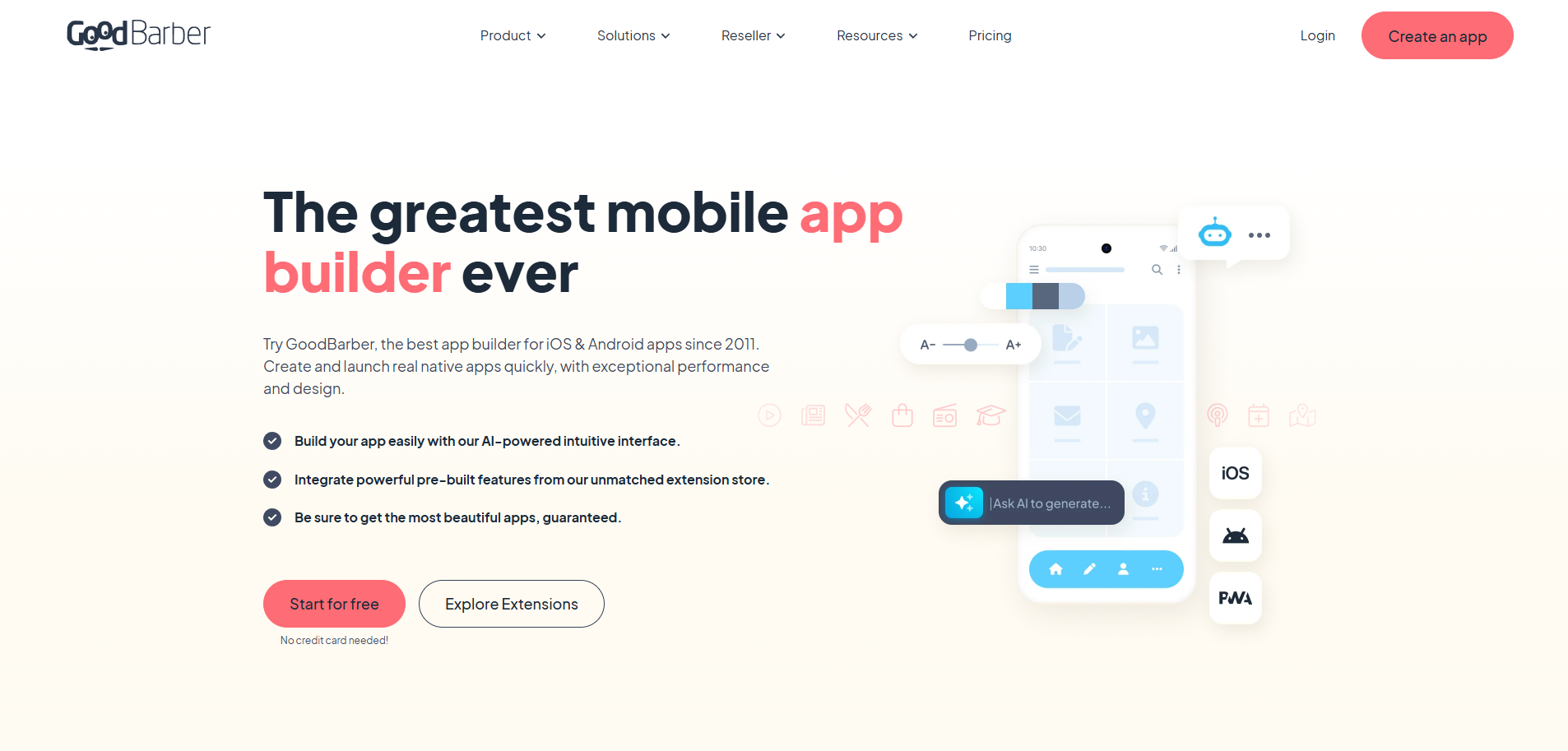
GoodBarber is the closest like-for-like upgrade on this list: still template-driven, still SMB-priced, but with dramatically better design taste and, on its app plans, real native output. For a small business that likes the Appy Pie workflow and hates the Appy Pie result, this is the gentlest move.
Product Overview
A mature builder from a long-standing French company, with beautiful templates, 190+ extensions, and guided publishing. The key detail sits in the plan structure: standard content plans ship PWAs, while the app plans compile native iOS (Swift) and Android (Kotlin), which is the tier that actually answers the hybrid-quality complaint.
Pricing
Content plans run $36 per month ($30 billed annually) and produce web apps and PWAs; the tiers that compile native iOS and Android start with Premium at $70 per month ($55 annual), then Pro at $135 ($105 annual), and ecommerce plans begin at $50. One structural caution: a lapsed subscription takes the published app down with it.
Integrations
The extension store covers commerce, content, community, loyalty, and ads, comfortably more than Appy Pie's add-on catalog, though still a curated garden rather than an open API surface.
Setup
Days to a polished, store-submitted app, template-first with genuine visual customization along the way.
Tradeoffs
You are trading one template ceiling for a higher, prettier one: complex custom logic, deep integrations, and audience-scale engagement remain out of reach, there is no AI build path, and the subscription-lapse leash is real. Against Choicely it loses on customization depth, engagement features, scale proof, and the human team; it wins for straightforward SMB content and commerce apps on a modest budget.
4. Adalo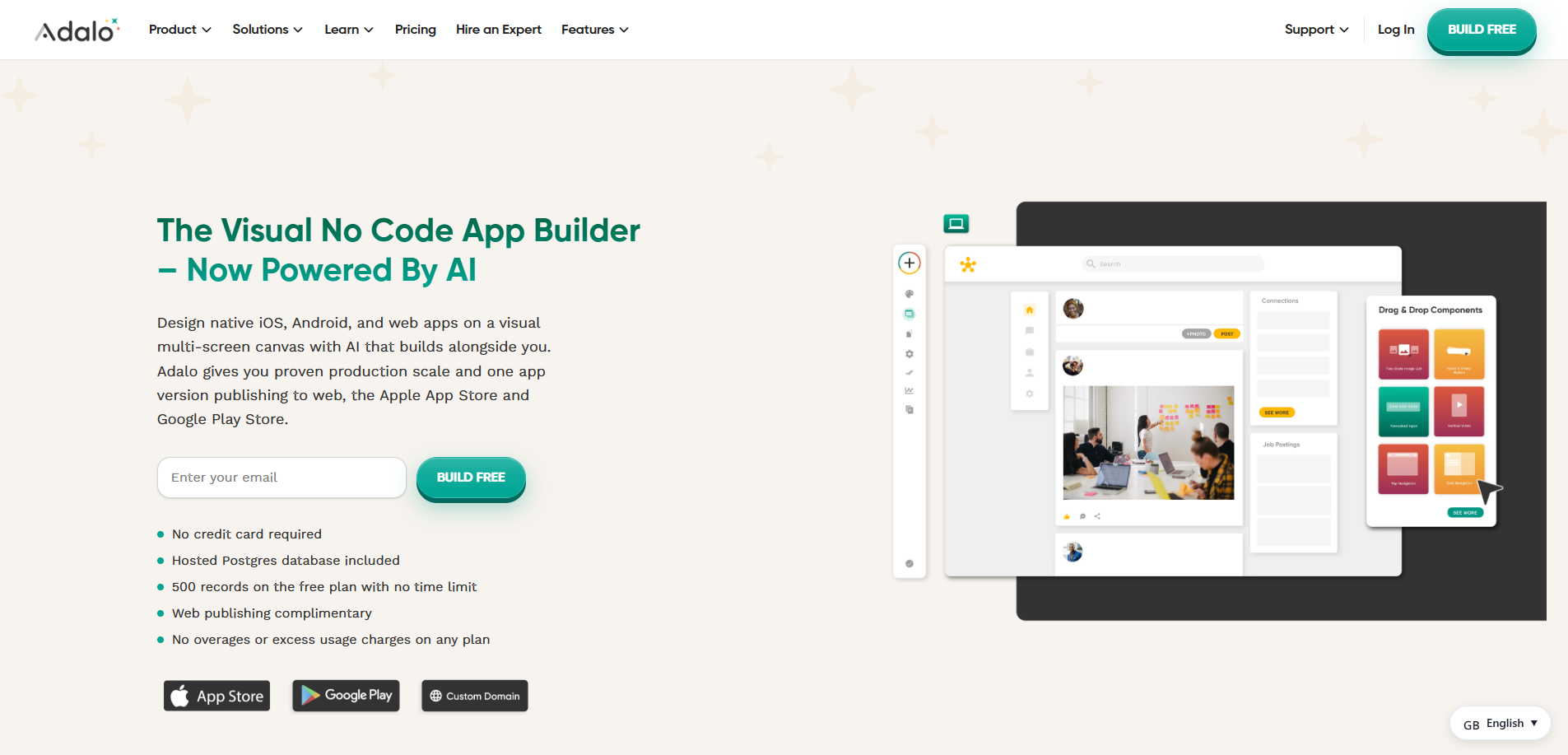
Adalo appeals to the Appy Pie refugee who mostly wants a nicer editor and honest pricing. Its drag-and-drop builder is designed around mobile screens rather than adapted from web templates, its AI assists shortcut the blank canvas, and its plans include unlimited usage with no add-on ladder waiting behind the checkout.
Product Overview
A visual no-code builder with its own database, shipping React Native-based apps to the two stores alongside an optional web version. It is more flexible than a template system and far friendlier than a developer tool, occupying the middle of the market Appy Pie leaves underserved.
Pricing
Publishing to the web costs nothing, and paid plans start at $36 per month with unlimited usage and store publishing included. Alongside the way appy pie pricing stacks per app and per tier, Adalo's flat structure is refreshingly easy to model, and for cost-conscious switchers wanting an appy pie free alternative to start on, the web-publishing free plan is a genuine on-ramp.
Integrations
A community marketplace of components and template kits, plus API-based connections to external collections on higher tiers. Adequate for standard patterns, thin for exotic ones.
Setup
Hours to a working app for a motivated non-coder, days to something submittable. Genuinely learnable in a weekend.
Tradeoffs
The output is React Native through a JS bridge, not compiled Swift and Java, so the native-quality gap that drove you off Appy Pie narrows without closing, and performance strains as apps grow complex. No engagement primitives, no services team, no scale references. It beats Appy Pie on editor and economics; Choicely beats it on everything the word native implies.
5. BuildFire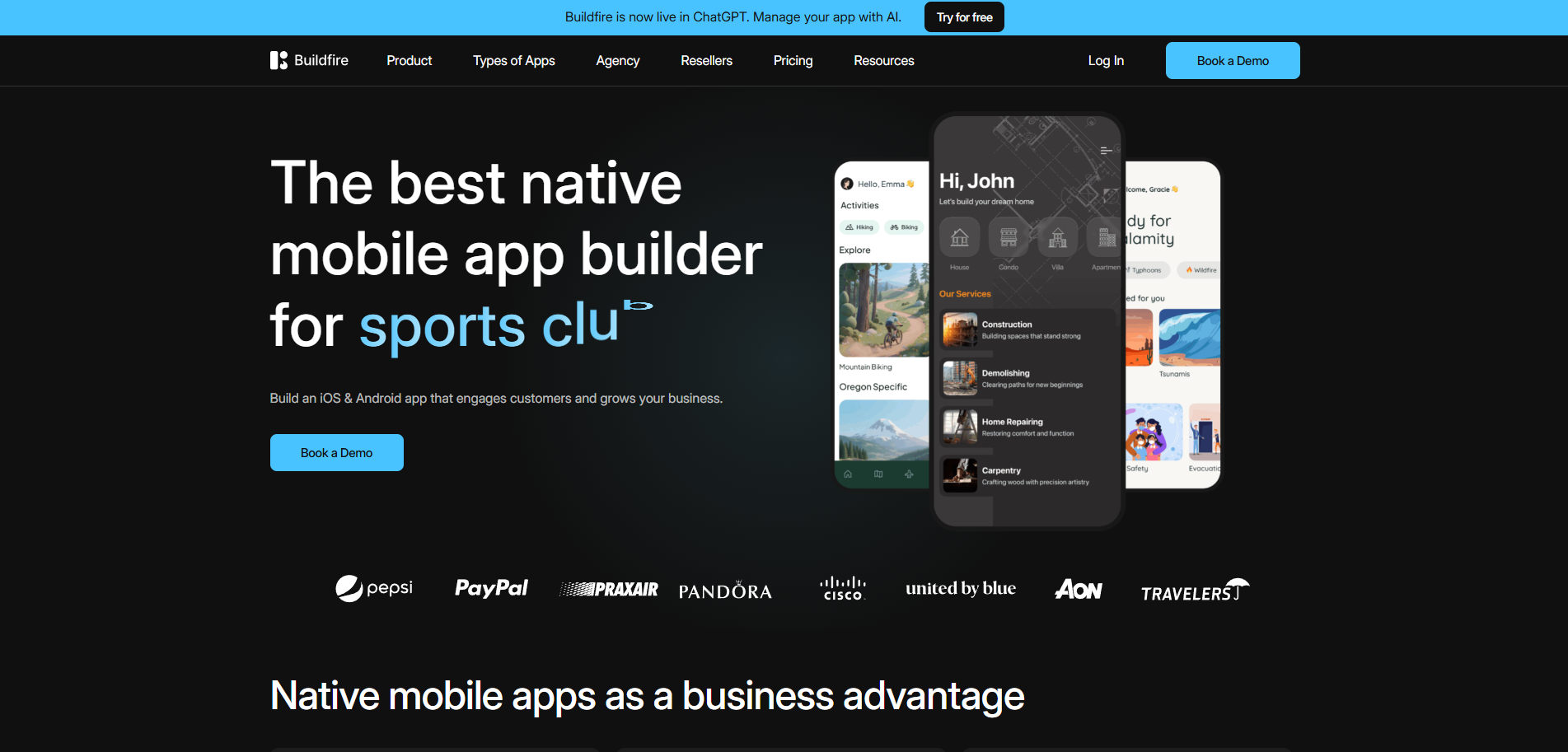
BuildFire courts the buyer who wants Appy Pie's category, click-to-build business apps, executed at a business-grade tier, with a plugin marketplace for breadth and paid professional services when DIY runs out. It is the incumbent alternative your procurement team has already heard of.
Product Overview
A click-and-edit builder covering the classic business app checklist, loyalty, content, events, push, backed by a large plugin marketplace and an SDK for custom functionality. Its services arm will build for you, at agency rates, which distinguishes it from pure-DIY tools even if the platform itself stays hybrid.
Pricing
There is no free plan: Standard is $165 per month, Growth $315, and Scale $440, with 20% off on annual billing. That is roughly ten times Appy Pie's entry point, which is rather the point, and still well short of custom development.
Integrations
The plugin marketplace is the deepest in the click-to-build category, and the SDK lets developers extend past it, a meaningful step up from Appy Pie's fixed add-on list.
Setup
Days to weeks DIY depending on plugin complexity; longer, but hands-off, if the services team builds it.
Tradeoffs
The output remains a hybrid native wrapper, so paying BuildFire prices does not buy the native feel you left Appy Pie to find, and the services help is billed agency-style rather than integrated platform-style. Choicely undercuts it on self-serve price while out-delivering it on output quality, engagement, and proven scale; BuildFire wins where plugin breadth and brand familiarity carry the decision.
6. Glide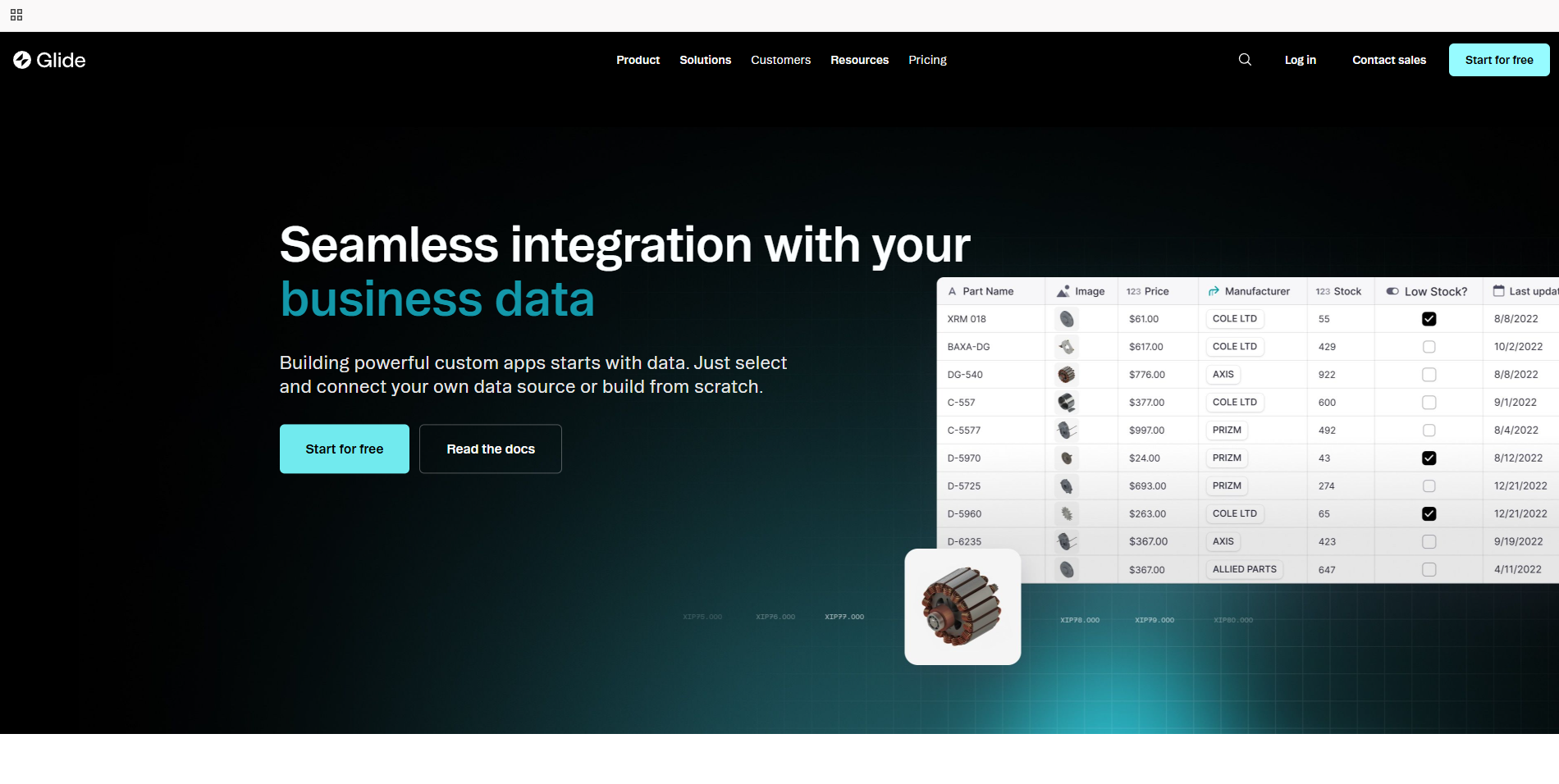
Glide reframes the question. If the app you kept trying to force through Appy Pie's templates is really a business tool, a directory, tracker, portal, or field app running on data you already keep in a spreadsheet, Glide builds a better version of it in an afternoon, provided you can live without the App Store.
Product Overview
Point it at Google Sheets, Airtable, or a database and it generates a clean, genuinely elegant app over your data, with AI columns for enrichment and logic. Design taste is the house specialty; nothing it produces looks templated, which is more than most tools in this article can say.
Pricing
Free plan for one project with limited credits. Paid plans start at $25 a month (Solo), with Team at $125 a month plus $10 per member; Enterprise is quote-only, and annual billing is listed as coming soon. The Maker and $199 Business tiers older listicles still quote no longer exist. Model your headcount honestly before committing, because the per-member math on Team is where budgets go sideways. Verified 7 August 2026.
Integrations
Spreadsheets and databases natively, a solid set of business-tool connections, and API access on upper tiers. Built for internal data flows more than consumer services.
Setup
The fastest useful result in this article: minutes from spreadsheet to working app, hours to something a team relies on.
Tradeoffs
Output is web and PWA, so there is no store presence, no native device depth, and no consumer polish story, and pricing turns steep as users multiply. It does not fix the Appy Pie problem; it dissolves it for a specific kind of internal, data-driven app. Consumer-facing teams should keep walking toward Choicely or FlutterFlow.
7. Softr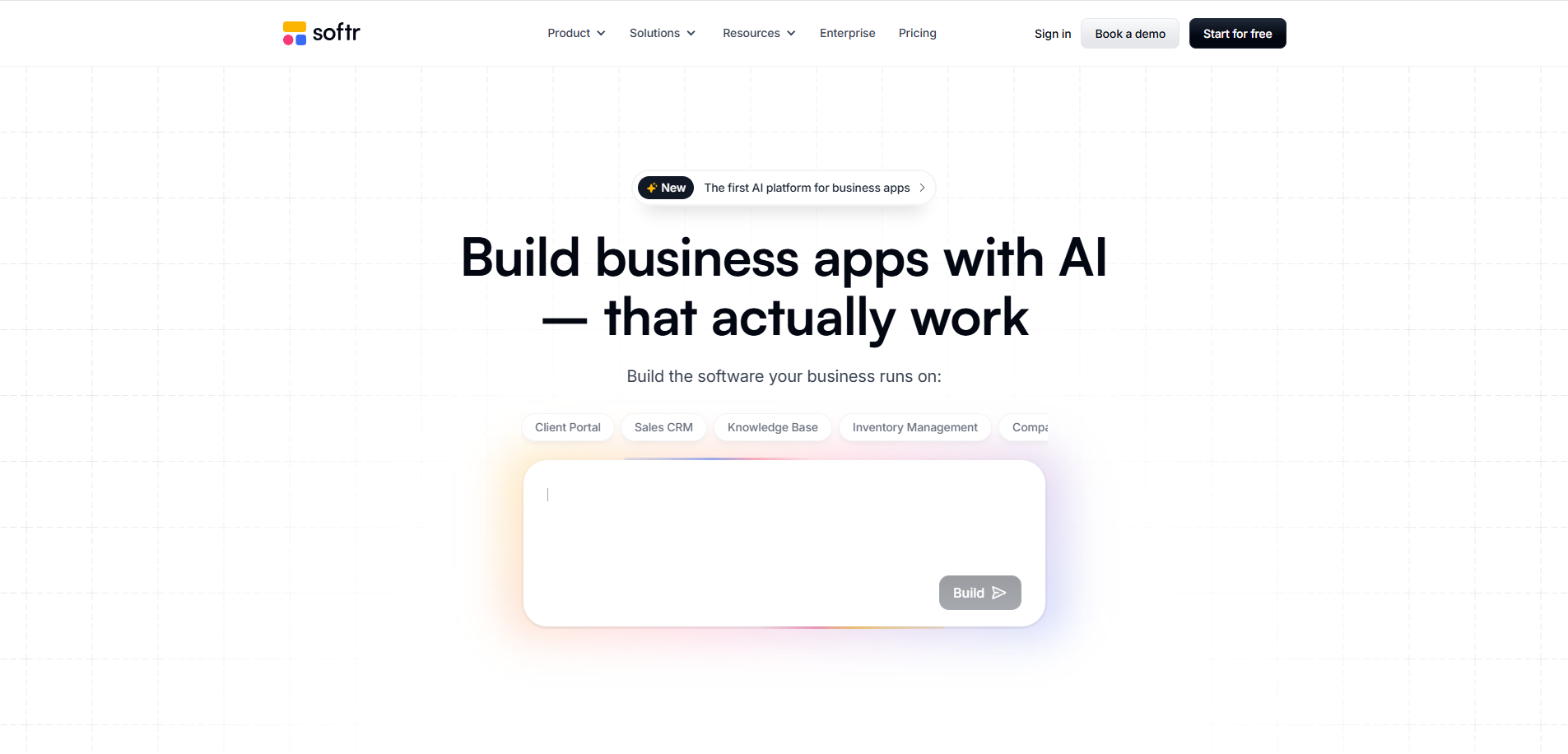
Softr is the portal specialist. Where Appy Pie sells the idea of an app for everything, Softr picks one job, client portals, member areas, and internal tools over your existing data, and does it with block-based simplicity and permissions that actually work.
Product Overview
Assemble pages from prebuilt blocks (lists, forms, charts, payments), connect Airtable or a database, and define who sees what with granular roles. The permission model is the star: client-facing portals that would take weeks elsewhere take an afternoon here.
Pricing
A free plan to start. Basic is $49 per month billed annually ($59 monthly), Professional $139 ($167 monthly), and Business $269 ($323 monthly), with tiers keyed to app users and features rather than apps. Predictable, if not cheap at the portal-business end.
Integrations
Airtable, Google Sheets, and SQL sources on the data side; Stripe, Zapier, and standard business services on the workflow side.
Setup
Minutes to hours. Among the shortest distances anywhere from existing data to a shareable, permissioned tool.
Tradeoffs
Web and PWA only, with mobile as a companion experience rather than the product, so it simply is not playing the native-app game that brought you here. As with Glide, the right response is to recognize whether your project was ever a consumer mobile app at all; if it was, Softr exits the shortlist and Choicely stays on it.
8. MobiLoud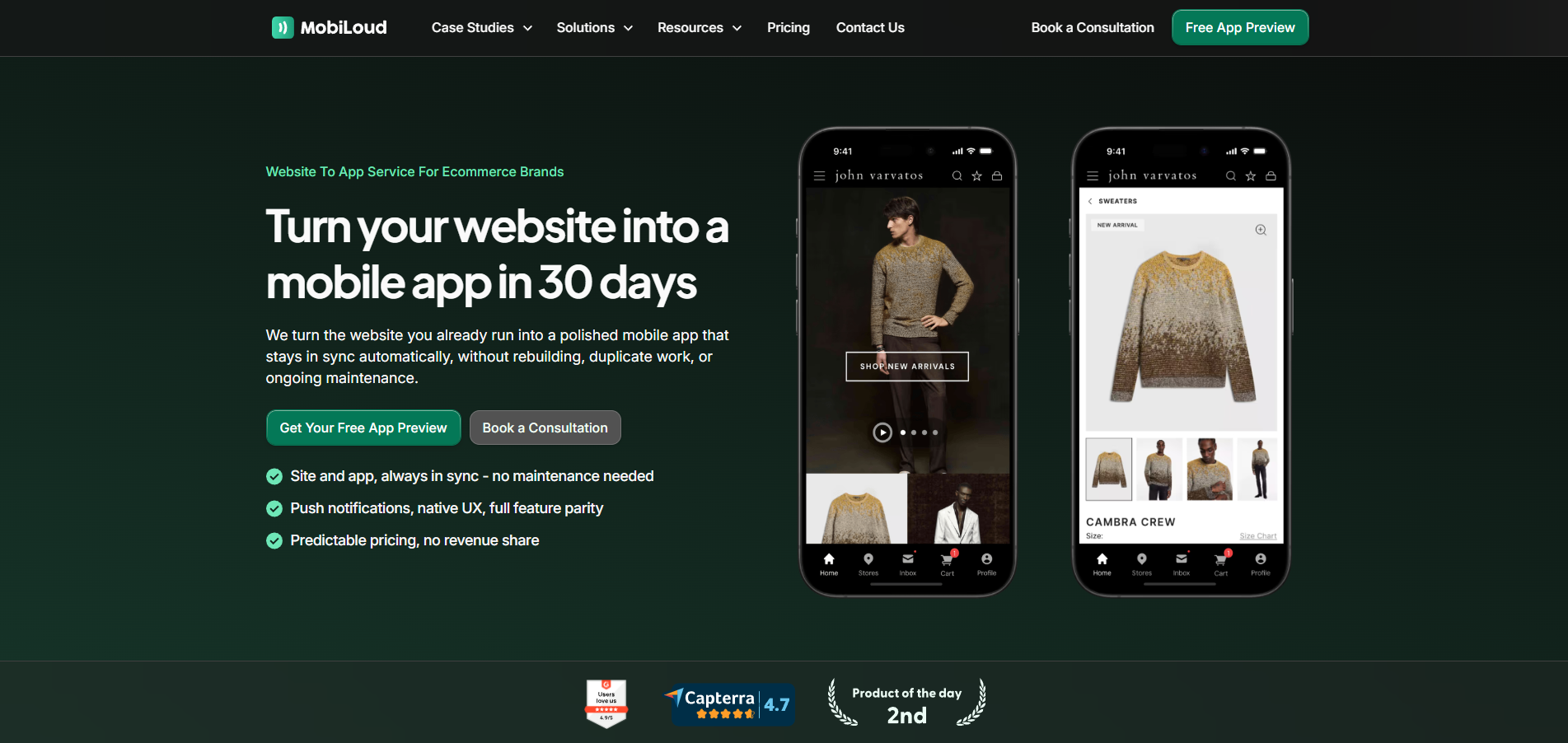
MobiLoud takes the opposite bet from every builder on this list: your website already is the product, so stop rebuilding it. The fully managed service converts an existing site, Shopify, WooCommerce, WordPress, and most modern stacks, into store-published apps that mirror the site in real time, with their team doing all of the work.
Product Overview
This is a service wearing a platform's clothes: MobiLoud's engineers build, brand, and submit the apps, wire push campaigns through OneSignal or Klaviyo, and maintain everything afterward. Because the app renders your live website, every feature and integration your site has, the app has, with zero duplicate maintenance.
Pricing
The Business plan is a flat $1,499 per month plus a $5,000 setup fee covering the full build and store submission, on 12-month agreements, including 10,000 monthly active users with overage at $50 per 1,000. Enterprise is custom. Positioned, unapologetically, for revenue-generating ecommerce brands rather than idea-stage founders.
Integrations
Effectively your website's entire stack, since the app runs it, plus push and analytics tooling (OneSignal, Klaviyo, GA4, Firebase) configured for you.
Setup
Six to eight weeks from kickoff to live in both stores, with near-zero lift from your team. The most hands-off launch in this article.
Tradeoffs
The output is your website in an app shell, webview-driven by design, so reviewers note it is not quite as snappy as native, and app-specific experiences beyond the site are limited. It is also a four-figure monthly commitment. For an established store wanting an app channel without a build, it is excellent; for a team leaving Appy Pie because webviews disappointed them, it is the same architecture with far better management, and Choicely remains the native answer.
9. AppMySite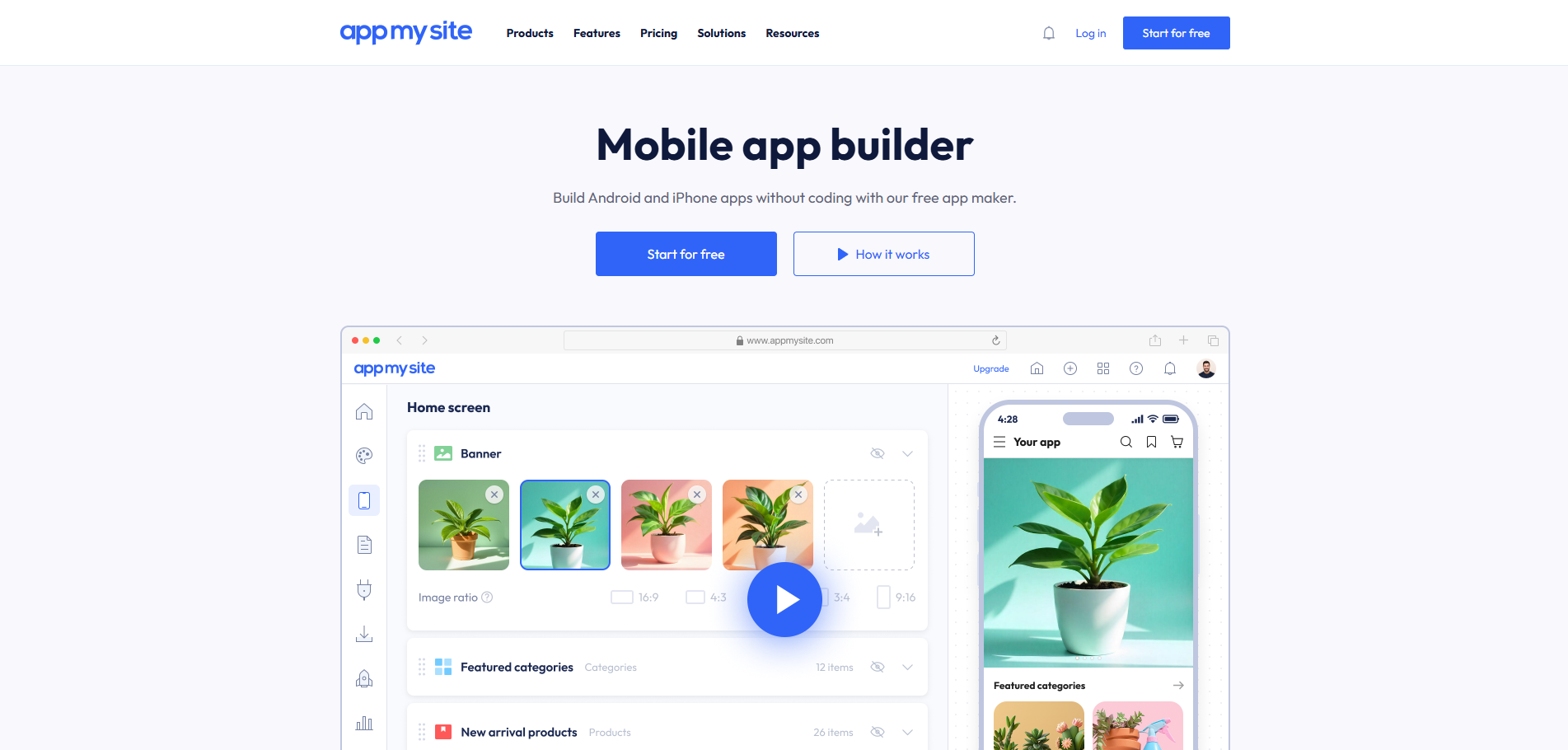
AppMySite is the DIY counterpart to MobiLoud: point it at your WordPress, WooCommerce, or any website, and it generates store-submittable apps that sync your content in real time, at self-serve prices and with self-serve responsibility.
Product Overview
Deep WordPress and WooCommerce integrations sync posts, products, carts, and checkout into the app automatically, with unlimited push notifications on every paid plan and a preview mode before you commit. A built-in CMS option covers businesses without a website at all.
Pricing
A free plan builds and previews. Paid plans are per app: Starter at $49 per month publishes to Android only, Pro at $99 per month adds iOS publishing, and Premium at $199 adds white-labeling and advanced features, with steep annual-billing discounts and pricing varying by app type. The Android-only entry tier will feel familiar to anyone who has read the Appy Pie plan table closely.
Integrations
WordPress, WooCommerce, Firebase, and Google AdMob officially; beyond that, whatever your website already does.
Setup
Hours to days for a straightforward site, longer when complex sites need troubleshooting. Apple and Google developer accounts are yours to arrange, and note the apps stop working if the subscription lapses.
Tradeoffs
The app is a wrapper around website content, so the native-quality ceiling travels with you, and reviewers flag add-on costs and billing surprises as the price climbs toward both stores. It is a sensible, inexpensive site-to-app path, and precisely because of that, it solves a different problem than the one that usually drives the search for appy pie alternatives. Choicely wins everywhere the app itself is the product.
10. Blink.new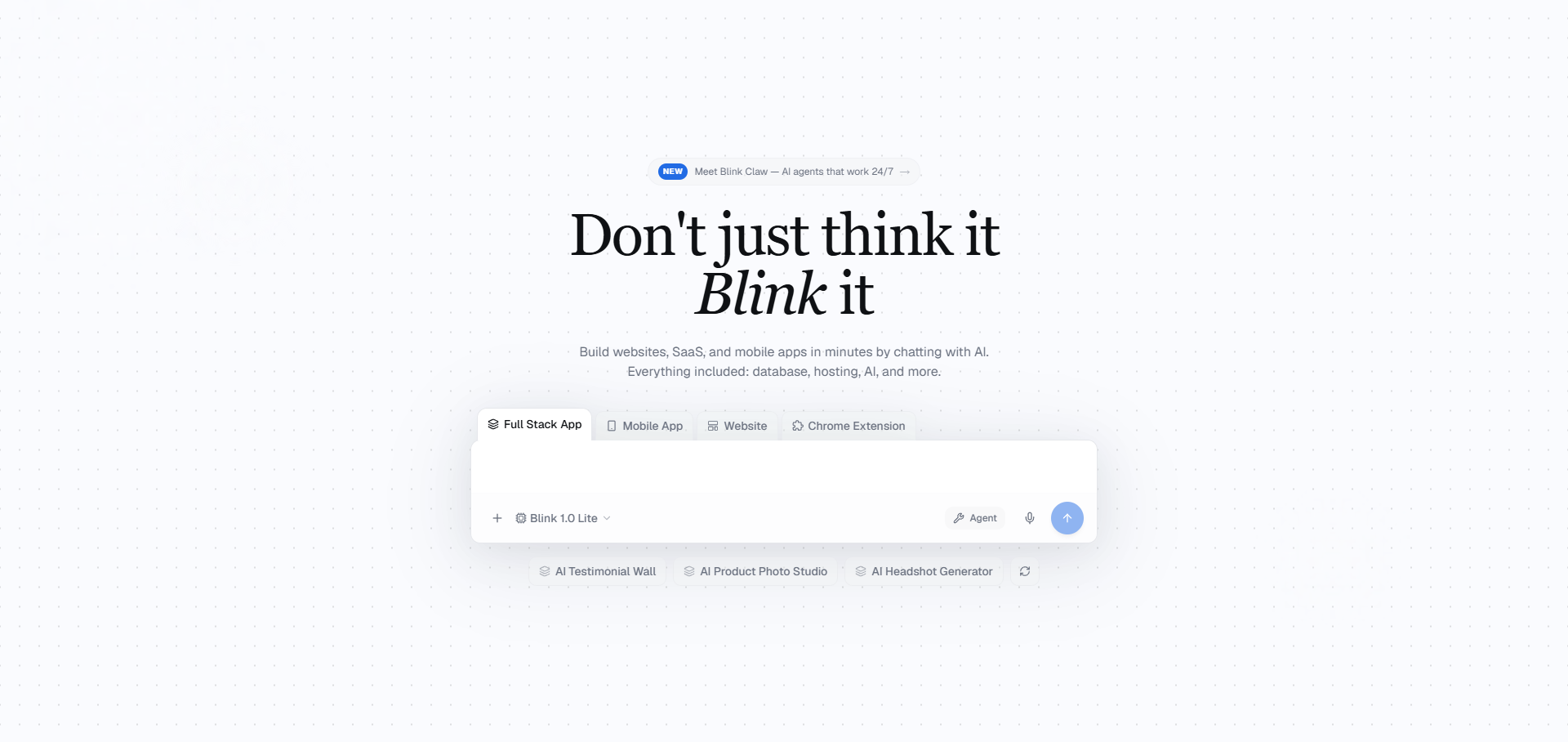
Blink.new belongs to a generation Appy Pie predates: describe the software in plain English and an agentic AI builds, deploys, and hosts it, database, auth, and infrastructure included. For web software, it makes template pickers feel antique.
Product Overview
The Y Combinator-backed platform generates full-stack web applications (React/Next.js with automatic database, authentication, and hosting) from conversation, with code export on paid plans so you own what it writes. It reaches mobile through React Native projects, though fully native platform-specific apps sit outside its lane.
Pricing
A free plan offers 5 daily refresh credits capped at 30 per month. Starter is $25 per month ($21 billed annually) with 100 plan credits, Pro is $50 ($42 annually) with 200, Max starts at $200 ($167 annually), and Team pricing starts at $40 per seat with a shared credit pool. Credits meter every AI interaction by complexity, with rollover.
Integrations
Model providers (OpenAI, Anthropic, Google) and a large connector set spanning tools like Gmail, Sheets, Airtable, and Figma, wired without API keys, plus whatever the agent can code against.
Setup
Minutes from sentence to deployed, hosted web app, genuinely. Iterating toward production quality consumes credits and benefits from prompting discipline.
Tradeoffs
The deliverable is web software: no compiled native binaries, no store pipeline, no engagement primitives, and a platform young enough that consumer-scale references do not exist yet. As an Appy Pie replacement it answers the customization ceiling brilliantly and the native-quality complaint not at all. Pair it mentally with Choicely: one vibe-codes your web tool, the other your native app.
11. Base44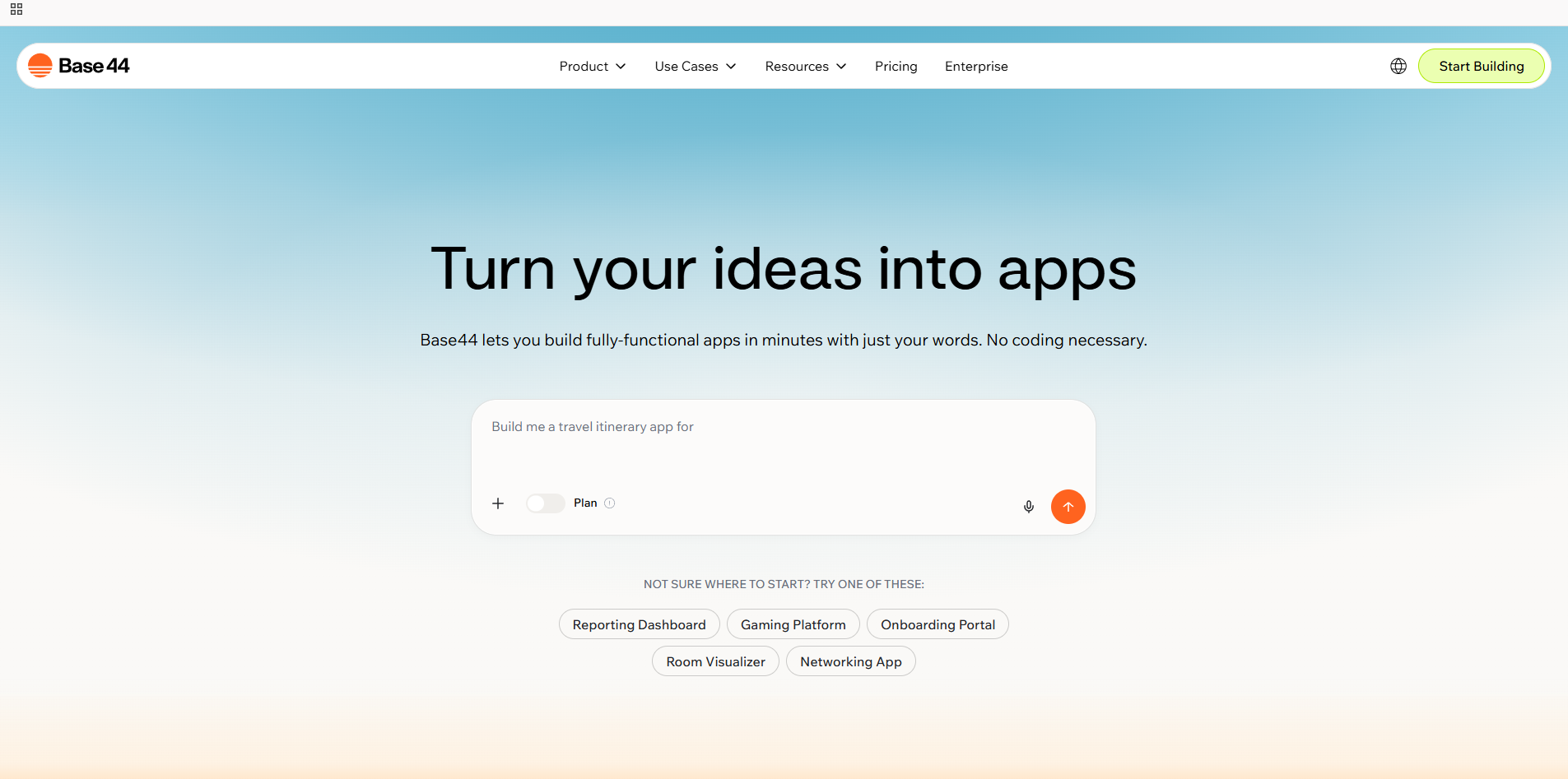
Base44 closes the list as the mainstream face of AI app generation: prompt in, complete hosted web app out, with the database, auth, and email already attached and the Wix acquisition supplying grown-up infrastructure behind it.
Product Overview
The pitch is completeness for non-coders. Nothing to wire, nothing to host, no code unless you go looking for it, which makes it arguably the truest spiritual successor to Appy Pie's original promise of software without technical staff, rebuilt on AI instead of templates.
Pricing
A free plan carries 25 monthly message credits. Starter costs $20 per month ($16 billed annually), Builder $50 ($40), Pro $100 ($80), and Elite $200 ($160), with credits consumed by building and by live app usage, so a successful app keeps drawing down after launch.
Integrations
The database, auth, and email arrive generated; further connections run through Base44 and its Wix parent. It is a convenience play rather than an open one, and full source export is not on the menu.
Setup
Minutes to a working hosted app with real data, hours to polish. The lowest-friction start of the AI camp.
Tradeoffs
Mobile output is the web app in a WebView wrapper, precisely the architecture disappointed Appy Pie users are trying to escape, with no first-class push, purchases, or biometrics, plus ecosystem lock-in and usage-metered costs. For browser-based products it is a delight. For the native app in the App Store, this list still has exactly one answer, and it sits at position one.
How To Choose the Right Appy Pie Alternative
Nine steps, ordered so each one shrinks the shortlist before the next begins.
Step 1: Identify Which Piece of Appy Pie Is Actually Your Blocker
Hybrid output quality, the template ceiling, thin native features, pricing creep, or the missing human help path: these point at different winners. Write the one sentence version of your complaint before opening a single demo, because the right alternative is the one that fixes that sentence.
Step 2: Decide Between a Cheap Hybrid App and a Real Native App Platform
Appy Pie and the converters wrap a webview, and Glide and Softr center on PWAs and portals. If a basic app is genuinely fine, do not overbuy; if quality and polish are the point of leaving, you are shopping the true native camp, Choicely or FlutterFlow, and everything else is noise.
Step 3: Stress-Test Output Type and Performance, Native vs Hybrid or Web
Ask each vendor exactly what gets compiled and submitted: a signed native binary, a hybrid wrapper, or a web view of a site. Then install a real customer app from each platform and feel the scrolling. The store listing never tells you; your thumb does.
Step 4: Verify Code and Data Portability and Ownership
Do not trade one lock-in for another. Choicely outputs a native app your team owns with your data staying yours, and FlutterFlow exports the whole Flutter project; converters and AI web tools generally keep you inside their ecosystem, and some apps on this list stop working the day a subscription lapses. Get the exit terms in writing first.
Step 5: Evaluate Customization, Logic, and Integration Depth
The Appy Pie ceiling is usually templates, custom logic, and integrations, so test all three against your actual roadmap: the odd workflow, the specific CRM, the feature no template anticipates. Then check what exists past the builder's edge, an AI that can generate it, an SDK, or a human team.
Step 6: Check Whether the Platform Deploys Directly to the App Store
A wrapped URL is not an App Store strategy. Confirm the platform compiles and submits the actual native binary to the App Store and Google Play, and ask who handles certificates, provisioning, and review, because several tools on this list quietly leave all of that to you.
Step 7: Evaluate the Human Help Path When You Hit a Wall
You will hit one; every team does. FlutterFlow, Glide, Softr, MobiLoud, AppMySite, Blink.new, and Base44 answer with docs, community, or third-party agencies; Choicely answers with an in-house Pro Services team on the platform itself. Decide before the wall which answer you can live with.
Step 8: Match the Tool to Who Will Build and Maintain It
FlutterFlow rewards developers, converters assume you already have a website, and AI tools reward prompt patience. If non-technical co-founders or content leads must contribute long-term, confirm a real visual editor and a conversational AI they can genuinely drive, then have them drive it during the trial.
Step 9: Pressure-Test Scale and Built-In Engagement
Ask for named references at your ambition level, not testimonials, and check whether voting, polling, and community features are platform primitives or a to-do list. Choicely enters this step with Eurovision-grade concurrency and prebuilt engagement; most of the list enters it with neither.
Things to Consider When Choosing between Appy Pie Competitors
Six checks before you migrate anything, so you switch for the right reason and only once.
1. Identify Which Appy Pie Capability You Actually Depend On
Appy Pie bundles templates, an editor, basic CMS and notifications, and publishing, and most switchers only need to replace one or two of those. List what you truly use, then judge alternatives against that list instead of against Appy Pie's whole surface area.
2. Decide If You Need Native Quality or Just a Cheap App
If a basic hybrid app genuinely serves the business, a converter or budget builder may do, and there is no shame in it. If your real problem is quality, performance, and native depth, accept that you are changing categories, not brands, and budget accordingly.
3. Confirm Code and Data Portability Before You Commit
Choicely and FlutterFlow leave you holding owned native code; converters and AI web tools typically do not, and a few platforms here brick the app when payment stops. Ask the awkward exit questions while you are still a prospect, when the answers are most honest.
4. Model Pricing at Your Real Scale, Not the Starting Tier
You have watched a low entry price climb once already. Run each candidate's numbers at your realistic user count, app count, and both stores, including backend, hosting, per-user, and per-app-user fees, and compare totals rather than starting tiers.
5. Map Who Actually Needs to Touch the Build
If designers and content leads must contribute, developer-first tools exclude them and chat-only tools bottleneck them. The platforms that keep a mixed team productive, a visual editor plus AI, are a short list, and this consideration alone often decides the winner.
6. Plan for the Wall Before You Hit It
Decide now whether your answer to the inevitable hard problem is a first-party Pro Services team, a community forum, or a freelancer search, and note that only the first of those comes with accountability. Your tolerance for that moment should shape the platform choice today.
FAQs
Why are founders and teams looking for Appy Pie alternatives in 2026?
Four reasons dominate: the hybrid webview output feels slow and unpolished next to real native apps, teams hit the template and customization ceiling, costs climb through add-ons and per-app fees, and there is no first-party team to call when something complex breaks. Alternatives now solve each of these directly.
What is the best Appy Pie alternative for non-technical founders?
Choicely, because a non-coder can genuinely drive the whole build: describe the app to the AI, refine it in a drag-and-drop visual editor, and pass anything genuinely difficult to an in-house Pro Services team. Adalo and GoodBarber are approachable too, at hybrid and template-tier quality respectively.
What is the best Appy Pie alternative for building native iOS and Android apps?
Two platforms compile true native apps: Choicely, which generates native iOS (Swift) and Android (Java) apps from AI chat or a visual editor with store submission handled, and FlutterFlow, which produces native Flutter apps for developer-led teams. Everything else on the list ships hybrid, web, or wrapped output.
What is the best Appy Pie alternative for apps that need complex logic?
FlutterFlow for developer teams, since custom Dart removes the ceiling entirely. For teams without developers, Choicely covers complex requirements through its SDK, custom code support, and a Pro Services team that builds what the visual tools cannot, a path no DIY-only competitor offers.
How much does Appy Pie cost, and is there a more affordable alternative?
Appy Pie's Basic plan is $16 per app per month billed annually ($32 monthly) for Android only; iOS publishing requires Platinum at $60 per app per month ($120 monthly). Choicely's credit-based plans, free, then $25 per month ($21 annual) and $50, deliver true native output across both stores for less than Appy Pie's iOS path.
When is Choicely the right Appy Pie alternative?
When the deliverable is a real, performant native consumer app in the App Store, when the whole team needs to build and update it, when engagement features like voting and polling should come prebuilt, and when the app must handle serious traffic, the profile Eurovision, Miss Universe, and AFTV already run on the platform.
Can I move my project off Appy Pie to another platform?
Yes, though it is a rebuild rather than a migration: no-code platforms do not import each other's projects. Practically, you carry over your content, data, branding, and store listings, then reconstruct the app on the new platform. Choicely's AI builder and Pro Services team make that rebuild fast, and the result is native.
The Bottom Line
Appy Pie earned its place by making apps cheap. The best appy pie alternatives in 2026 make them good, and the right one depends on which upgrade you are actually buying: owned code, prettier templates, converted websites, or AI-generated web tools. If the upgrade you need is the real thing, a native iOS and Android app with engagement built in, a team behind the builder, and scale already proven, start where that is the entire point of the platform. Build free at studio.choicely.com/build-apps, or book a Choicely demo and bring your Appy Pie frustrations with you. They make an excellent brief.
For the full market view, see our price-verified ranking of the best AI app builders.
Sources & disclosure: Pricing verified on the vendors' official pricing pages (Appy Pie, FlutterFlow, Choicely) as of August 3, 2026. Choicely publishes this guide and appears in the ranking, so we have a commercial interest in one of the tools compared. Rankings weigh fit for real native iOS and Android output; where a rival tool is the better fit, we say so.
Build your own app by chatting with AI

Create mobile apps for App Store & Google Play by chatting with Choicely AI
Keep reading, here are some similar posts
Last updated: July 23, 2026 A no-code app builder lets you create a working app by describing it or dragging...
Last updated: August 10, 2026 If you are reading a guide to Thunkable alternatives, the decision is probably...
Last updated: August 10, 2026 If you’re weighing Replit alternatives, you’ve probably already hit the wall:...