If you have seen headlines about Android developer verification and a September deadline, here is the short version: if you publish on Google Play, you almost certainly do not need to do anything. Google registered your apps for you in March 2026.
The requirement is real, the date is real, and for a small group of developers it genuinely matters. For most, it has already been handled. This page separates the two.
The short answer
Google's own guidance is unambiguous: "Although 99% of apps on Google Play are automatically registered, check Play Console to register any remaining apps." Elsewhere it puts it more plainly still — for most Play developers, no new action is required for identity verification.
That registration happened automatically in March 2026, using the identity information Play developers had already provided when they set up their accounts. You did not have to opt in and you will not have been asked to do anything.
So the honest first step is not to panic-read a policy document. It is to spend two minutes checking.
The two-minute check
Open Play Console and look for the developer verification or app registration status. If your apps show as registered, you are done — that is the whole task.
If something is missing, Google provides a manual registration path for the remainder. In its words, in the rare case it could not register your apps for you, you follow a manual app claim process. It is a handful of apps out of every hundred, not a widespread problem.
Worth being precise about one thing, because the two get confused: this is not the same as the identity verification you completed when creating your Play developer account. That is a separate, older requirement, and we cover it in creating a Google Play developer account. This new one is about registering the apps so they can be installed on certified Android devices.
What "certified Android devices" means, and why it matters
The requirement is scoped to certified Android devices, and that phrase is doing a lot of work that the coverage rarely unpacks.
Certified devices are the ones that ship with Google's services and have passed Google's compatibility testing — which is most mainstream phones sold with the Play Store on them. Devices without Google services, and custom builds, sit outside that definition.
So the scope is: apps installed on ordinary phones, in the enforcement countries, from participating stores or by sideloading. That is a broad reach in practice, but it is not "all Android everywhere" — and it is one more reason the framing of this as an ecosystem-wide shutdown overstates what happens in September.
Who actually needs to act
Three groups, and only three:
- Anyone distributing outside Google Play — APKs from your own website, alternative stores, direct installs. These apps are not covered by Play's automatic registration and must be registered through the Android Developer Console.
- The remaining 1% whose Play apps were not auto-registered. The check above finds them.
- Developers registering from now on, who go through the process as part of setting up.
If you are not in one of those three groups, the deadline does not apply to you in any practical sense.
How we got here, and why you probably missed it
If this is the first you are hearing of it, that is not carelessness — most of it happened without developers needing to do anything.
- November 2025 — early access. Google invited developers who distribute outside Play to verify.
- March 2026 — the console opened to everyone, and Play apps were registered automatically using information developers had already given. This is the step that covered the 99%.
- August 2026 — limited distribution accounts and the Android Developer Console API went global.
- 30 September 2026 — enforcement begins in the first four countries.
- 2027 — planned expansion to certified Android devices globally.
The March step is the one worth internalising. It is why the honest answer for most Play developers is "already done" rather than "act now" — the work was done on your behalf five months ago, quietly, and the only thing left is to confirm it landed.
What the deadline actually does
Enforcement begins on 30 September 2026, and it starts narrow: Brazil, Indonesia, Singapore and Thailand. Google has said expansion to certified Android devices globally is planned for 2027.
It covers more than the Play Store. Google's list of participating stores includes Google Play, the Galaxy Store, the OPPO and HONOR app markets, Palm Store, V-Appstore and GetApps.
And this is the part the alarmist coverage tends to skip. Google's wording: apps from developers who have not completed the steps by the deadline "will be unavailable for new installation on certified Android devices in applicable countries."
New installation. Apps already on someone's phone are not removed, and nothing changes outside those four countries this year. That is a meaningfully smaller event than "your app stops working in September", which is roughly how it is being reported.
If you publish in Brazil or Indonesia
Two of the four first-wave countries are substantial app markets, and if your audience is there this stops being theoretical. The practical implication is narrow but worth acting on: make sure the Play Console check above is done before the end of September rather than after, because the consequence lands on new installs — which is to say, on growth rather than on your existing users.
If your app reaches those markets through Play and shows as registered, you are already fine.
Sideloading is not being switched off
The strongest claims in circulation are that Android is ending sideloading. It is not.
Google is introducing an advanced flow for installing apps from unverified developers. It requires enabling developer mode, restarting the device, waiting 24 hours, and reauthenticating before the install can proceed.
That is obstructive by design — the stated purpose is to resist coercion scams, where someone is talked through installing a malicious app in real time over the phone. A 24-hour delay breaks that script. It is not a ban, but it is emphatically not a route you would ask ordinary users to take.
The practical reading: if sideloading is how real users get your app, verification is no longer optional in the countries where enforcement is live.
The free tier nobody mentions
There are two account types, and the coverage almost entirely ignores the cheaper one.
- Full distribution — unlimited apps and installs. Organisations need a D-U-N-S number and organisation website verification.
- Limited distribution — no registration fee. Apps can be installed on up to 20 devices that end users have explicitly authorised. Google frames it as suited to students, hobbyists, and people building for a closed group of trusted connections.
Personal identity details are required either way — legal name, address, email, phone — though Google's console guidance indicates a government ID is not needed for the limited tier specifically.
Twenty devices is genuinely useful for an internal tool, a club app, a conference build or a test group, and it costs nothing. If that describes what you are distributing, this is the tier to look at rather than assuming you need the full one.
If you do need the full account and the D-U-N-S requirement is new to you, that number is free and there are four specific things that go wrong when people request it — we wrote them up in the D-U-N-S number, and what actually goes wrong.
So what should you actually do?
- Publishing on Play only → open Play Console, confirm your apps show as registered, done.
- Distributing APKs or using other stores → register through the Android Developer Console. Check whether the free limited distribution tier covers you before paying for the full one.
- Not yet publishing anywhere → nothing to do now; it becomes part of setting up. The account-type decision is covered in individual or organization developer account?
Then put a note in the calendar for late September, and ignore the rest of the noise until then.
Where Choicely sits in this
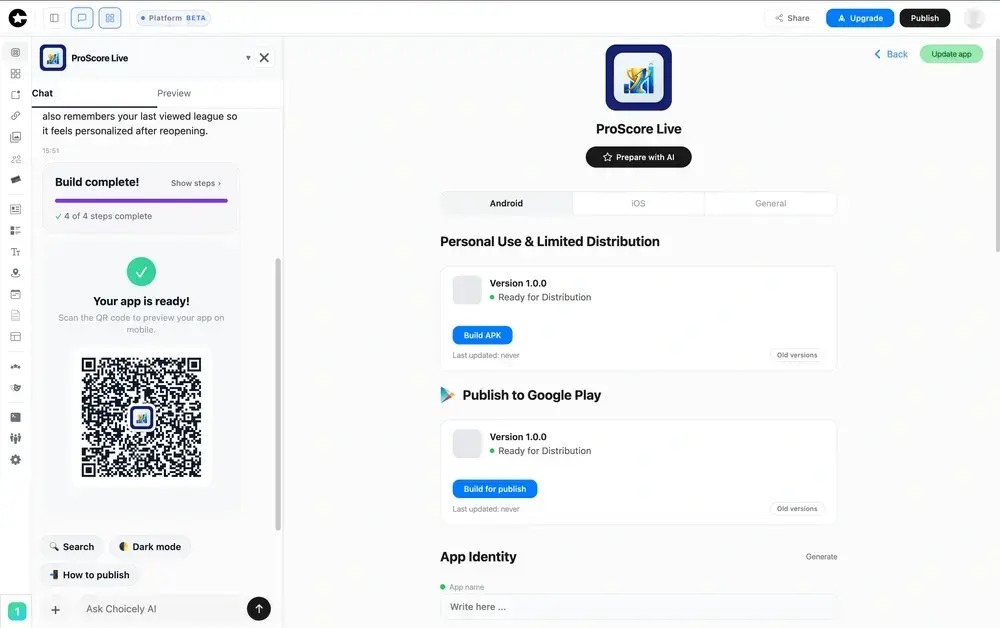
Apps built with Choicely are published to Google Play under your own developer account, which means they fall inside Play's automatic registration along with everyone else's — there is nothing separate for you to do because you used us.
What we do remove is the surrounding work: the build toolchain, the signing, the store listing and the deadlines that arrive without warning. If you would rather hand the publishing over entirely, that is our app publishing service.