Short answer: ChatGPT, Claude and Gemini can all write most of a mobile app, and one of them can now put a working Android app on your own phone. None of them can put an app in the App Store. The best any AI product manages today is to compile a real binary and push it into App Store Connect — you still submit it for review yourself, under your own Apple Developer account. And that isn't a gap the industry is about to close: there's a specific Apple rule that makes it impossible on purpose.
Verified against OpenAI's, Anthropic's, Google's and Apple's own documentation, July 2026.
Three different things are called "building an app with ChatGPT"
Most of the confusion here isn't the reader's fault. The phrase now covers three genuinely different products, and none of them ends with an app on the App Store.
| What people mean |
What it actually is |
Ends up in the App Store? |
| "Apps in ChatGPT" |
An integration that renders inside the conversation — an MCP server plus a UI panel. OpenAI's own design guidance keeps every display mode inside ChatGPT |
No. There is no binary. It is never submitted to Apple or Google, and it cannot be installed on a phone |
| ChatGPT Sites |
Publishes an interactive web app to a public URL |
No. It is a web page |
| Codex writing app code |
A coding assistant. OpenAI's own guidance for iOS describes producing Swift source plus build scripts, driven from the command line |
Only if you do the developer work — Xcode, signing, an Apple Developer account, review |
One naming note worth having, because a lot of articles are now out of date: OpenAI folded its app directory into a plugin directory in July 2026. If you read about a "ChatGPT App Store", that is what it was describing — a directory of things that run inside ChatGPT, not a mobile app store.
ChatGPT
It will write you a working app's worth of code, plan your screens, and argue with you productively about scope. What it will not do is compile, sign or submit anything. OpenAI's own iOS guidance is straightforward about this: you get Swift source and build scripts, and you supply Xcode and the developer account.
Claude
Claude's Artifacts and Design features produce documents, prototypes and web interfaces — not native mobile apps. Claude Code is the genuinely capable path: it reads a codebase, edits files, runs commands, and on macOS it can now drive an iOS Simulator in a public beta. Note the boundary in Anthropic's own documentation: it drives simulated devices and "can't control a physical iPhone or iPad", and it needs a Mac with Xcode installed.
So Claude can write essentially all of your app and run the build. It cannot buy your Apple membership, pass your review, or find you twelve Android testers.
Gemini
Google AI Studio's build mode is the most interesting thing in this whole category, and the most honestly documented. Describe an Android app and it generates a Kotlin and Jetpack Compose project, previews it in a browser-based emulator, and — genuinely — creates your app record and uploads the bundle to an internal testing track in Google Play.
Read that last part carefully, because it is where most coverage overreaches. An internal test track is up to 100 testers and is not a public listing. It does not satisfy the closed-testing requirement that new personal Play accounts must clear before production. Google's own framing is that the results are for personal use for now. And there is no iOS path at all.
Gemini Canvas builds web apps, games and infographics — nothing that reaches a store. And if you find guides recommending Firebase Studio for this, they are out of date: Google is sunsetting it in March 2027 and disabled new signups in June 2026.
The tools that actually build apps — and why none of them lives in your chat
There is a real category of AI app builders now, and they work. But almost none of them is something you use inside ChatGPT or Claude. They are separate web products with their own chat interfaces, and the distinction matters if you went looking for one inside ChatGPT and came away thinking the category doesn't exist.
Of the builders we checked, exactly one has a first-party presence inside ChatGPT that relates to building an app, and what it does is generate a prompt for you to paste into its own product. It builds nothing in the chat. The rest have no ChatGPT-side presence at all — one of them publishes content arguing against using ChatGPT for this.
Where they land is remarkably consistent. Every one of them builds a real binary and gets it as far as App Store Connect or TestFlight, and every one of them stops there. In their own words: users complete the final submission step independently; you can submit for review directly from App Store Connect; for Android, you upload the bundle yourself.
Why the whole category stops at App Store Connect
This looks like a gap someone will eventually close. It isn't. Apple's App Store Review Guidelines include a rule aimed squarely at this situation — Guideline 4.2.6, which rejects apps created from a commercialised template or app generation service unless they are submitted directly by the provider of the app's content.
Read plainly: the business whose app it is has to be the one submitting it. So a service that submits every customer's app from its own account isn't offering a convenience — it is describing the exact pattern the rule exists to stop. "We'll submit it for you" is not a feature that's coming. It is a policy violation.
That is worth knowing before you choose a tool, because it reframes what to look for. The question is not "who submits for me" — nobody does, and nobody should. The question is how much of everything else is handled: the build, the signing, the store assets, the privacy declarations, and whether the tool tells you the truth about the parts you still own.
What no AI does for you
Whichever route you take, this list is yours. It is worth reading before you start, because the expensive surprises are all in here rather than in the code.
| What |
Detail |
| Apple Developer Program |
$99/year, recurring, in your own name. A free Apple account covers development and testing only |
| Google Play registration |
$25, once |
| Identity verification |
With both Apple and Google. Organisations also need a D-U-N-S number |
| Code signing |
Certificates, provisioning profiles, an Android keystore. One-time, fiddly, and the most common place non-developers stall |
| Store listing assets |
Icon, screenshots at required sizes, description, a privacy policy URL, privacy and data-safety declarations, content rating |
| Google's closed test |
Personal Play accounts created after 13 November 2023 need 12 testers opted in for 14 continuous days before production. Calendar time no tool can compress |
| Review |
Apple's is human and discretionary. Guideline 4.2.6 explicitly targets app-generation output, and Guideline 4.2 targets thin apps |
| Maintenance |
Apple's membership renews annually, and Google raises its target API requirement every year. Miss either and the app comes down |
The gap between an AI chat and a listed app is not the last ten percent of the code. It is money, legal identity, cryptographic signing, a fourteen-day human testing gate, and a discretionary human review. A better language model shortens none of those.
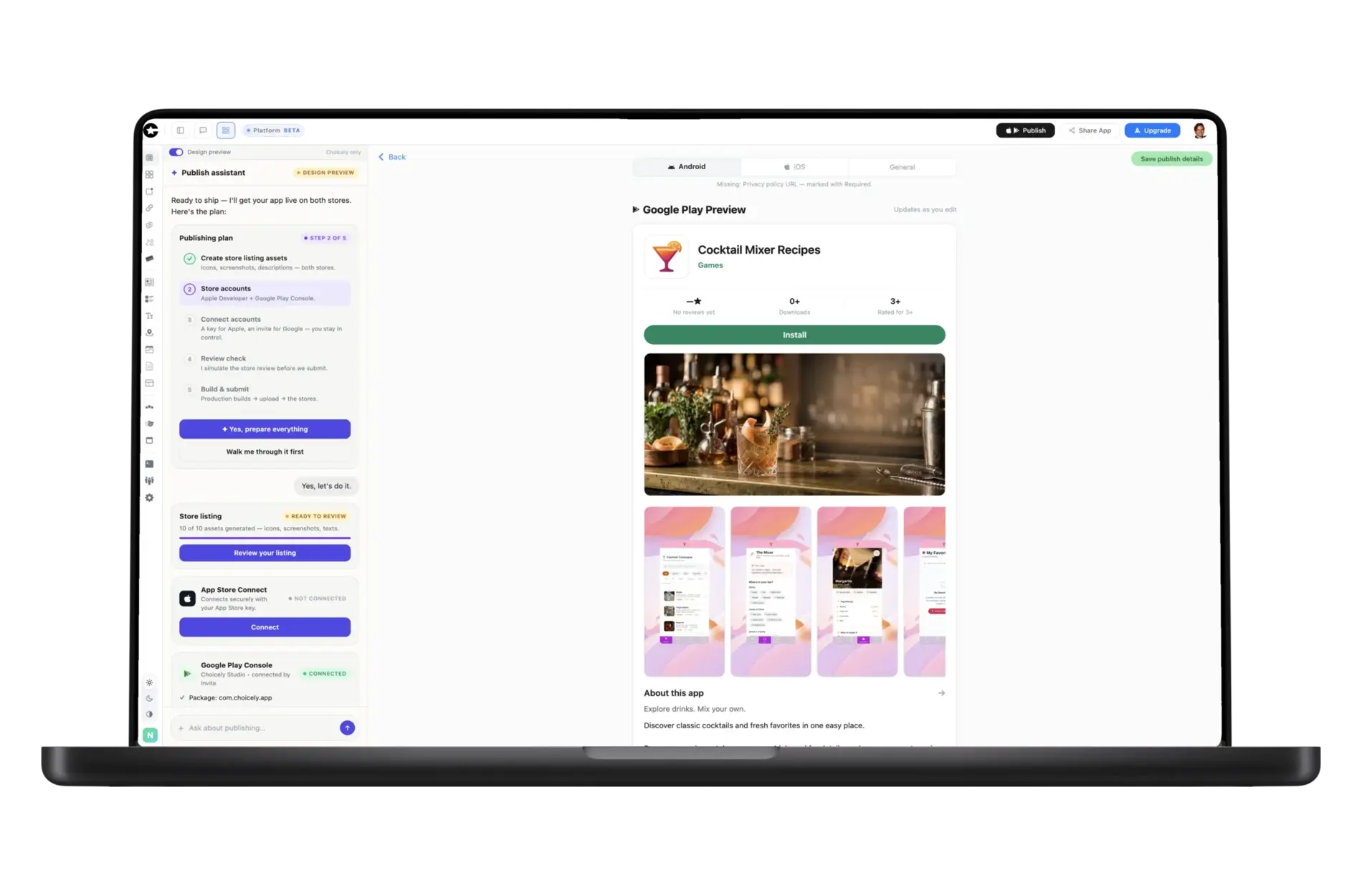
Rows one, two, six and seven of that table are yours whichever tool you pick. Nobody sells you out of Apple's $99, an identity check, Google's fourteen days, or a human review. What a builder can remove is the middle: Choicely builds a real native iOS and Android app free — 150 credits monthly, no credit card — signs it, and prepares your listing and privacy declarations. You keep your own developer accounts and you submit, because Guideline 4.2.6 requires that of everyone. Build your app free →
Claims worth reading twice
This category markets hard, and two patterns are worth recognising.
The first is "native" used as a synonym for good. One vendor advertises native Android apps on its product pages while its own pricing page describes every paid tier as webview-based. Another states its builds are not React Native wrappers, while its own developer documentation says the apps are built with React Native — the binaries are real, but the denial isn't. A third claims fully native output while naming no framework anywhere, and its chat produces a configuration file for its own platform rather than source code.
The second is claims about the parts the vendor doesn't control. One builder's marketing says you need no Apple developer account, while its own FAQ says you do — the claim is true only for installing on your own device under Apple's free seven-day provisioning, not for App Store distribution. Another promises to handle compliance "so your app gets approved". No third party can promise that; Apple's review is discretionary.
The honest vendors are worth naming too, because they show what candour looks like here: Glide states plainly that its apps are progressive web apps and that store publishing isn't supported; Median describes itself as a webview platform; Bubble says its mobile apps run on React Native; FlutterFlow and Draftbit hand you real exportable code. You can disagree with those trade-offs, but you know what you're buying.
What would have to change for a chat to really ship an app
Two of the requirements above are technical and could plausibly be automated further — building and signing are already automated by cloud services, and there are now tools that let an AI assistant trigger a real cloud build and push the result into App Store Connect without you owning a Mac.
The rest are not technical. Apple charges $99 a year to a verified identity. Google requires twelve real humans to test your app for two weeks. Apple's review is performed by people with discretion, and Guideline 4.2.6 deliberately requires the app's owner to be the one submitting. Those are policy and identity problems, not model-capability problems, and no amount of AI progress touches them.
Which means the honest version of the promise is not "build and publish an app from a chat". It is "do everything up to the point where the store requires you personally" — and that is a genuinely useful thing, just not the thing being advertised.
Can ChatGPT build a mobile app?
It can write most of the code, plan the screens and help you scope the product, but it cannot compile, sign or submit an app. OpenAI's own iOS guidance describes producing Swift source and build scripts, with Xcode and an Apple Developer account supplied by you. Separately, "apps in ChatGPT" are integrations that run inside the conversation — they are not iOS or Android apps and cannot be installed on a phone.
Can Claude build a mobile app?
Claude Code can write a full app, edit a real codebase, run builds, and on macOS drive an iOS Simulator in a public beta. Anthropic's documentation notes it drives simulated devices only and needs a Mac with Xcode. It cannot buy your Apple membership, pass Apple's review, or supply the 12 Android testers Google requires from new personal accounts.
Can Gemini build a mobile app?
Google AI Studio's build mode generates a real Kotlin and Jetpack Compose Android app, previews it in a browser emulator, and can create your app record and upload it to an internal test track on Google Play. But an internal test is up to 100 testers, not a public listing; it does not satisfy the closed-testing requirement for production; Google frames the results as being for personal use for now; and there is no iOS path.
Is there an AI that publishes to the App Store for me?
No, and there should not be. Apple's Guideline 4.2.6 rejects apps built from a commercialised template or app generation service unless submitted by the provider of the app's own content. So a tool that submitted every customer's app from its own account would be violating the rule rather than saving you work. The best any tool can honestly do is build the binary, upload it to App Store Connect and prepare your listing.
How much does it cost if the AI part is free?
The AI is the cheap part. Apple charges $99 a year for the Developer Program and Google charges $25 once, so about $124 in your first year and $99 a year after that. Those go to Apple and Google directly. Most AI builders then charge $20 to $50 a month, and a few reach $200.
What is the fastest honest route from an idea to a published app?
Use an AI tool to build and preview the app, then expect to spend real time on the store side: the developer accounts, the listing assets and privacy declarations, Google's 14-day closed test if you are on a new personal account, and Apple's review. Set up your developer accounts early — identity verification and a D-U-N-S number are the slowest steps and neither depends on your app being finished.
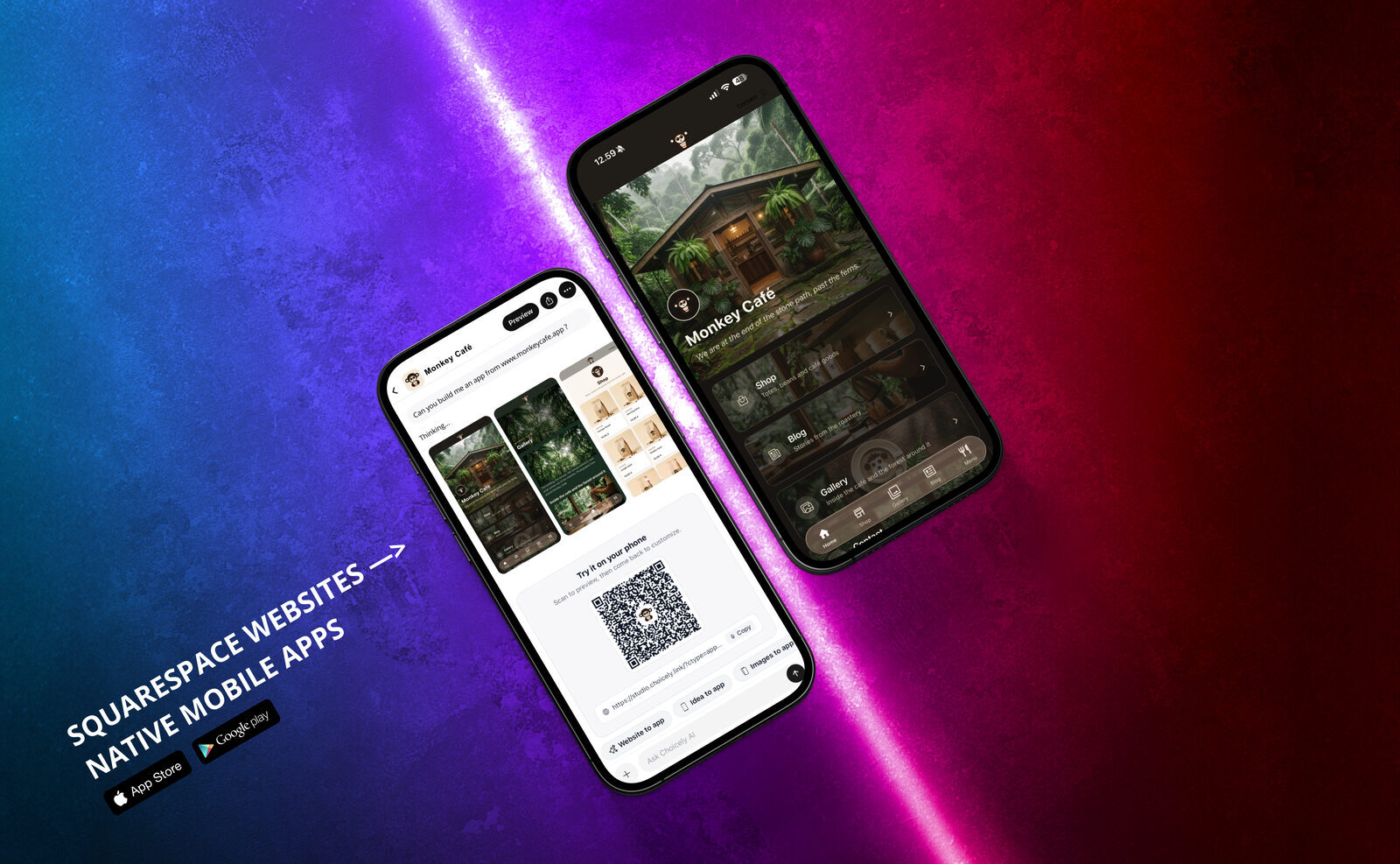
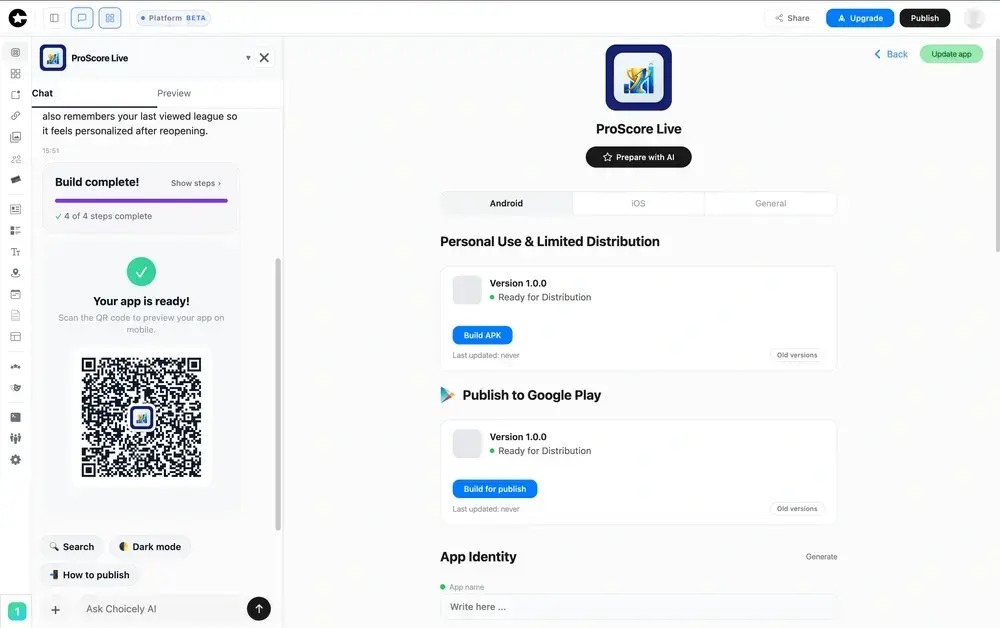
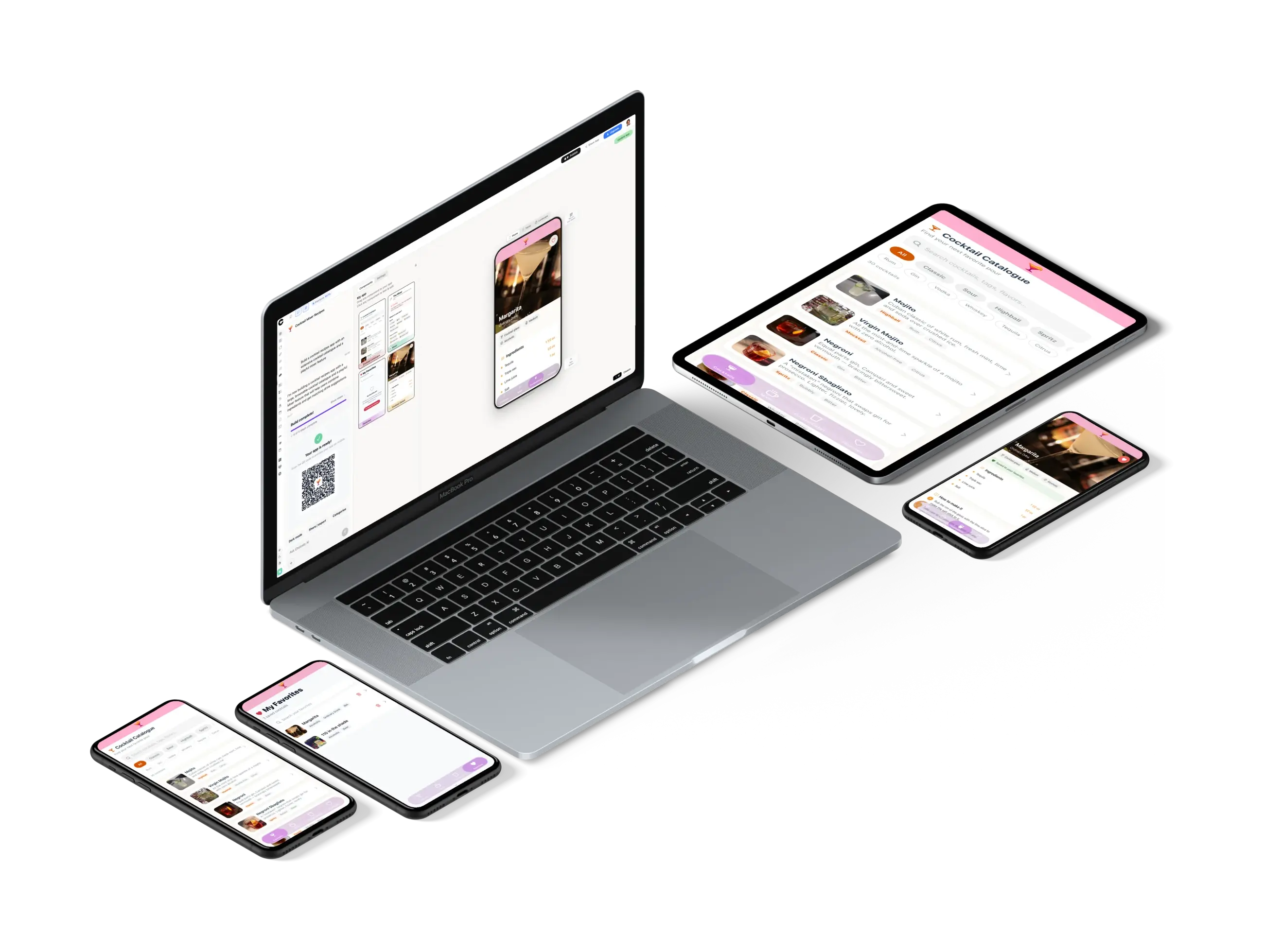
Choicely is one of the tools in the category above, and worth being precise about: you build a real native iOS and Android app free — 150 credits every month, no credit card — and preview it on your own phone. When you publish, the Publish Assistant checks your app against Apple's and Google's rules, prepares your store listing, and walks the submission with you. You keep your own developer accounts and you submit, because Guideline 4.2.6 requires that of everyone.